
[Paper Review] An Exploration of AGN and Stellar Feedback Effects in the Intergalactic Medium via the Low Redshift Lyman-$α$ Forest
This study investigates how active galactic nucleus (AGN) and stellar feedback influence the low-redshift Lyman-alpha forest using cosmological simulations from the CAMELS suite. It finds that AGN jet feedback in the Simba model significantly alters the column density and Doppler width distributions of the intergalactic medium, while stellar feedback regulates black hole growth and affects the thermal state of the IGM, highlighting the need for simultaneous modeling of both feedback mechanisms.
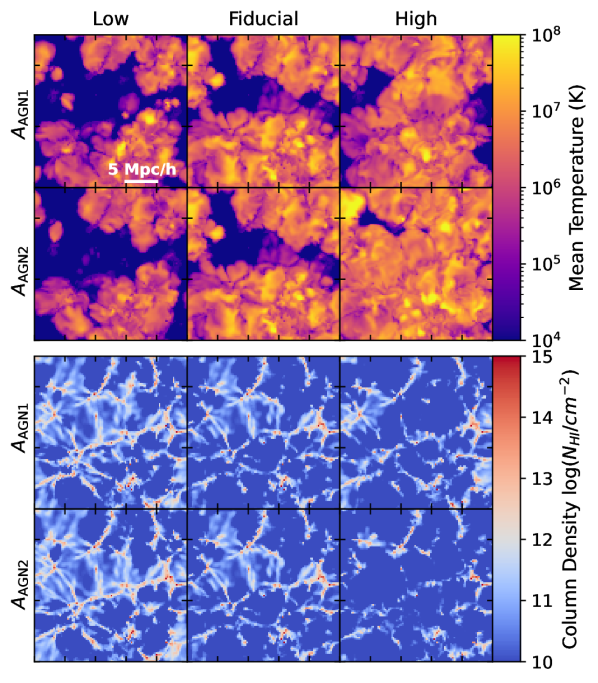
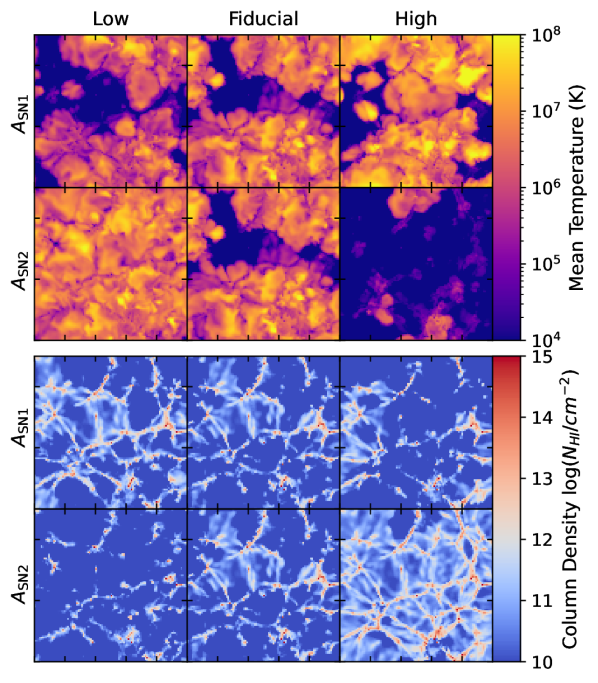
We explore the role of galactic feedback on the low redshift Lyman-$α$ (Ly$α$)~forest ($z \lesssim 2$) statistics and its potential to alter the thermal state of the intergalactic medium. Using the Cosmology and Astrophysics with Machine Learning Simulations (CAMELS) suite, we explore variations of the AGN and stellar feedback models in the IllustrisTNG and Simba sub-grid models. We find that both AGN and stellar feedback in Simba play a role in setting the Ly$α$ forest column density distribution function (CDD) and the Doppler width ($b$-value) distribution. The Simba AGN jet feedback mode is able to efficiently transport energy out to the diffuse IGM causing changes in the shape and normalization of the CDD and a broadening of the $b$-value distribution. We find that stellar feedback plays a prominent role in regulating supermassive black hole growth and feedback, highlighting the importance of constraining stellar and AGN feedback simultaneously. In IllustrisTNG, the AGN feedback variations explored in CAMELS do not affect the Ly$α$ forest, but varying the stellar feedback model does produce subtle changes. Our results imply that the low-$z$ Ly$α$ forest can be sensitive to changes in the ultraviolet background (UVB), stellar and black hole feedback, and that AGN jet feedback in particular can have a strong effect on the thermal state of the IGM.
Motivation & Objective
- To assess the impact of AGN and stellar feedback on the low-redshift Lyman-alpha forest (z ≤ 2).
- To determine how variations in feedback models affect the column density distribution function (CDD) and Doppler b-value distribution in the intergalactic medium (IGM).
- To evaluate the sensitivity of the Lyman-alpha forest to changes in the ultraviolet background (UVB), stellar feedback, and AGN feedback.
- To investigate the interplay between stellar feedback and supermassive black hole growth in regulating IGM conditions.
Proposed method
- Utilized the CAMELS cosmological simulation suite to explore variations in AGN and stellar feedback models across IllustrisTNG and Simba sub-grid models.
- Compared simulated Lyman-alpha forest statistics—specifically the column density distribution function (CDD) and Doppler b-value distribution—against observational data.
- Applied UVB corrections by scaling the Haardt & Madau (2012) ionizing background to match low-redshift observations, with factors ranging from 0.28 to 4.0.
- Used reduced chi-squared (χ²_R) statistics to quantify the goodness of fit between simulations and observed Lyα forest data.
- Analyzed feedback effects by varying feedback amplitude parameters (A_AGN, A_SN) across multiple simulation runs.
- Focused on the low-redshift IGM (z ≲ 2), where feedback effects are less studied than at high redshift.
Experimental results
Research questions
- RQ1How do AGN and stellar feedback models affect the column density distribution function (CDD) of the low-redshift Lyman-alpha forest?
- RQ2To what extent does AGN jet feedback alter the Doppler b-value distribution and thermal state of the intergalactic medium?
- RQ3How does stellar feedback influence supermassive black hole growth and feedback efficiency?
- RQ4Why do AGN feedback variations in IllustrisTNG show no detectable effect on the Lyα forest, while stellar feedback does?
- RQ5Can the low-redshift Lyman-alpha forest be used to constrain the thermal history and ionizing background of the IGM?
Key findings
- AGN jet feedback in the Simba model significantly alters the shape and normalization of the column density distribution function (CDD), with best-fit simulations achieving χ²_R ≈ 0.24 for A_AGN1 = 1.32.
- The Simba AGN jet feedback mode broadens the Doppler b-value distribution, indicating a strong influence on the thermal state of the IGM.
- Stellar feedback in Simba plays a key role in regulating black hole growth and feedback, demonstrating the importance of coupled feedback modeling.
- In IllustrisTNG, AGN feedback variations do not affect the Lyα forest, but stellar feedback variations produce subtle but measurable changes in the CDD.
- The CAMELS-Simba simulations achieve excellent agreement with observations, with reduced χ²_R values close to 1, indicating robust fits to the low-redshift Lyα forest data.
- UVB corrections in CAMELS-Simba simulations range from 0.28 to 4.0 times the Haardt & Madau (2012) value, with best fits favoring lower UVB levels than some recent observational estimates.
Better researchstarts right now
From reading papers to final review, dramatically reduce your research time.
No credit card · Free plan available
This review was created by AI and reviewed by human editors.