
[论文解读] Analysis of fluid flow models
本文提出了一种全面的矩阵分析方法,用于分析流体流模型,特别是受控流体队列,通过利用再生过程和Riccati方程来计算平稳分布。研究证明,可通过具有二次收敛速度的加倍算法高效计算平稳分布,并将该框架扩展至广义模型,如有限缓冲区、水平反馈、跳跃过程以及二维流体模型。
Markov-modulated fluids have a long history. They form a simple class of Markov additive processes, and were initially developed in the 1950s as models for dams and reservoirs, before gaining much popularity in the 1980s as models for buffers in telecommunication systems, when they became known as fluid queues. More recent applications are in risk theory and in environmental studies. In telecommunication systems modelling, the attention focuses on determining the stationary distribution of the buffer content. Early ODE resolution techniques have progressively given way to approaches grounded in the analysis of the physical evolution of the system, and one only needs now to solve a Riccati equation in order to obtain several quantities of interest. To the early algorithms proposed in the Applied Probability literature, numerical analysts have added new algorithms, improved in terms of convergence speed, numerical accuracy, and domain of applicability. We give here a high-level presentation of the matrix-analytic approach to the analysis of fluid queues, briefly address computational issues, and conclude by indicating how this has been extended to more general processes.
研究动机与目标
- 提出一种统一框架,利用半再生过程和矩阵分析方法分析受控流体队列。
- 表征在零处吸收且流速依赖于状态的流体队列的平稳分布。
- 将分析扩展至广义流体模型,包括有限缓冲区、水平依赖的相位转移、跳跃过程以及二维流体。
- 提出高效数值算法——特别是具有二次收敛速度的加倍算法——以求解底层的Riccati方程。
- 弥合理论流体队列分析与应用概率和随机建模中实际计算实现之间的差距。
提出的方法
- 使用半再生过程建模流体队列,再生时刻定义为缓冲区为空(Y(t) = 0)且相位属于 S⁻ 的时刻。
- 将平稳分布表示为包含平稳向量 ρ 和期望驻留时间矩阵 M(x) 的混合形式,从而得到 G(x) = (ρᵀm)⁻¹ρᵀM(x)。
- 应用矩阵符号迭代与Riccati方程方法求解矩阵 Ψ,其通过 e^{Kx} 和 e^{K̂(B−x)} 形式控制平稳密度。
- 采用保持结构的加倍算法(SDA、SDA 缩放-移位、分量精度优化变体)以实现快速、稳定且具有二次收敛速度的求解。
- 通过引入边界之间的首达概率,将框架扩展至有限缓冲区,得到两个矩阵指数的混合形式。
- 通过类似的再生与谱技术,将方法推广至具有跳跃(如相型跳跃分布)的模型以及马氏调制的布朗运动。
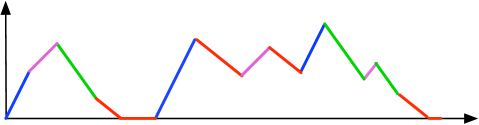
![Figure 1: Sample trajectory of a fluid flow (top) and of its controlling Markov chain (bottom). The fluid rates vector is $\boldsymbol{c}=[-0.8,-1.4,2,1]$ so that different states correspond to different slopes.](https://ar5iv.labs.arxiv.org/html/1802.04355/assets/x1.png)
实验结果
研究问题
- RQ1如何利用半再生过程表征受控流体队列的平稳分布?
- RQ2Riccati方程与矩阵符号迭代在计算流体队列平稳密度中起什么作用?
- RQ3加倍算法在求解流体队列模型时,如何提升数值解的收敛速度与精度?
- RQ4在哪些方面可以将流体队列框架扩展以包含有限缓冲区、水平依赖的相位转移与跳跃过程?
- RQ5将流体队列推广至二维或更高维系统,其理论与计算意义是什么?
主要发现
- 受控流体队列的平稳分布为 G(x) = (ρᵀm)⁻¹ρᵀM(x),其中 M(x) 捕获在 [0,x]×{j} 上的条件期望驻留时间。
- 求解Riccati方程 Ψ = |C⁻|⁻¹T⁻⁺Ψ + Ψ|C⁻|⁻¹T⁻⁺Ψ 的矩阵 Ψ 在 μ ≠ 0 条件下具有二次收敛性。
- 如 SDA 及其变体等加倍算法实现二次收敛,计算高效,可实现流体队列模型的稳健数值求解。
- 对于有限缓冲区流体队列,平稳密度为两个矩阵指数的混合形式:e^{Kx} 和 e^{K̂(B−x)},由边界之间的首达概率导出。
- 当跳跃大小服从相型分布时,该框架可自然推广至包含跳跃的模型(如漏桶、替换过程)。
- 二维流体模型仍为开放研究领域,存在显著的理论与计算挑战,尽管已有基于马氏更新过程的初步扩展。
更好的研究,从现在开始
从阅读论文到最终审阅,大幅缩短您的研究时间。
无需绑定信用卡
本解读由 AI 生成,并经人工编辑审核。