
[论文解读] Attack-Resilient Distributed Algorithms for Exponential Nash Equilibrium Seeking
该论文提出了一种在非合作博弈中针对有向通信网络下非周期性拒绝服务(DoS)攻击的抗干扰分布式算法,用于指数收敛于纳什均衡(NE)。通过显式分析攻击频率和持续时间的上下界,该算法即使在敌对网络干扰下仍能确保精确的NE收敛,且收敛速度为指数级,相较于以往假设理想通信条件的研究,实现了关键性进展。
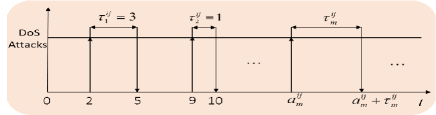
This paper investigates a resilient distributed Nash equilibrium (NE) seeking problem on a directed communication network subject to malicious cyber-attacks. The considered attacks, named as Denial-of-Service (DoS) attacks, are allowed to occur aperiodically, which refers to interruptions of communication channels carried out by intelligent adversaries. In such an insecure network environment, the existence of cyber-attacks may result in undesirable performance degradations or even the failures of distributed algorithm to seek the NE of noncooperative games. Hence, the aforementioned setting can improve the practical relevance of the problem to be addressed and meanwhile, it poses some technical challenges to the distributed algorithm design and exponential convergence analysis. In contrast to the existing distributed NE seeking results over a prefect communication network, an attack-resilient distributed algorithm is presented such that the NE can be exactly reached with an exponential convergence rate in the presence of DoS attacks. Inspired by the previous works in [21]-[26], an explicit analysis of the attack frequency and duration is investigated to enable exponential NE seeking with resilience against attacks.Examples and numerical simulation results are given to show the effectiveness of the proposed design.
研究动机与目标
- 为解决现有分布式NE寻找算法在恶意网络攻击(尤其是DoS攻击)下缺乏鲁棒性的问题。
- 设计一种分布式算法,即使在间歇性通信中断的情况下,仍能保持对纳什均衡的指数收敛。
- 显式刻画允许的DoS攻击频率和持续时间的上界,以保证收敛性。
- 通过摒弃对完美通信网络的假设,扩展先前成果,实现在敌对条件下的精确NE收敛。
- 通过在不同网络拓扑、攻击特征和系统参数下进行数值仿真,验证算法的可扩展性和鲁棒性。
提出的方法
- 设计了一种基于梯度的分布式算法,每个参与者通过本地信息和基于邻居的一致性协议,在有向图上更新其策略。
- 该算法引入控制增益和一种动态更新律,以应对DoS攻击导致的通信丢失。
- 采用时变网络拓扑模型,对攻击频率和持续时间进行显式分析,确保攻击不超出预设阈值。
- 采用基于李雅普诺夫的稳定性分析方法,证明在推导出的攻击约束下,系统能实现对纳什均衡的指数收敛。
- 收敛性分析利用了有向图拉普拉斯矩阵的性质以及最小非零特征值(λa)来量化收敛速度。
- 采用双时间尺度动力学方法对算法进行建模,以处理在攻击条件下一致性与梯度博弈之间的相互作用。
实验结果
研究问题
- RQ1在有向通信网络中,是否可在非周期性DoS攻击下实现分布式纳什均衡的指数收敛?
- RQ2仍能实现NE指数收敛的攻击频率和持续时间的显式上界是什么?
- RQ3控制增益如何影响算法在攻击下的收敛速度和鲁棒性?
- RQ4该算法在不同玩家数量和不同网络拓扑下的可扩展性如何?
- RQ5在一般非二次型代价函数和真实攻击模式下,该算法表现如何?
主要发现
- 所提出的算法在攻击频率和持续时间受有界约束的前提下,即使在非周期性DoS攻击下,仍能实现对纳什均衡的指数收敛。
- 仿真结果表明,控制增益κ越高,收敛速度越快:κ=5时误差衰减快于κ=1。
- 该算法可扩展至不同数量的参与者,仿真中在N=3、5、10时表现更优。
- 网络拓扑显著影响收敛性:λa越大(拉普拉斯矩阵的非零最小特征值越大),收敛越快,表现为误差的对数曲线更陡峭。
- 当攻击频率和持续时间超过理论推导的边界(14)和(15)时,收敛失败,验证了所导出条件的必要性。
- 在一般非二次型博弈中,该算法在DoS攻击下成功将所有参与者的策略引导至纳什均衡x* = col(-4.6589, 4.1589, 0, -2, 2.5),且相对误差呈指数衰减。
![Figure 2: Simulated results generated by the existing algorithm [ 11 ] in the absence of DoS attacks. Left: plot of players’ strategies and the NE $x^{*}_{i}$ ; Right: plot of an undirected graph in [ 11 ] and its associated Laplacian matrix.](https://ar5iv.labs.arxiv.org/html/2009.10666/assets/x2.png)
更好的研究,从现在开始
从阅读论文到最终审阅,大幅缩短您的研究时间。
无需绑定信用卡
本解读由 AI 生成,并经人工编辑审核。