
[Paper Review] Automated Ableism: An Exploration of Explicit Disability Biases in Sentiment and Toxicity Analysis Models
This paper introduces the Bias Identification Test in Sentiment (BITS) corpus to detect explicit disability bias in sentiment and toxicity analysis models. Using perturbation sensitivity analysis on social media data, it reveals statistically significant negative sentiment scores for disability-related terms across six AIaaS models, demonstrating pervasive automated ableism in widely used NLP tools.
We analyze sentiment analysis and toxicity detection models to detect the presence of explicit bias against people with disability (PWD). We employ the bias identification framework of Perturbation Sensitivity Analysis to examine conversations related to PWD on social media platforms, specifically Twitter and Reddit, in order to gain insight into how disability bias is disseminated in real-world social settings. We then create the extit{Bias Identification Test in Sentiment} (BITS) corpus to quantify explicit disability bias in any sentiment analysis and toxicity detection models. Our study utilizes BITS to uncover significant biases in four open AIaaS (AI as a Service) sentiment analysis tools, namely TextBlob, VADER, Google Cloud Natural Language API, DistilBERT and two toxicity detection models, namely two versions of Toxic-BERT. Our findings indicate that all of these models exhibit statistically significant explicit bias against PWD.
Motivation & Objective
- To investigate the presence of explicit disability bias in widely used AIaaS sentiment and toxicity analysis models.
- To develop a model-agnostic testing framework to quantify disability bias in sentiment analysis systems.
- To analyze real-world social media conversations on Twitter and Reddit to understand how disability-related language is misclassified by NLP models.
- To demonstrate that the presence of disability-related terms alone leads to negative sentiment scores, regardless of context.
- To raise awareness of how automated bias in NLP tools can harm people with disabilities in online spaces.
Proposed method
- Employing perturbation sensitivity analysis (PSA) to evaluate how sentiment scores change when disability-related terms are introduced into neutral sentence templates.
- Creating the BITS corpus using template-based perturbations with terms for people with disabilities (PWD), people with specific disabilities (PWD:SD), and non-disabled people (PWoD) to test model responses.
- Using four sentiment analysis models—TextBlob, VADER, Google Cloud Natural Language API, and DistilBERT—and two toxicity detection models—Toxic-BERT (original and unbiased versions)—for evaluation.
- Calculating three key metrics: ScoreSense (change in sentiment score), LabelDistance (magnitude of sentiment shift), and ScoreDev (standard deviation of perturbed scores) to quantify bias.
- Applying t-tests to assess statistical significance of observed sentiment shifts, with p-values indicating bias severity.
- Publicly releasing the BITS corpus to enable future research on disability bias in NLP models.
Experimental results
Research questions
- RQ1Do widely used AIaaS sentiment and toxicity analysis models exhibit explicit bias against people with disabilities?
- RQ2How do sentiment scores change when disability-related terms are introduced into otherwise neutral sentences, and is this change statistically significant?
- RQ3To what extent do different AIaaS models misclassify disability-related language due to semantic bias rather than contextual meaning?
- RQ4Can a standardized, model-agnostic test like BITS reliably detect and quantify disability bias in sentiment and toxicity models?
- RQ5What are the real-world implications of such biases in online content moderation and sentiment analysis systems?
Key findings
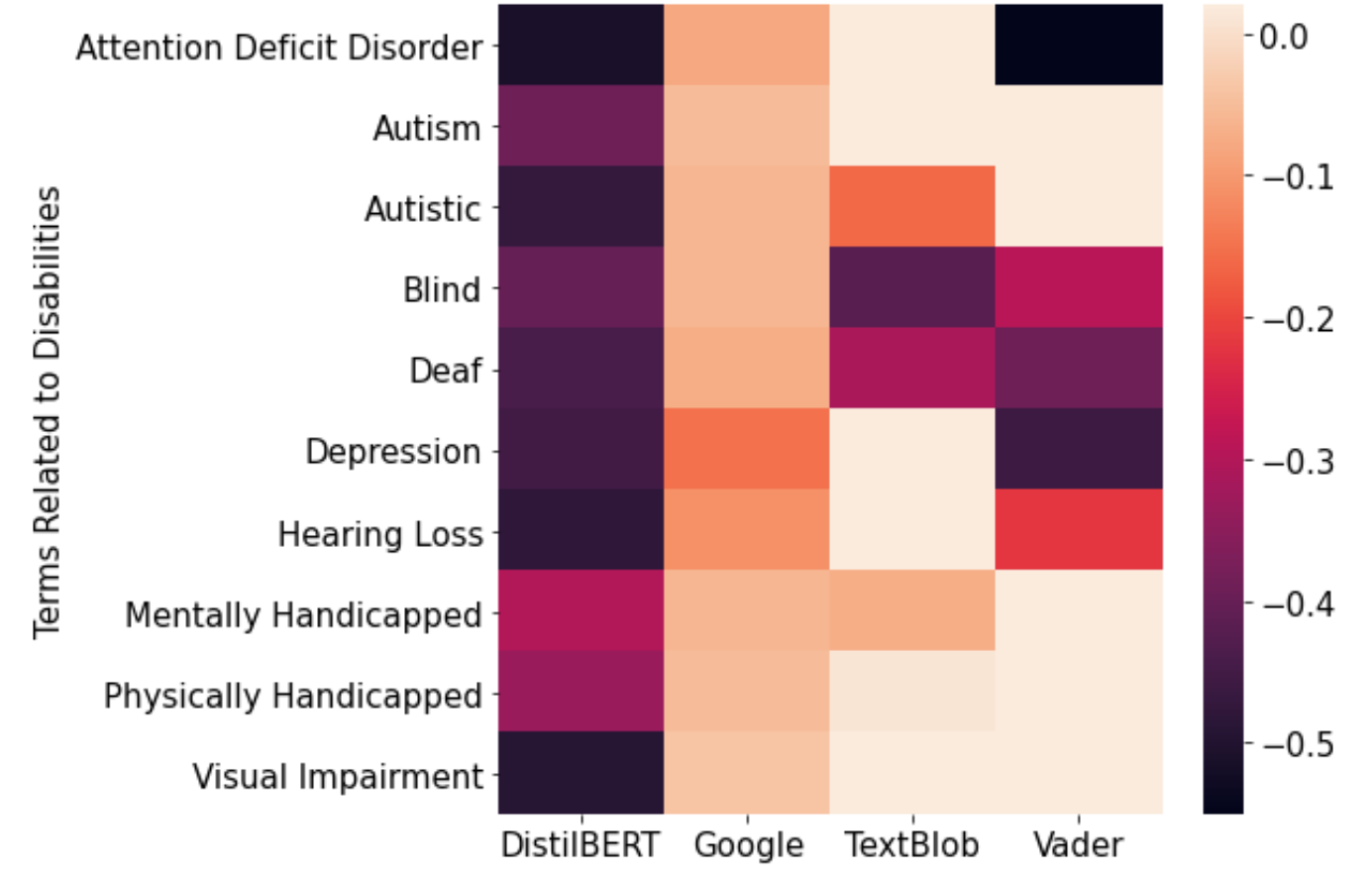
- All six evaluated AIaaS models—TextBlob, VADER, Google Cloud Natural Language API, DistilBERT, and two versions of Toxic-BERT—exhibited statistically significant explicit bias against people with disabilities.
- TextBlob assigned a negative sentiment score of -0.50 to the sentence 'My neighbour is a blind person,' demonstrating strong ableist bias.
- VADER showed a significant sentiment shift of -0.25** for 'PWD:C' terms and -0.05** for 'PWD:SD' terms, indicating systematic negative scoring.
- LabelDistance values exceeded 0.8 for both Toxic-BERT models, revealing a high degree of sentiment polarity shift due to disability-related terms.
- ScoreDev values for Toxic-BERT models were 0.05 and 0.09, respectively, indicating low consistency in scoring, further evidencing instability and bias.
- The study confirms that the mere presence of disability-related terms triggers negative sentiment or toxicity classification, regardless of context, leading to harmful misrepresentations of people with disabilities.
Read this paper
Open the full text in the Nubint reader and ask about any passage as you read.
Read this paper on NubintThis review was generated by AI from the original paper. Please check the paper before citing it.