
[Paper Review] Automating Computational Design with Generative AI
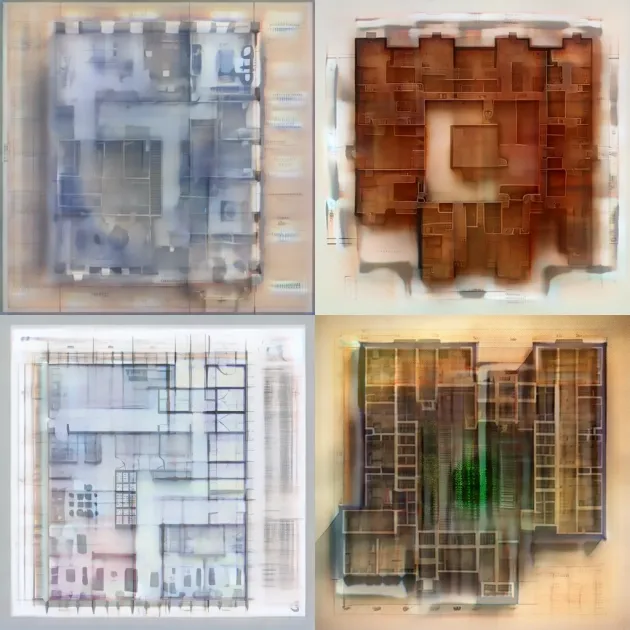
This paper proposes enhancing diffusion models for computational design in architecture by introducing semantic encoding to improve the validity of generated floor plans. By fine-tuning text-to-image diffusion models with structured semantic prompts, the authors increase floor plan validity from 6% to 90%, demonstrating significant progress toward practical AI-assisted architectural design while identifying the need for future BIM-native diffusion models.
AI image generators based on diffusion models have recently garnered attention for their capability to create images from simple text prompts. However, for practical use in civil engineering they need to be able to create specific construction plans for given constraints. This paper investigates the potential of current AI generators in addressing such challenges, specifically for the creation of simple floor plans. We explain how the underlying diffusion-models work and propose novel refinement approaches to improve semantic encoding and generation quality. In several experiments we show that we can improve validity of generated floor plans from 6% to 90%. Based on these results we derive future research challenges considering building information modelling. With this we provide: (i) evaluation of current generative AIs; (ii) propose improved refinement approaches; (iii) evaluate them on various examples; (iv) derive future directions for diffusion models in civil engineering.
Motivation & Objective
- To evaluate the capability of diffusion models in generating valid architectural floor plans under design constraints.
- To identify limitations of current image-based diffusion models in computational design, particularly regarding semantic understanding and structural validity.
- To propose and test improved semantic encoding techniques for diffusion models to enhance generation quality and validity.
- To explore the feasibility and requirements of integrating Building Information Modeling (BIM) data directly into diffusion models for future semantic-aware design automation.
- To derive future research directions for diffusion models in civil engineering, emphasizing the shift from image-based to BIM-native generation.
Proposed method
- Fine-tuning text-to-image diffusion models (e.g., Stable Diffusion) using a custom dataset of floor plans paired with semantic text prompts describing spatial layout, room types, and connectivity.
- Implementing multi-scale semantic encoding by conditioning the diffusion process on structured, hierarchical descriptions of floor plan components (e.g., rooms, walls, zones).
- Using a hierarchical, graph-based representation of BIM models to preserve semantic and structural relationships during the diffusion process.
- Training the model to reverse a noise-adding process at multiple resolution levels, with semantic labels guiding the denoising step to maintain design validity.
- Evaluating model performance through qualitative assessment and quantitative metrics such as floor plan validity and structural consistency.
- Proposing a multi-layer Graph Neural Network (GNN) architecture to represent BIM models at different abstraction levels, enabling diffusible, semantic-aware generation.

Experimental results
Research questions
- RQ1Can diffusion models be effectively fine-tuned to generate structurally valid and semantically meaningful floor plans?
- RQ2How does semantic encoding improve the validity and coherence of generated floor plans compared to standard text prompting?
- RQ3What are the key limitations of current image-based diffusion models in architectural computational design?
- RQ4To what extent can BIM data be integrated into diffusion models to preserve semantic and structural integrity?
- RQ5What architectural and data requirements are necessary for developing BIM-native diffusion models for automated design?
Key findings
- Fine-tuning diffusion models with semantic prompts increased the validity of generated floor plans from 6% to 90%.
- The proposed semantic encoding method significantly outperformed standard text prompting in generating structurally coherent and semantically accurate floor plans.
- Current image-based diffusion models struggle with semantic understanding, leading to invalid or nonsensical spatial arrangements despite high visual quality.
- Rasterizing BIM models for use in image-based diffusion models results in loss of semantic and hierarchical structure, reducing model effectiveness.
- A multi-scale, graph-based diffusion model architecture is a promising path forward, leveraging the hierarchical nature of BIM for more accurate and meaningful design generation.
- Future research must focus on developing BIM-native diffusion models that preserve semantic relationships and enable direct, structured design generation.
Read this paper
Open the full text in the Nubint reader and ask about any passage as you read.
Read this paper on NubintThis review was generated by AI from the original paper. Please check the paper before citing it.