
[Paper Review] Automorphism Ensemble Polar Code Decoders for 6G URLLC
This paper proposes an Automorphism Ensemble Decoding (AED) architecture for polar codes tailored for 6G URLLC, leveraging parallel successive cancellation (SC) decoders with a novel path metric-based candidate selection to achieve near-ML error correction performance. In a 12nm FinFET implementation, AED outperforms state-of-the-art SCL decoders by up to 4.4x in latency, 8.9x in area efficiency, and 4.6x in energy efficiency while matching or exceeding their error correction performance.
The URLLC scenario in the upcoming 6G standard requires low latency and ultra reliable transmission, i.e., error correction towards ML performance. Achieving near-ML performance is very challenging especially for short block lengths. Polar codes are a promising candidate and already part of the 5G standard. The Successive Cancellation List (SCL) decoding algorithm provides very good error correction performance but at the cost of high computational decoding complexity resulting in large latency and low area and energy efficiency. Recently, Automorphism Ensemble Decoding (AED) gained a lot of attention to improve the error correction capability. In contrast to SCL, AED performs several low-complexity (e.g., SC) decoding in parallel. However, it is an open question whether AED can compete with sophisticated SCL decoders, especially from an implementation perspective in state of the art silicon technologies. In this paper we present an elaborated AED architecture that uses an advanced path metric based candidate selection to reduce the implementation complexity and compare it to state of the art SCL decoders in a 12nm FinFET technology. Our AED implementation outperform state of the art SCL decoders by up to 4.4x in latency, 8.9x in area efficiency and 4.6x in energy efficiency, while providing the same or even better error correction performance.
Motivation & Objective
- To address the challenge of achieving near-ML error correction performance with low latency and high energy efficiency in short-block-length polar codes for 6G URLLC.
- To investigate whether Automorphism Ensemble Decoding (AED) can outperform conventional Successive Cancellation List (SCL) decoding in terms of hardware efficiency and performance.
- To design and implement an AED architecture that leverages parallel low-complexity SC decoders with optimized path metric-based candidate selection for high throughput and low latency.
- To provide the first comprehensive ASIC comparison of AED and SCL decoders under real silicon constraints using 12nm FinFET technology.
Proposed method
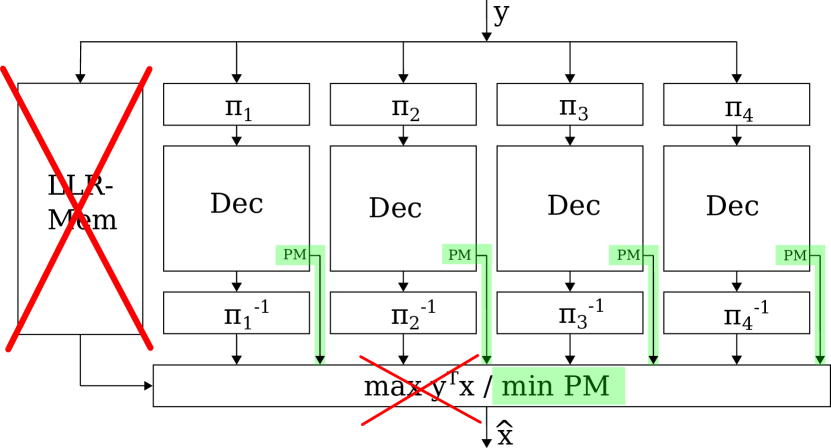
- Proposes a data-driven permutation selection method to identify effective automorphisms for polar codes, enabling diverse code word decoding.
- Employs a Fast Simplified SC (SSC) algorithm with a new path metric-based candidate selection to reduce computational overhead in each ensemble decoder instance.
- Uses multiple parallel SC decoders (M instances) to decode permuted versions of the received codeword, each with low complexity and high locality.
- Applies path metrics to select the best candidate among decoded paths, improving error correction without increasing complexity per decoder.
- Performs full physical synthesis, placement, and routing in 12nm FinFET technology to evaluate real-area, latency, power, and energy efficiency metrics.
- Compares AED with state-of-the-art CRC-aided SCL decoders for both 5G-compatible (128,60+C) and standard (128,60) polar codes under identical conditions.
Experimental results
Research questions
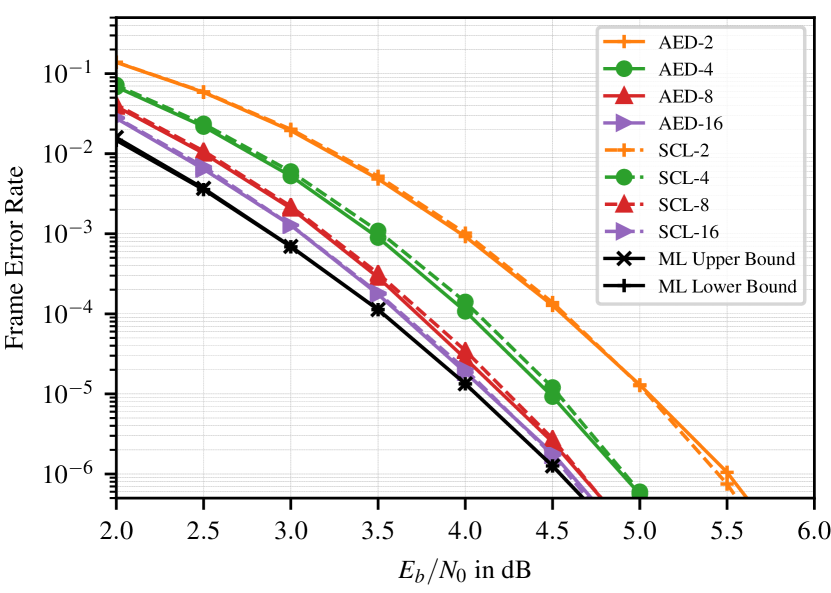
- RQ1Can AED achieve error correction performance comparable to or better than SCL decoding for short polar codes in the 6G URLLC context?
- RQ2Does AED offer significant advantages in latency, area, and energy efficiency over SCL decoding when implemented in modern silicon technology?
- RQ3How does the performance of AED scale with the number of ensemble decoder instances (M), and what is the optimal trade-off between performance and hardware cost?
- RQ4Can AED outperform CRC-aided SCL decoding for 5G-compatible polar codes, especially considering the 5G code's inherent rate and structure advantages?
- RQ5What is the impact of path metric-based candidate selection on AED performance and implementation efficiency?
Key findings
- For the same polar code (128,60), AED with M=16 achieves 4.4x lower latency (11 ns vs. 119.1 ns) than SCL with L=16.
- AED with M=16 achieves 8.9x higher area efficiency (187.0 Gbps/mm² vs. 20.9 Gbps/mm²) than SCL with L=16.
- AED with M=16 achieves 4.6x lower energy efficiency (10.12 pJ/bit vs. 46.21 pJ/bit) than SCL with L=16.
- For the 5G-compatible code (128,60+C), AED-4 matches the performance of CRC-aided SCL-8 while requiring significantly less area and power.
- The AED implementation shows a 5.3x shorter latency and 8.9x better area efficiency than SCL at M=L=16, with the performance gap widening as M increases.
- The path metric-based candidate selection enables high error correction performance with minimal additional complexity, making AED highly scalable and efficient in hardware.
Read this paper
Open the full text in the Nubint reader and ask about any passage as you read.
Read this paper on NubintThis review was generated by AI from the original paper. Please check the paper before citing it.