
[Paper Review] Bayesian Simulation-based Inference for Cosmological Initial Conditions
This paper presents a Bayesian simulation-based inference framework that combines neural ratio estimation, autoregressive modeling, and Gibbs sampling via exact data augmentation to reconstruct cosmological initial conditions from late-time density fields. The method efficiently samples from the posterior distribution using non-differentiable forward simulators and achieves accurate large-scale reconstruction with fast inference on a laptop GPU.
Reconstructing astrophysical and cosmological fields from observations is challenging. It requires accounting for non-linear transformations, mixing of spatial structure, and noise. In contrast, forward simulators that map fields to observations are readily available for many applications. We present a versatile Bayesian field reconstruction algorithm rooted in simulation-based inference and enhanced by autoregressive modeling. The proposed technique is applicable to generic (non-differentiable) forward simulators and allows sampling from the posterior for the underlying field. We show first promising results on a proof-of-concept application: the recovery of cosmological initial conditions from late-time density fields.
Motivation & Objective
- Address the challenge of reconstructing cosmological initial conditions from non-linear, non-local, and noisy late-time observations.
- Overcome the limitations of traditional methods that rely on differentiable forward models or assume Gaussian likelihoods.
- Enable efficient posterior sampling for high-dimensional field inference using simulation-based inference and autoregressive modeling.
- Develop a scalable, general-purpose framework applicable to image and field reconstruction problems beyond cosmology.
- Demonstrate the feasibility of combining SBI with exact data augmentation for posterior sampling in complex, non-linear inverse problems.
Proposed method
- Frame field reconstruction as a parameter inference problem by treating pixel values of the initial field as parameters to be inferred.
- Use neural ratio estimation (NRE) to estimate pixel-wise likelihood ratios without explicit likelihood computation, enabling posterior approximation via classification.
- Implement an autoregressive decomposition of the joint likelihood estimate by splitting the observation space and modeling conditional dependencies through summary statistics.
- Introduce a locally adaptive summary statistic $\bm{s}_i(\bm{x})$ and a learnable autoregressive function $\bm{L}$ to capture spatial correlations in the data.
- Employ a Gibbs sampling algorithm based on exact data augmentation (GEDA) to draw posterior samples from the full joint posterior $p(\bm{z}|\bm{x}_o)$, using a tempered posterior and a diagonal precision matrix.
- Leverage the power spectrum of the target field as a prior constraint in the GEDA sampling process, improving small-scale reconstruction fidelity.
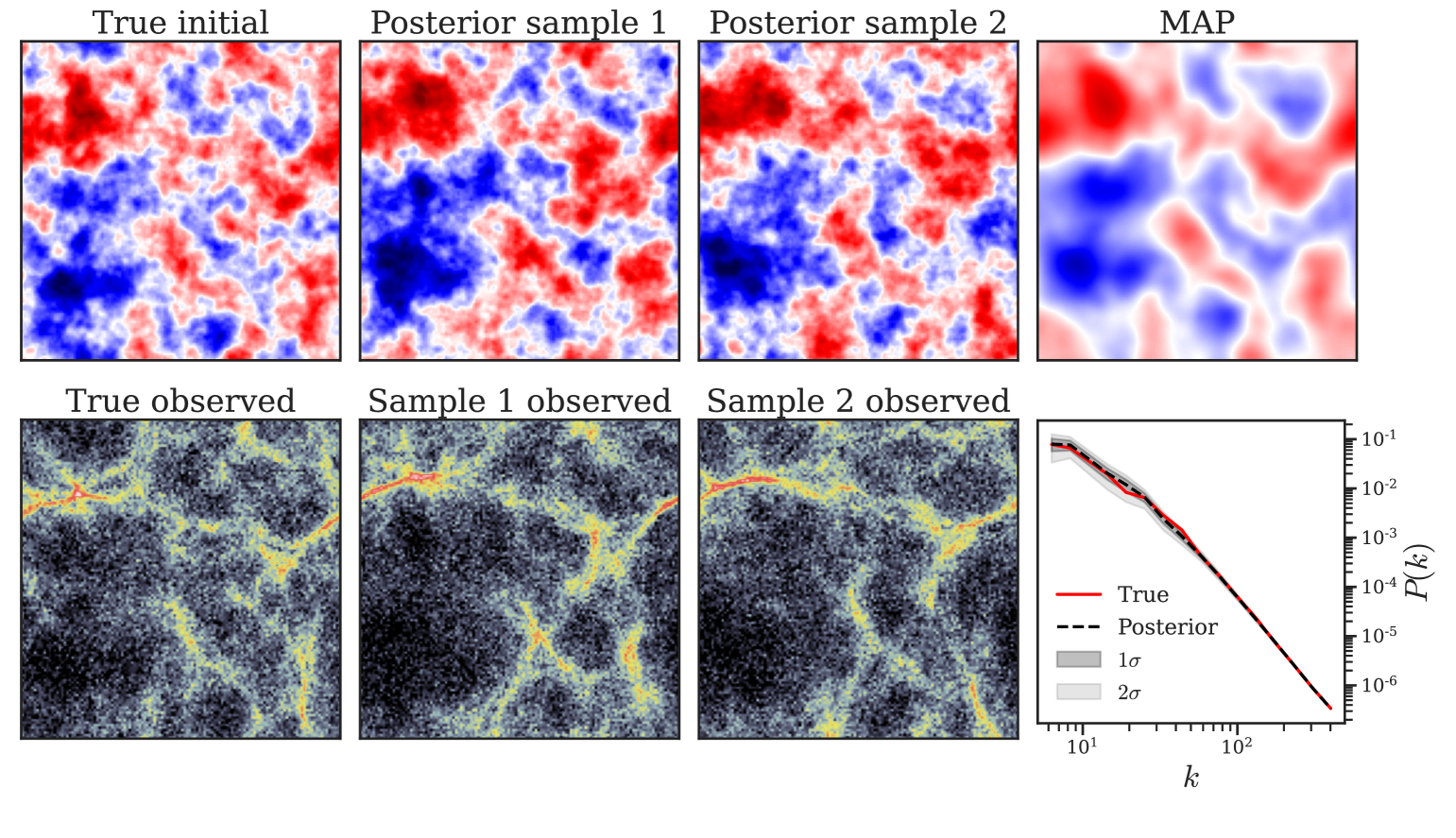
Experimental results
Research questions
- RQ1Can simulation-based inference be effectively extended to high-dimensional field reconstruction problems such as cosmological initial condition recovery?
- RQ2How can autoregressive modeling improve posterior estimation in non-linear, non-local inverse problems with non-differentiable simulators?
- RQ3To what extent does incorporating spatial structure via summary statistics and autoregressive dependencies enhance reconstruction accuracy?
- RQ4Can exact data augmentation enable fast and unbiased posterior sampling in high-dimensional field inference tasks?
- RQ5How does the choice of local summary statistics and autoregressive structure affect the quality and convergence of posterior samples?
Key findings
- The method successfully reconstructs the large-scale structure of cosmological initial conditions with high fidelity, even when the forward simulator is non-differentiable and non-linear.
- Posterior samples exhibit power spectra consistent with the true initial field, particularly on small and intermediate scales, due to the inclusion of the fixed power spectrum in the prior precision matrix.
- The framework achieves full posterior sampling in less than 1 second per sample using 300 GEDA steps, with MAP estimation completed in under 3 seconds on a laptop GPU.
- Training on only 1,000 simulated $(\bm{x}, \bm{z})$-pairs for 15 epochs takes approximately 3 minutes, demonstrating low computational cost and high sample efficiency.
- The method remains robust under varying choices of the autoregressive context size $\gamma$, with a trade-off between statistical power and unbiasedness observed at $\gamma = 0.5$.
- The framework is generalizable to other image and field reconstruction problems, including those involving non-physical simulators, due to its reliance on simulation-only access.
Read this paper
Open the full text in the Nubint reader and ask about any passage as you read.
Read this paper on NubintThis review was generated by AI from the original paper. Please check the paper before citing it.