
[Paper Review] Bound isoscalar axial-vector $bc\bar u\bar d$ tetraquark $T_{bc}$ from lattice QCD using two-meson and diquark-antidiquark variational basis
This lattice QCD study investigates the existence of a bound isoscalar axial-vector tetraquark state $T_{bc} = bc\bar{u}\bar{d}$ with $J^P = 1^+$, using a variational method with two-meson and diquark-antidiquark interpolating operators on four MILC ensembles. It finds a $+0.57$ fm scattering length and a binding energy of $-43^{+6}_{-7}$ MeV at physical pion mass, indicating a stable $T_{bc}$ bound state.
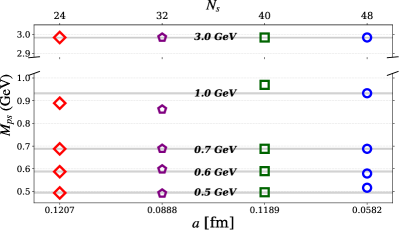
We report a lattice QCD study of the heavy-light meson-meson interactions with an explicitly exotic flavor content $bc\bar u\bar d$, isospin $I\!=\!0$, and axialvector $J^P=1^+$ quantum numbers in search of possible tetraquark bound states. The calculation is performed at four values of lattice spacing, ranging $\sim$0.058 to $\sim$0.12 fm, and at five different values of valence light quark mass $m_{u/d}$, corresponding to pseudoscalar meson mass $M_{ps}$ of about 0.5, 0.6, 0.7, 1.0, and 3.0 GeV. The energy eigenvalues in the finite-volume are determined through a variational procedure applied to correlation matrices built out of two-meson interpolating operators as well as diquark-antidiquark operators. The continuum limit estimates for $D\bar B^*$ elastic $S$-wave scattering amplitude are extracted from the lowest finite-volume eigenenergies, corresponding to the ground states, using amplitude parametrizations supplemented by a lattice spacing dependence. Light quark mass $m_{u/d}$ dependence of the $D\bar B^*$ scattering length ($a_0$) suggests that at the physical pion mass $a_0^{phys} = +0.57(^{+4}_{-5})(17)$ fm, which clearly points to an attractive interaction between the $D$ and $\bar B^*$ mesons that is strong enough to host a real bound state $T_{bc}$, with a binding energy of $-43(_{-7}^{+6})(_{-24}^{+14})$ MeV with respect to the $D\bar B^*$ threshold. We also find that the strength of the binding decreases with increasing $m_{u/d}$ and the system becomes unbound at a critical light quark mass $m^{*}_{u/d}$ corresponding to $M^{*}_{ps} = 2.73(21)(19)$ GeV.
Motivation & Objective
- To investigate the existence of a bound $T_{bc} = bc\bar{u}\bar{d}$ tetraquark state with $J^P = 1^+$, $I = 0$ in lattice QCD.
- To determine whether the $D B^*$ interaction is attractive enough to form a real bound state, given the system's exotic flavor content.
- To assess the interplay between molecular and compact diquark-antidiquark configurations in bottom-charm tetraquarks.
- To extrapolate finite-volume lattice spectra to the physical point and extract the scattering length and binding energy.
- To identify the critical light quark mass at which the $T_{bc}$ state becomes unbound, probing the stability of the state.
Proposed method
- Employed four MILC lattice ensembles with dynamical $u/d$, $s$, and $c$ quarks using the HISQ action, with lattice spacings from 0.058 to 0.12 fm.
- Used overlap fermions for valence $u/d$ and $c$ quarks, and nonrelativistic QCD for the bottom quark with $\mathcal{O}(\alpha_s v^4)$ improvement.
- Constructed correlation matrices from two-meson interpolating operators and local diquark-antidiquark operators for variational analysis.
- Extracted finite-volume energy levels via a variational procedure on correlation matrices with multiple source-sink separations.
- Performed global fits to the energy spectra using parametrized $DB^*$ scattering amplitudes, including discretization and $m_{u/d}$-dependence corrections.
- Extrapolated results to zero lattice spacing and physical $m_{u/d}$ using a combined fit model, yielding the scattering length and binding energy.
Experimental results
Research questions
- RQ1Does the $D B^*$ interaction in the $I=0$, $J^P=1^+$ channel support a bound state for the $T_{bc}$ tetraquark?
- RQ2What is the binding energy of the $T_{bc}$ state with respect to the $D B^*$ threshold at physical pion mass?
- RQ3How does the binding strength of $T_{bc}$ depend on the light quark mass, and at what critical $m_{u/d}$ does it become unbound?
- RQ4To what extent does the $T_{bc}$ state exhibit molecular or compact diquark-antidiquark character, based on operator overlaps?
- RQ5How robust are the extracted energy levels and scattering parameters across different lattice ensembles with varying volumes and spacings?
Key findings
- The $DB^*$ scattering length at physical pion mass is $a_0^{\text{phys}} = +0.57^{+4}_{-5}(17)$ fm, indicating a strongly attractive interaction.
- The $T_{bc}$ state is found to be a bound state with a binding energy of $-43^{+6}_{-7}(-24)^{+14}$ MeV relative to the $D B^*$ threshold.
- The binding energy decreases with increasing light quark mass, and the state becomes unbound at a critical $m_{u/d}^*$ corresponding to $M_{\text{ps}}^* = 2.73(21)(14)$ GeV.
- The ground state energy lies below the $D B^*$ threshold across all ensembles, with consistent energy splittings and operator overlaps confirming its stability.
- Operator overlap analysis shows that the ground state is dominated by both two-meson and diquark-antidiquark components, indicating a mixed molecular-compact structure.
- The results are robust across different lattice volumes and spacings, with consistent energy levels and fits, especially in larger-volume $L_1$ and $S_1$ ensembles.
Better researchstarts right now
From reading papers to final review, dramatically reduce your research time.
No credit card · Free plan available
This review was created by AI and reviewed by human editors.