
[Paper Review] Role of left-hand cut contributions on pole extractions from lattice data: Case study for $T_{cc}(3875)^+$
This paper demonstrates that left-hand cuts (LHCs) from one-pion exchange (OPE) significantly impact pole extraction from lattice QCD data for near-threshold hadronic molecules like the $T_{cc}^+(3875)^+$. When the pion mass exceeds the $D^* - D$ mass splitting, the LHC appears near the $DD^*$ threshold, invalidating the effective-range expansion and necessitating explicit OPE inclusion in scattering amplitudes for reliable pole determination—highlighting a critical but previously overlooked source of systematic error in lattice analyses of exotic states.
We discuss recent lattice data for the $T_{cc}(3875)^+$ state to stress, for the first time, a potentially strong impact of left-hand cuts from the one-pion exchange on the pole extraction for near-threshold exotic states. In particular, if the left-hand cut is located close to the two-particle threshold, which happens naturally in the $DD^*$ system for the pion mass exceeding its physical value, the effective-range expansion is valid only in a very limited energy range up to the cut and as such is of little use to reliably extract the poles. Then, an accurate extraction of the pole locations requires the one-pion exchange to be implemented explicitly into the scattering amplitudes. Our findings are general and potentially relevant for a wide class of hadronic near-threshold states.
Motivation & Objective
- To investigate the impact of left-hand cuts (LHCs) from one-pion exchange (OPE) on the extraction of resonance poles from lattice QCD data for near-threshold hadronic molecules.
- To assess whether the effective-range expansion (ERE) remains valid when LHCs are located close to the two-particle threshold, particularly in unphysical pion mass regimes.
- To demonstrate that explicit inclusion of OPE interactions is essential for reliable pole determination when LHCs are near the threshold, challenging the validity of standard ERE-based fitting procedures.
- To provide a general framework applicable to other near-threshold exotic hadronic states where similar LHC effects may distort pole extraction.
Proposed method
- The authors use lattice QCD data for the $T_{cc}^+(3875)^+$ state, focusing on the $DD^*$ scattering amplitude in the $S$-wave channel.
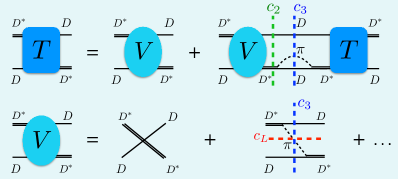
- They model the scattering amplitude using a Lippmann-Schwinger equation with an interaction potential that includes one-pion exchange (OPE) explicitly.
- The $p\cot\delta(p^2)$ function is extracted from lattice data via the Lüscher method and fitted using a Bayesian approach with 1000 quasi-data sets to account for non-Gaussian uncertainties.
- The fitting procedure minimizes $\chi^2$ between model predictions and quasi-data, with parameters $c_0$ and $c_2$ representing low-energy constants of the potential.
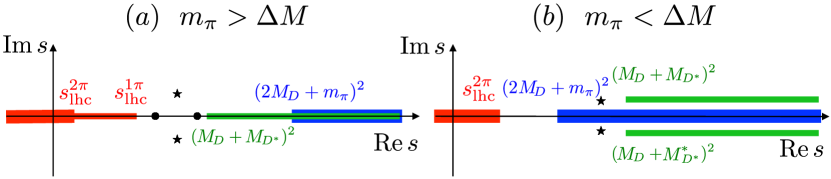
- The position of the left-hand cut branch point is calculated as a function of pion mass, and its proximity to the $DD^*$ threshold is analyzed for $m_\pi > \Delta M$.
- The effect of varying OPE strength (by factors of 1/10 and 5) is studied to isolate its role in shifting the pole and residue in $p\cot\delta(p^2)$.
Experimental results
Research questions
- RQ1How does the presence of a left-hand cut from one-pion exchange affect the reliability of effective-range expansion in extracting resonance poles from lattice QCD data?
- RQ2What happens to the pole structure of the $p\cot\delta(p^2)$ function when the left-hand cut is located near the $DD^*$ threshold, as occurs for $m_\pi > \Delta M$?
- RQ3To what extent does the one-pion exchange interaction determine the existence and position of the pole in the scattering amplitude, especially when the OPE strength is varied?
- RQ4Can standard fitting procedures based on the effective-range expansion yield reliable pole positions when the left-hand cut is close to the physical threshold?
Key findings
- When the pion mass exceeds the $D^* - D$ mass difference ($m_\pi > \Delta M$), the left-hand cut branch point lies close to the $DD^*$ threshold, invalidating the effective-range expansion over a limited energy range.
- The left-hand cut from one-pion exchange becomes a dominant source of non-analyticity in the scattering amplitude, distorting pole extraction when the cut is near the threshold.
- The pole in $p\cot\delta(p^2)$ moves toward the left-hand cut as the OPE strength is reduced, and vanishes when OPE is turned off, proving OPE is essential for pole formation.
- For the physical pion coupling, the pole and left-hand cut nearly coincide, suggesting a delicate balance that can mislead pole extraction if not explicitly modeled.
- Fits to lattice data at $m_\pi = 280$ MeV and smaller charm quark masses show consistent behavior: the LHC effect is strong and cannot be ignored.
- The study concludes that explicit inclusion of one-pion exchange is necessary for reliable pole extraction in near-threshold exotic states, especially in unphysical pion mass regimes.
Read this paper
Open the full text in the Nubint reader and ask about any passage as you read.
Read this paper on NubintThis review was generated by AI from the original paper. Please check the paper before citing it.