
[Paper Review] Building a Multi-domain Neural Machine Translation Model using Knowledge Distillation
This paper proposes a knowledge distillation-based framework to train a single multi-domain neural machine translation (NMT) model by distilling expertise from multiple domain-specific teacher models, achieving up to 2 BLEU point gains over standard finetuning without increasing inference cost. The method uses a pretrained generic student and dynamic data selection to efficiently transfer knowledge across 2–4 domains.
Lack of specialized data makes building a multi-domain neural machine translation tool challenging. Although emerging literature dealing with low resource languages starts to show promising results, most state-of-the-art models used millions of sentences. Today, the majority of multi-domain adaptation techniques are based on complex and sophisticated architectures that are not adapted for real-world applications. So far, no scalable method is performing better than the simple yet effective mixed-finetuning, i.e finetuning a generic model with a mix of all specialized data and generic data. In this paper, we propose a new training pipeline where knowledge distillation and multiple specialized teachers allow us to efficiently finetune a model without adding new costs at inference time. Our experiments demonstrated that our training pipeline allows improving the performance of multi-domain translation over finetuning in configurations with 2, 3, and 4 domains by up to 2 points in BLEU.
Motivation & Objective
- Address the scalability and efficiency challenges of deploying multiple single-domain NMT models in real-world applications.
- Overcome the limitations of existing multi-domain adaptation techniques that rely on ensembling, reranking, or input classification, which add complexity and cost.
- Develop a scalable, low-inference-cost method that combines expertise from multiple specialized domain models into a single unified student model.
- Demonstrate that knowledge distillation can outperform standard mixed finetuning while maintaining the simplicity and speed of a generic model.
- Generalize the approach to 2, 3, and 4 domains, showing consistent performance gains across diverse domains like medical, legal, software, and religious texts.
Proposed method
- Train multiple specialized teacher models using state-of-the-art single-domain adaptation techniques on domain-specific data.
- Use knowledge distillation to transfer knowledge from these teachers to a single, pretrained generic student model.
- Apply dynamic data selection during teacher finetuning to improve domain-specific performance before distillation.
- Train the student model using both hard labels (from teachers) and soft labels (logits) via a weighted loss combining negative log-likelihood and Kullback-Leibler divergence.
- Optimize the distillation process with a hyperparameter λ balancing the cross-entropy loss and KL divergence loss.
- Preserve the original student architecture without architectural modifications or parameter increases, ensuring inference efficiency.
Experimental results
Research questions
- RQ1Can knowledge distillation effectively combine expertise from multiple domain-specific teacher models into a single multi-domain student model?
- RQ2Does the proposed distillation framework outperform standard mixed finetuning in terms of BLEU score across multiple domains?
- RQ3How does label smoothing affect the performance of knowledge distillation in multi-domain NMT?
- RQ4Is the distillation approach scalable and effective across 2, 3, and 4 domains with varying data complexity?
- RQ5Can the method maintain inference efficiency while improving translation quality compared to ensembling or prior classification methods?
Key findings
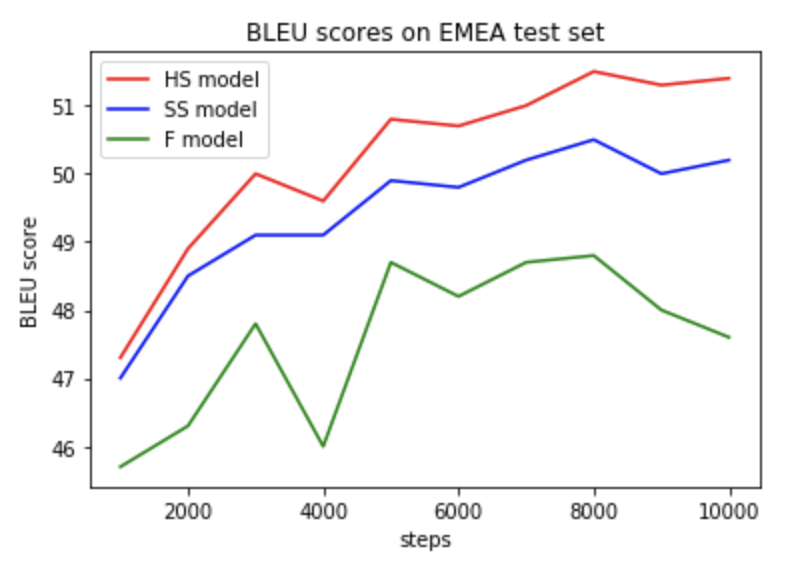
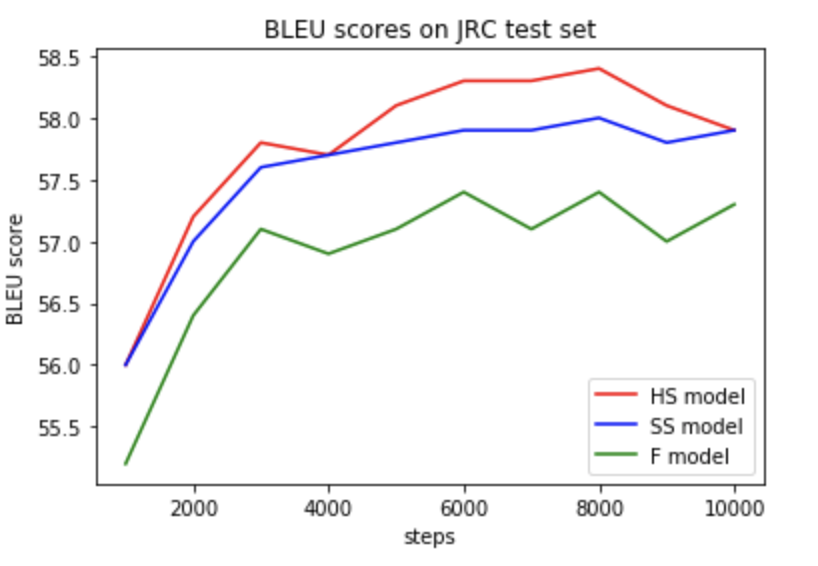
- The proposed knowledge distillation method achieved up to 2.0 BLEU point improvement over mixed finetuning in the 2-teacher configuration, with gains of 1.55 BLEU in the 4-teacher setup.
- The hard-label distillation (HS) strategy outperformed soft-label distillation (SS), with ΔHS averaging 2.0, 1.1, and 1.55 BLEU across 2, 3, and 4 domains respectively.
- On the Medical and Religion datasets—where the generic model performed poorly—the distillation approach showed significant gains, with improvements of up to 20 BLEU points over the base model.
- The method outperformed ensembling and prior classification techniques, especially in low-resource or out-of-domain settings, while maintaining low inference cost.
- Label smoothing had a measurable negative impact on distillation performance, with hard-label distillation yielding better results than soft-label distillation.
- The approach generalized well across diverse domains, including Legal (high baseline), Medical (large improvement), Software (short sentences), and Religion (historical language).
Read this paper
Open the full text in the Nubint reader and ask about any passage as you read.
Read this paper on NubintThis review was generated by AI from the original paper. Please check the paper before citing it.