
[Paper Review] Categorical Symmetry of the Standard Model from Gravitational Anomaly
The paper shows that a noninvertible, categorical B-L symmetry survives in gravitational backgrounds due to mixed U(1)–gravity and Z4/gravity anomalies in the Standard Model, and constructs corresponding topological defect operators via anomaly inflow and TQFTs.
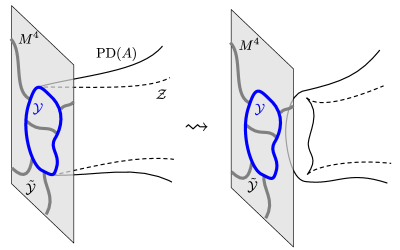
In the Standard Model, some combination of the baryon $\bf B$ and lepton $\bf L$ number symmetry is free of mixed anomalies with strong and electroweak $su(3) imes su(2) imes u(1)_{ ilde Y}$ gauge forces. However, it can still suffer from a mixed gravitational anomaly, hypothetically pertinent to leptogenesis in the very early universe. This happens when the total "sterile right-handed" neutrino number $n_{ν_R}$ is not equal to the family number $N_f$. Thus the invertible $\bf B - L$ symmetry current conservation can be violated quantum mechanically by gravitational backgrounds such as gravitational instantons. In specific, we show that a noninvertible categorical $\bf B - L$ generalized symmetry still survives in gravitational backgrounds. In general, we propose a construction of noninvertible symmetry charge operators as topological defects derived from invertible anomalous symmetries that suffer from mixed gravitational anomalies. Examples include the perturbative local and nonperturbative global anomalies classified by $\mathbb{Z}$ and $\mathbb{Z}_{16}$ respectively. For this construction, we utilize the anomaly inflow bulk-boundary correspondence, the 4d Pontryagin class and the gravitational Chern-Simons 3-form, the 3d Witten-Reshetikhin-Turaev-type topological quantum field theory corresponding to a 2d rational conformal field theory with an appropriate rational chiral central charge, and the 4d $\mathbb{Z}_4^{ m TF}$-time-reversal symmetric topological superconductor with 3d boundary topological order.
Motivation & Objective
- Clarify how mixed gravitational anomalies affect B-L and related U(1) symmetries in the Standard Model.
- Demonstrate that noninvertible (categorical) B-L symmetry charges persist in curved spacetime backgrounds.
- Develop a construction of noninvertible symmetry operators from anomalous U(1) and Z4-gravity anomalies using bulk-boundary inflow and TQFT techniques.
- Relate perturbative and global anomalies (Z and Z16 classifications) to noninvertible categorical symmetries within the SM framework.
Proposed method
- Express the 4d SM anomaly structure via a 6d anomaly polynomial derived from the Atiyah–Singer index theorem.
- Present the mixed U(1)–gravity and pure U(1) anomalies as elements of Z^2 and Z16, and connect to cobordism classifications.
- Construct noninvertible symmetry topological defects by attaching 3d TQFTs to defect worldvolumes that couple to bulk gravitational/U(1) backgrounds.
- Use anomaly inflow to relate 6d polynomial data to 5d invertible phases and 4d boundary phenomena, yielding noninvertible charges.
- Discuss framing, Atiyah’s 2-framing, and the role of gravitational Chern–Simons terms in defining topological defects.
Experimental results
Research questions
- RQ1How do mixed U(1)–gravity and pure U(1) anomalies affect the conservation of B-L in the Standard Model?
- RQ2Can the nonconservation induced by gravitational backgrounds be reformulated as a noninvertible (categorical) symmetry?
- RQ3What is the explicit construction of noninvertible B-L symmetry operators using 3d TQFTs and bulk-boundary inflow?
- RQ4How do Z4 and Z16 global anomaly classifications manifest as noninvertible categorical symmetries in SM contexts?
- RQ5How do cobordism and anomaly inflow frameworks unify the perturbative and global anomaly data in generating noninvertible symmetries?
Key findings
- A noninvertible B-L generalized symmetry survives gravitational backgrounds when n_{νR} ≠ Nf, replacing the conserved current with noninvertible charges.
- The mixed U(1)–gravity anomaly and the global Z4,X gravity anomaly can be encoded as topological defects derived from 3d TQFTs attached to defect worldvolumes.
- The anomaly data organize into a 6d polynomial, whose inflow to 5d iTFT and 4d boundary theory yields a consistent noninvertible symmetry structure.
- Two anomaly classes are treated: perturbative local anomalies classified by Z^2 and global anomalies classified by Z16, both realizable as noninvertible symmetries.
- The framework uses anomaly inflow, the 4d Pontryagin class, gravitational Chern–Simons forms, and a 3d RT-type TQFT with framing anomalies to define the categorical symmetry operators.
- The approach connects to cobordism-based classifications of anomalies and suggests a pathway to integrate BSM sectors or interacting TQFT/CFT sectors in leptogenesis/baryogenesis scenarios.
Better researchstarts right now
From reading papers to final review, dramatically reduce your research time.
No credit card · Free plan available
This review was created by AI and reviewed by human editors.