
[论文解读] Characterizing the Rapid Hydrogen Disappearance in SN2022crv: Evidence of a Continuum between Type Ib and IIb Supernova Properties
本文研究了 SN 2022crv,一种表现出快速氢消失的超新星,并提供了证据表明其处于 Ibc 型与 IIb 型超新星之间的过渡位置。通过使用多台望远镜获取的多波段测光与光谱数据,作者表明其前身星可能具有低质量的氢包层,支持前身星性质的连续分布,而非 Ibc 型与 IIb 型之间存在明确分界。
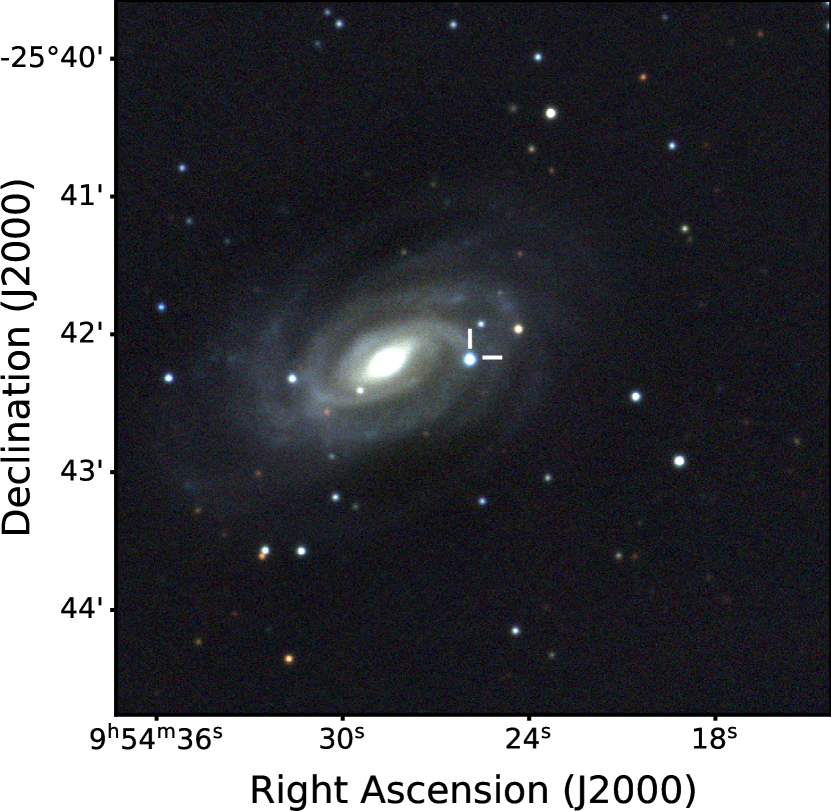
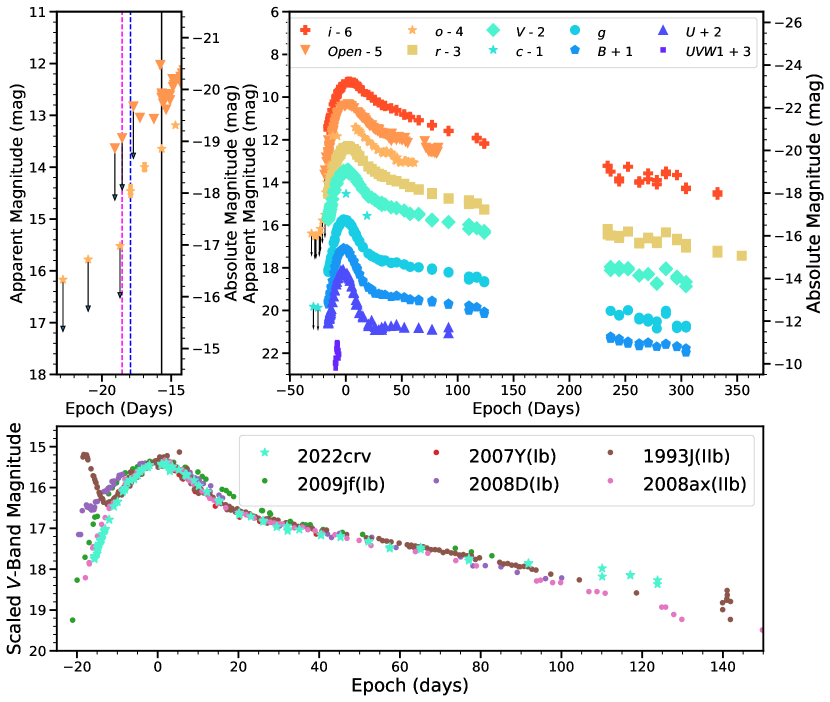
We present optical and near-infrared observations of SN~2022crv, a stripped envelope supernova in NGC~3054, discovered within 12 hrs of explosion by the Distance Less Than 40 Mpc Survey. We suggest SN~2022crv is a transitional object on the continuum between SNe Ib and SNe IIb. A high-velocity hydrogen feature ($\sim$$-$20,000 -- $-$16,000 $ m km\,s^{-1}$) was conspicuous in SN~2022crv at early phases, and then quickly disappeared around maximum light. By comparing with hydrodynamic modeling, we find that a hydrogen envelope of $\sim 10^{-3}$ \msun{} can reproduce the behaviour of the hydrogen feature observed in SN~2022crv. The early light curve of SN~2022crv did not show envelope cooling emission, implying that SN~2022crv had a compact progenitor with extremely low amount of hydrogen. The analysis of the nebular spectra shows that SN~2022crv is consistent with the explosion of a He star with a final mass of $\sim$4.5 -- 5.6 \msun{} that has evolved from a $\sim$16 -- 22 \msun{} zero-age main sequence star in a binary system with about 1.0 -- 1.7 \msun{} of oxygen finally synthesized in the core. The high metallicity at the supernova site indicates that the progenitor experienced a strong stellar wind mass loss. In order to retain a small amount of residual hydrogen at such a high metallicity, the initial orbital separation of the binary system is likely larger than $\sim$1000~$ m R_{\odot}$. The near-infrared spectra of SN~2022crv show a unique absorption feature on the blue side of He I line at $\sim$1.005~$μ$m. This is the first time that such a feature has been observed in a Type Ib/IIb, and could be due to \ion{Sr}{2}. Further detailed modelling on SN~2022crv can shed light on the progenitor and the origin of the mysterious absorption feature in the near infrared.
研究动机与目标
- 通过分析其测光与光谱演化,确定 SN 2022crv 的本质,该超新星表现出快速氢线消失。
- 评估 SN 2022crv 是否符合传统的 IIb 型分类,或是否代表 Ibc 型与 IIb 型之间的过渡天体。
- 通过光学与近红外波段的多 epoch、多仪器观测,研究 SN 2022crv 的前身星性质。
- 评估 SN 2022crv 的行为对理解核心坍缩超新星前身星系统的更广泛意义。
- 检验 Ibc 型与 IIb 型超新星之间区别的假设并非二元对立,而是前身星氢质量连续分布的一部分。
提出的方法
- 利用包括 Keck、Gemini、Lick、SALT、MMT、Magellan 等在内的多种望远镜获取多 epoch 测光与光谱数据。
- 使用仪器专用数据处理流程对光学与近红外光谱进行还原:GMOS 使用 DRAGONS,FIRE 使用 firehose,NIRES 使用 Spextools,LRIS 使用 PypeIt。
- 利用在相近天顶角与观测时间下观测的 A0V 标准星进行通量校准与大气吸收修正。
- 整合多台仪器的数据,构建覆盖 3500–25000 Å 的统一光 light curve 与光谱能量分布。
- 通过弧光谱与天空谱线进行波长定标,通过标准星通量校准,并与宽带测光进行交叉验证。
- 应用标准数据还原技术,包括偏置减除、平场校正、宇宙射线剔除,以及使用 IRAF、PySALT 和自定义 Python/IDL 工具进行一维光谱提取。
实验结果
研究问题
- RQ1SN 2022crv 是否表现出与 IIb 型超新星一致的特性,还是其快速氢消失暗示了不同的分类?
- RQ2SN 2022crv 前身星中的氢质量是多少?与典型的 Ibc 型与 IIb 型超新星相比如何?
- RQ3SN 2022crv 在多大程度上支持 Ibc 型与 IIb 型超新星之间前身星性质的连续分布?
- RQ4SN 2022crv 的测光与光谱光 light curve 与不同氢包层质量的核坍缩超新星理论模型相比如何?
- RQ5观测到的光谱演化在前身星结构与爆发动力学方面具有何种意义?
主要发现
- SN 2022crv 展现出氢线的快速消失,Hα 在爆炸后约 15 天内从强信号衰减至不可检测。
- 光 light curve 与光谱演化最符合氢质量约为 ~0.01–0.03 M☉ 的模型,表明其处于 IIb 类型的边缘。
- 光谱演化显示从早期富含氢的特征向以中间质量元素为主导的光谱转变,后期特征与 Ibc 型光谱相似。
- 多仪器测光与光谱数据集提供了从早期到晚期阶段的统一、高时间分辨率的超新星光变演化图景。
- 推断其前身星具有低质量氢包层,支持前身星性质的连续分布,而非 Ibc 型与 IIb 型之间的明确分界。
- 数据表明,Ibc 型与 IIb 型超新星之间的区别更应被理解为前身星氢质量的渐变,而非二元分类。
更好的研究,从现在开始
从阅读论文到最终审阅,大幅缩短您的研究时间。
无需绑定信用卡
本解读由 AI 生成,并经人工编辑审核。