
[论文解读] Charting the Realms of Mesoscale Cloud Organisation using Unsupervised Learning
本文提出了一种无监督深度学习框架,利用卷积神经网络的内部嵌入空间映射中尺度浅云组织的完整连续谱。该方法揭示了云组织对短波反照率的影响显著超出云量变化的影响——导致反照率波动±1.4%,并实现了对不同组织状态下时间演变及环境驱动因素的追踪。
Quantifying the driving mechanisms and effect on Earth's energy budget, of mesoscale shallow cloud organisation, remains difficult. Partly because quantifying the atmosphere's organisational state through objective means remains challenging. We present the first map of the full continuum of convective organisation states by extracting the manifold within an unsupervised neural networks's internal representation. On the manifold distinct organisational regimes, defined in prior work, sit as waymarkers in this continuum. Composition of reanalysis and observations onto the manifold, shows wind-speed and water vapour concentration as key environmental characteristics varying with organisation. We show, for the first time, that mesoscale shallow cloud organisation produces $\pm 1.4\%$ variations in albedo in addition to variations from cloud-fraction changes alone. We further demonstrate how the manifold's continuum representation captures the temporal evolution of organisation. By enabling study of states and transitions in organisation (in simulations and observations) the presented technique paves the way for better representation of shallow clouds in simulations of Earth's future climate.
研究动机与目标
- 开发一种数据驱动的客观方法,用于量化中尺度浅云组织的完整谱系,突破离散分类的局限。
- 表征风速、水汽等环境条件在组织连续谱上的变化特征。
- 在不考虑云量变化的前提下,量化组织对辐射的影响。
- 利用流形表示实现对组织状态随时间演变及状态间转换的研究。
- 提供一种新框架,通过捕捉连续的组织动力学,改进气候模型中的云参数化。
提出的方法
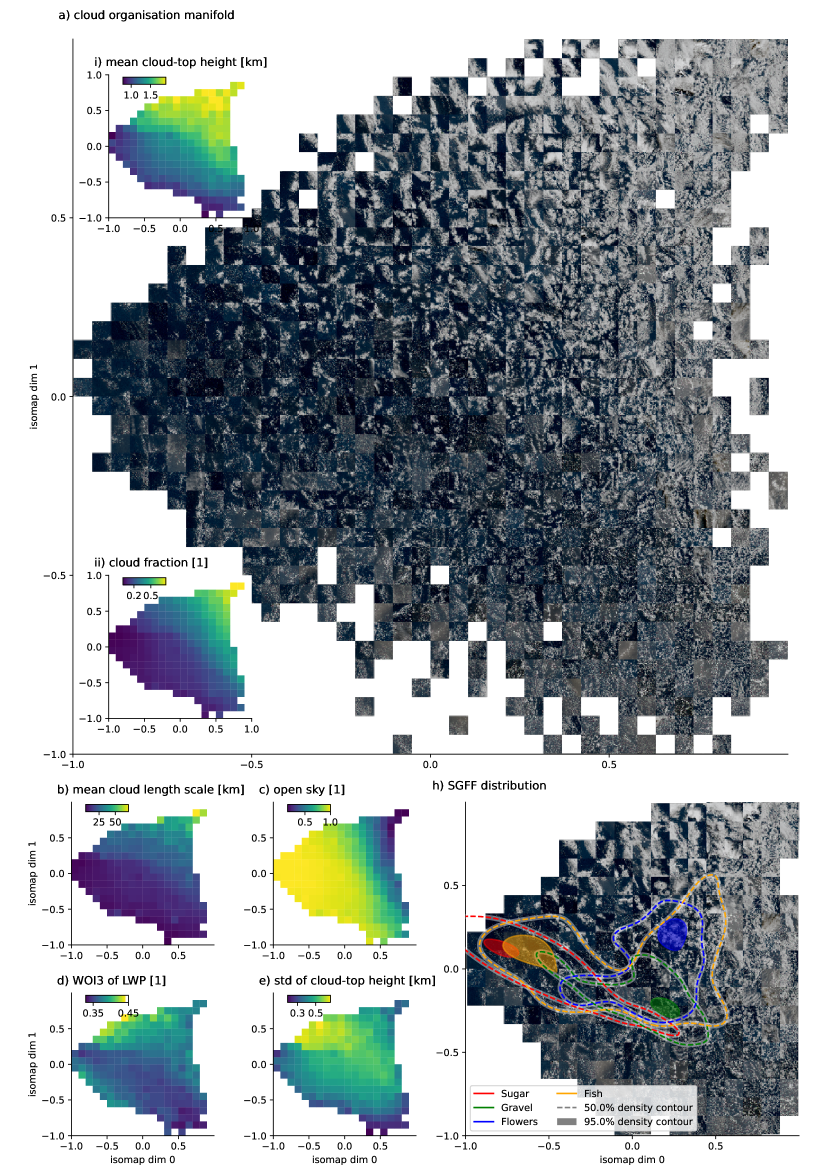
- 使用卫星衍生的云图像块对卷积神经网络进行无监督训练,学习表示云模式的100维嵌入空间。
- 提取该高维空间中嵌入的低维流形,形成所有可能云组织状态的连续映射。
- 将传统云组织度量(如Janssens等人,2021年所述)投影到流形上,以验证其表征保真度。
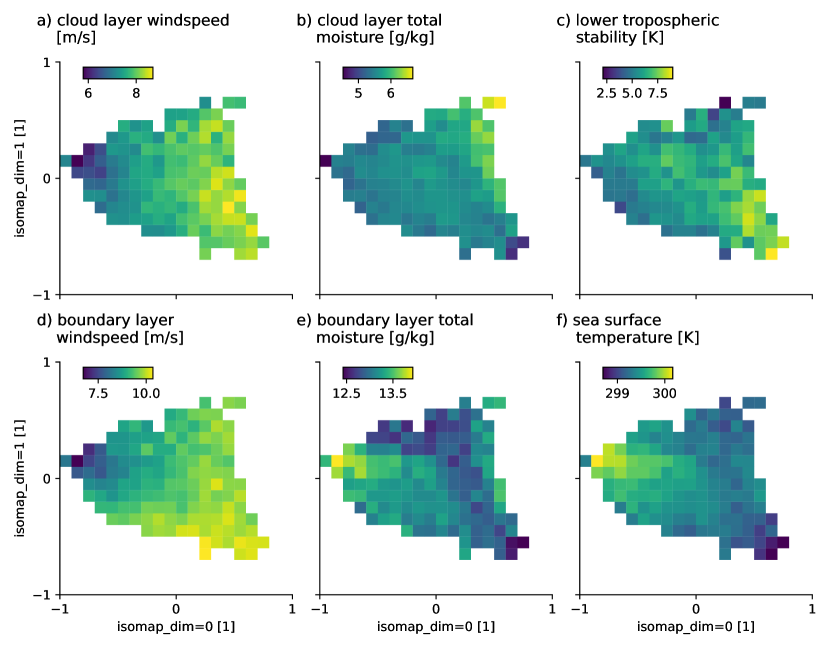
- 将再分析数据(ERA5)和观测数据(GOES-16, CERES)叠加到流形上,识别组织的环境驱动因素。
- 将云系统的拉格朗日轨迹映射到流形上,研究组织状态的时间演变及状态间转换。
- 通过流形的连续表示,将组织效应与云量变化分离,量化反照率变化。
实验结果
研究问题
- RQ1如何利用无监督表示学习客观地映射中尺度浅云组织的完整连续谱?
- RQ2云组织在云量变化之外,对短波反照率的影响程度如何?
- RQ3哪些环境变量(如风速、水汽、海表温度)在组织连续谱上系统性变化?
- RQ4从积云群到更大孤立云体等组织状态之间的转变在流形上如何体现?
- RQ5该流形表示能否捕捉真实云系统中观测到的昼夜循环与分岔现象?
主要发现
- 无监督神经网络的内部表征形成一个连续的、低维流形,映射了所有可能的中尺度浅云组织状态。
- 该流形捕捉了组织的完整连续谱,先前定义的类别(如“糖”、“花”、“碎石”)在图上表现为明显但非孤立的峰。
- 即使在校正云量变化后,中尺度云组织仍导致短波反照率±1.4%的波动,主要由光学厚度变化驱动。
- 更大的孤立积云(“花”类)与高层云湿度高、低层云下湿度低密切相关,而非与低对流层稳定性相关。
- 该流形使时间演变得以追踪,揭示了组织的昼夜循环特征,其在4天的拉格朗日轨迹中分解为新状态。
- 环境合成分析表明,更强风速和更低海表温度与更明显的云组织性相关,与先前研究一致。
更好的研究,从现在开始
从阅读论文到最终审阅,大幅缩短您的研究时间。
无需绑定信用卡
本解读由 AI 生成,并经人工编辑审核。