
[Paper Review] ChatGPT MT: Competitive for High- (but not Low-) Resource Languages
This study evaluates ChatGPT's machine translation (MT) performance across 204 languages using the FLORES-200 benchmark, comparing it to NLLB, Google Translate, and GPT-4. It finds that while ChatGPT matches or exceeds traditional MT models for high-resource languages, it significantly underperforms for low-resource languages—especially African languages—on 84.1% of evaluated languages.
Large language models (LLMs) implicitly learn to perform a range of language tasks, including machine translation (MT). Previous studies explore aspects of LLMs' MT capabilities. However, there exist a wide variety of languages for which recent LLM MT performance has never before been evaluated. Without published experimental evidence on the matter, it is difficult for speakers of the world's diverse languages to know how and whether they can use LLMs for their languages. We present the first experimental evidence for an expansive set of 204 languages, along with MT cost analysis, using the FLORES-200 benchmark. Trends reveal that GPT models approach or exceed traditional MT model performance for some high-resource languages (HRLs) but consistently lag for low-resource languages (LRLs), under-performing traditional MT for 84.1% of languages we covered. Our analysis reveals that a language's resource level is the most important feature in determining ChatGPT's relative ability to translate it, and suggests that ChatGPT is especially disadvantaged for LRLs and African languages.
Motivation & Objective
- To evaluate ChatGPT's machine translation capabilities across a broad, diverse set of 204 languages, including many low-resource and underrepresented languages.
- To determine whether end users, especially speakers of low-resource languages (LRLs), can reliably use ChatGPT for translation compared to established systems.
- To analyze the impact of language resource level, linguistic features, and prompt engineering on LLM-based MT performance.
- To compare translation costs across multiple systems, including ChatGPT, GPT-4, Google Translate, and NLLB.
- To provide actionable insights for end users and researchers on when and how to use LLMs for translation, especially in low-resource settings.
Proposed method
- Evaluated ChatGPT (gpt-3.5-turbo) on the FLORES-200 benchmark using 1,012 devtest sentences for 203 non-English languages, translating from English to target languages.
- Compared performance against NLLB (state-of-the-art open-source MT model), Google Translate (commercial system), and GPT-4 (on a 20-language subset) using chrF++ scores.
- Tested both zero-shot and five-shot prompting to assess the marginal benefit of in-context examples for LLM translation.
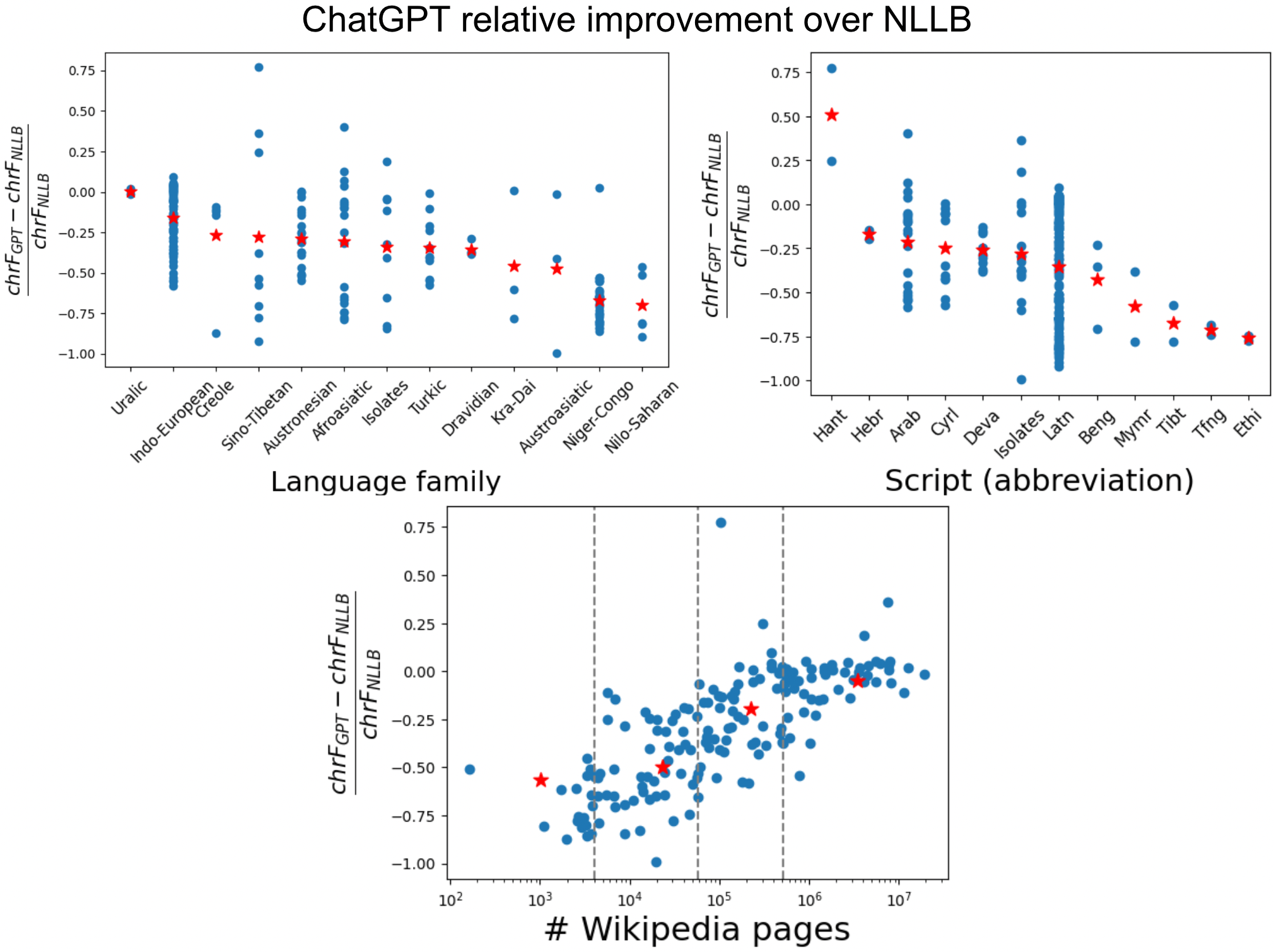
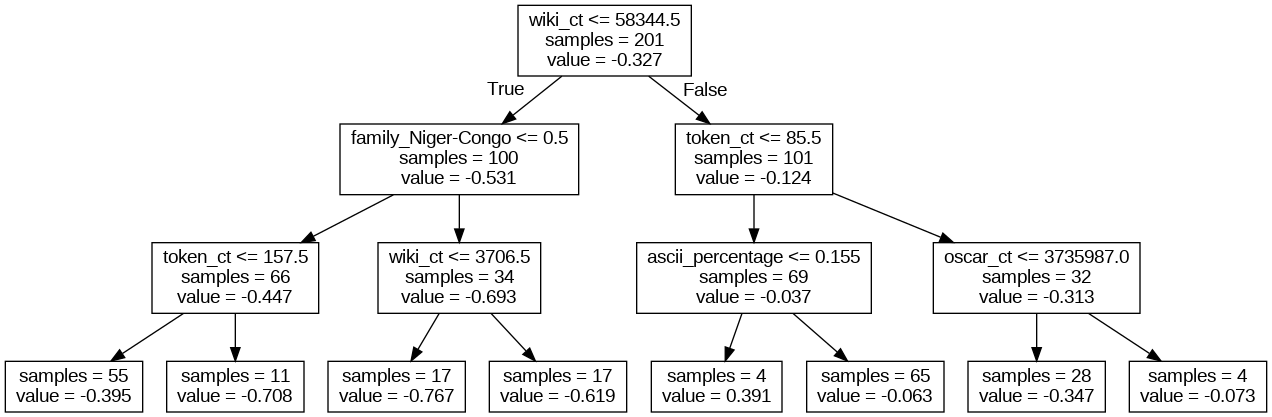
- Conducted a decision tree analysis to identify language features (e.g., resource level, script, family) most correlated with ChatGPT’s MT effectiveness.
- Performed cost analysis by estimating inference costs per translation using OpenAI API pricing, comparing ChatGPT to other systems.
- Used language-specific features such as resource level, script, language family, and geographic region to assess predictive power for translation quality.
Experimental results
Research questions
- RQ1How does ChatGPT’s translation performance compare to traditional MT models (e.g., NLLB) across a wide range of languages, particularly high- and low-resource ones?
- RQ2To what extent do few-shot prompts improve ChatGPT’s MT output quality, and is the improvement cost-effective for end users?
- RQ3Which language-level features (e.g., resource level, script, language family) most strongly predict ChatGPT’s translation performance?
- RQ4How do translation costs vary across systems like ChatGPT, GPT-4, Google Translate, and NLLB, and what are the implications for end users?
- RQ5Is ChatGPT a viable translation tool for speakers of low-resource and African languages, given its performance and cost?
Key findings
- ChatGPT matches or exceeds NLLB performance for 15.9% of languages, but underperforms NLLB on 84.1% of the 203 languages evaluated, indicating strong limitations for low-resource languages.
- For high-resource languages (HRLs), ChatGPT achieves competitive performance, with chrF++ scores approaching or surpassing NLLB in several cases, such as in French (chrF++: 45.8) and Spanish (49.7).
- Few-shot prompting provides only marginal improvements in translation quality, with no consistent or substantial gains across languages, suggesting limited benefit for end users.
- Language resource level is the strongest predictor of ChatGPT’s MT performance, with low-resource languages (LRLs) showing significantly worse results than high-resource ones.
- ChatGPT is especially disadvantaged for African languages, with average chrF++ scores below 20.0 for many (e.g., 11.5 for isiXhosa, 13.3 for Tigrinya), and performs poorly on languages like Tamashek (1.0) and Tamashek (Tfng) (0.2).
- GPT-4 outperforms ChatGPT on all 20 languages tested, but at 1,900% higher cost, making it impractical for most users; ChatGPT remains more cost-effective despite lower performance.
Read this paper
Open the full text in the Nubint reader and ask about any passage as you read.
Read this paper on NubintThis review was generated by AI from the original paper. Please check the paper before citing it.