
[Paper Review] Check Your Facts and Try Again: Improving Large Language Models with External Knowledge and Automated Feedback
The paper presents LLM-Augmenter, a plug-and-play system that augments a fixed LLM with external knowledge, iterative prompt revision via automated feedback, and a trainable policy to reduce hallucinations while maintaining fluency. It validates effectiveness on information-seeking dialog and open-domain Wiki QA.
Large language models (LLMs), such as ChatGPT, are able to generate human-like, fluent responses for many downstream tasks, e.g., task-oriented dialog and question answering. However, applying LLMs to real-world, mission-critical applications remains challenging mainly due to their tendency to generate hallucinations and their inability to use external knowledge. This paper proposes a LLM-Augmenter system, which augments a black-box LLM with a set of plug-and-play modules. Our system makes the LLM generate responses grounded in external knowledge, e.g., stored in task-specific databases. It also iteratively revises LLM prompts to improve model responses using feedback generated by utility functions, e.g., the factuality score of a LLM-generated response. The effectiveness of LLM-Augmenter is empirically validated on two types of scenarios, task-oriented dialog and open-domain question answering. LLM-Augmenter significantly reduces ChatGPT's hallucinations without sacrificing the fluency and informativeness of its responses. We make the source code and models publicly available.
Motivation & Objective
- Motivate reducing hallucinations and knowledge gaps in large language models deployed in mission-critical tasks.
- Propose a plug-and-play architecture (LLM-Augmenter) to ground LLM responses with external knowledge.
- Enable iterative prompt refinement through automated feedback to improve response quality.
- Explore training strategies for the policy and modules to operate with fixed LLMs without full fine-tuning.
Proposed method
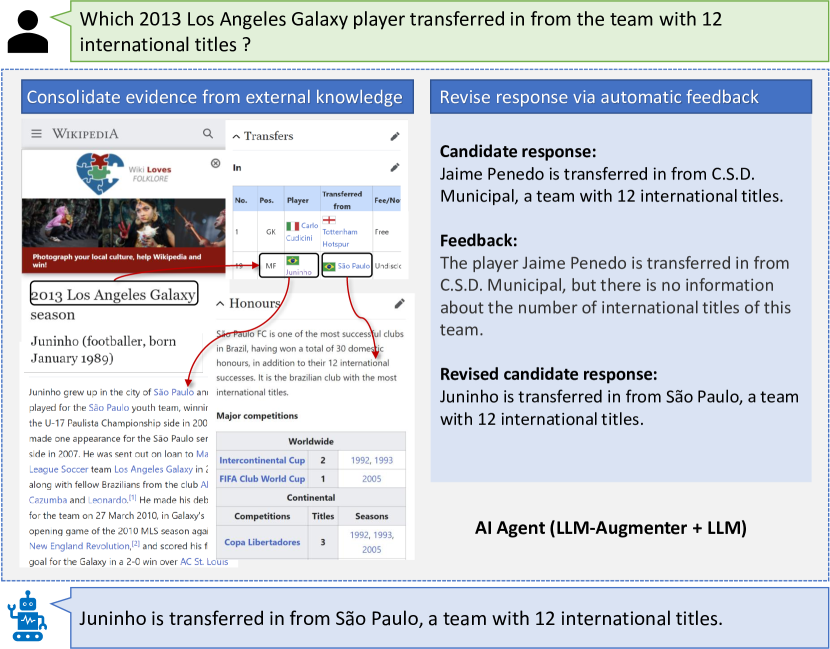
- Introduce LLM-Augmenter as a system of plug-and-play modules that augment a fixed LLM with external knowledge and automated feedback.
- Model the human-system conversation as a Markov Decision Process to guide module interactions.
- Implement a Knowledge Consolidator to retrieve and chain external evidence and an Evidence Chainer for grounding.
- Use a Prompt Engine to generate prompts incorporating evidence and feedback for the LLM.
- Develop a Utility module to produce scores and feedback guiding prompt revisions.
- Train the Policy (pi) via REINFORCE to maximize a reward based on grounding and usefulness.
Experimental results
Research questions
- RQ1Can external knowledge grounding reduce hallucinations in fixed LLMs without sacrificing fluency?
- RQ2Does automated feedback and iterative prompt revision improve factual grounding and usefulness of responses?
- RQ3How effective is a trainable policy in deciding when to use external knowledge sources?
- RQ4What is the impact of knowledge consolidation and feedback on open-domain Wiki QA and dialog tasks?
Key findings
- LLM-Augmenter significantly improves grounding and reduces hallucinations on News Chat and Customer Service tasks compared to ChatGPT alone.
- Using golden knowledge yields large performance gains, underscoring value of task-specific external knowledge for grounding.
- Automated feedback and evidence consolidation together substantially improve KF1 and related metrics over baselines.
- A trainable policy with knowledge consolidation achieves better grounding than no-knowledge-consolidator and self-ask variants, with higher efficiency than always using knowledge.
- In Wiki QA, CORE-based consolidation with feedback significantly improves recall and F1 over raw DPR evidence and closed-book ChatGPT.
- Human evaluation shows LLM-Augmenter is more useful and human-like than ChatGPT alone in customer service scenarios.
Read this paper
Open the full text in the Nubint reader and ask about any passage as you read.
Read this paper on NubintThis review was generated by AI from the original paper. Please check the paper before citing it.