
[Paper Review] Chiral limit of twisted trilayer graphene
This paper develops a spectral theoretic framework to study flat bands in twisted trilayer graphene (TTG) in the chiral limit, where interlayer tunneling at AA sites is neglected. It proves that magic parameters—tunneling amplitudes yielding flat bands—are nowhere continuous functions of the twisting angles, using trace formulae and analysis of the Bistritzer-MacDonald Hamiltonian under commensurability assumptions.
We initiate the mathematical study of the Bistritzer-MacDonald Hamiltonian for twisted trilayer graphene in the chiral limit (and beyond). We develop a spectral theoretic approach to investigate the presence of flat bands under specific magic parameters. This allows us to derive trace formulae that show that the tunnelling parameters that lead to flat bands are nowhere continuous as functions of the twisting angles.
Motivation & Objective
- To initiate a rigorous mathematical study of the Bistritzer-MacDonald Hamiltonian for twisted trilayer graphene in the chiral limit.
- To investigate the existence and structure of flat bands at specific magic parameters in the presence of commensurate twisting angles.
- To analyze the continuity properties of the tunneling parameters that yield flat bands as functions of the twisting angles.
- To establish a spectral theoretic approach using trace formulae to characterize the energy band structure in TTG.
Proposed method
- Formal derivation of the Bistritzer-MacDonald Hamiltonian (1.1) for TTG, separating interlayer tunneling at AB/BA and AA sites.
- Focus on the chiral limit by setting the AA-tunneling parameters $\tilde{\alpha} = 0$, reducing the Hamiltonian to a block off-diagonal form.
- Use of Bloch-Floquet theory and periodicity on the moiré lattice $\Gamma_3 = \Gamma/3$, with $\Gamma = 4\pi i(\omega\mathbb{Z} \oplus \omega^2\mathbb{Z})$, to analyze the Hamiltonian's spectrum.
- Application of trace formulae to relate spectral properties to the geometry of the moiré pattern and tunneling amplitudes.
- Employment of complex analysis and operator theory to study invertibility of resolvent operators and spectral gaps.
- Proof via block matrix inversion and asymptotic estimates in the anti-chiral limit to show absence of flat bands at zero energy.
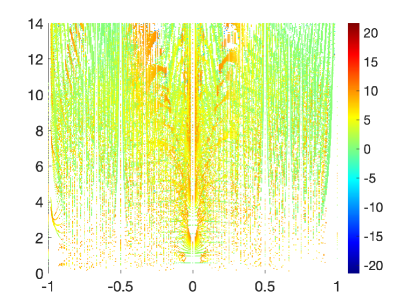
Experimental results
Research questions
- RQ1Under what conditions does the chiral limit of the TTG Hamiltonian exhibit flat bands?
- RQ2How do the magic tunneling parameters—those inducing flat bands—depend on the twisting angles $\zeta_1$ and $\zeta_2$?
- RQ3Are the magic parameters continuous functions of the twisting angles, or do they exhibit discontinuities?
- RQ4What spectral properties emerge in the anti-chiral limit, and does it support flat bands at zero energy?
- RQ5How does the commensurability of the twisting angles affect the existence and structure of flat bands?
Key findings
- The magic parameters—tunneling amplitudes $\alpha_{12}, \alpha_{23}$ that yield flat bands—are nowhere continuous functions of the twisting angles $\zeta_1, \zeta_2$.
- Trace formulae derived in the paper show that the set of magic parameters forms a complex, non-smooth structure in the parameter space, with discontinuities even under commensurability assumptions.
- In the anti-chiral limit ($\alpha = 0$), the Hamiltonian does not support flat bands at zero energy, as shown by the invertibility of the resolvent operator for generic $k$-vectors.
- The invertibility of the off-diagonal block $A_{11}(k)$ in the Bloch-Floquet transformed Hamiltonian is established using spectral estimates and $L^\infty$-bounds on the potential terms.
- The asymptotic decay $\|A_{11}(k)^{-1}\| \lesssim \langle \mu_2 \rangle^{-1}$ for large imaginary part $\mu_2$ of the quasi-momentum $k$ ensures invertibility of the full resolvent, excluding flat bands.
- The analysis confirms that flat bands in the chiral limit are highly sensitive to parameter variations, with no continuous dependence on the twisting angle ratio $\zeta_2/\zeta_1$.
Better researchstarts right now
From reading papers to final review, dramatically reduce your research time.
No credit card · Free plan available
This review was created by AI and reviewed by human editors.