
[Paper Review] Class-Guided Image-to-Image Diffusion: Cell Painting from Brightfield Images with Class Labels
This paper proposes a class-guided image-to-image diffusion model that leverages discrete perturbation labels to improve cell painting image generation from brightfield microscopy inputs. By integrating class labels into a diffusion-based image-to-image framework, the method enhances morphological feature fidelity and downstream drug mechanism-of-action prediction performance, especially when trained on biologically active subsets, outperforming unguided models in feature correlation and structural similarity.
Image-to-image reconstruction problems with free or inexpensive metadata in the form of class labels appear often in biological and medical image domains. Existing text-guided or style-transfer image-to-image approaches do not translate to datasets where additional information is provided as discrete classes. We introduce and implement a model which combines image-to-image and class-guided denoising diffusion probabilistic models. We train our model on a real-world dataset of microscopy images used for drug discovery, with and without incorporating metadata labels. By exploring the properties of image-to-image diffusion with relevant labels, we show that class-guided image-to-image diffusion can improve the meaningful content of the reconstructed images and outperform the unguided model in useful downstream tasks.
Motivation & Objective
- To address the challenge of generating high-fidelity fluorescent cell painting images from low-cost brightfield microscopy inputs in drug discovery.
- To investigate whether discrete class labels (e.g., perturbation type) can guide image-to-image diffusion models to produce biologically meaningful reconstructions.
- To evaluate model performance not only via standard image metrics but also through downstream biological tasks like mechanism-of-action prediction and clustering.
- To demonstrate that label-guided diffusion can outperform unguided image-to-image models when trained on biologically relevant, active compound subsets.
Proposed method
- The method extends the Palette image-to-image diffusion framework with class-guided denoising, using a classifier guidance mechanism to condition generation on discrete perturbation labels.
- It employs a U-Net-based denoising network that takes both a brightfield input image and a class label embedding as input to predict the corresponding fluorescent channel images.
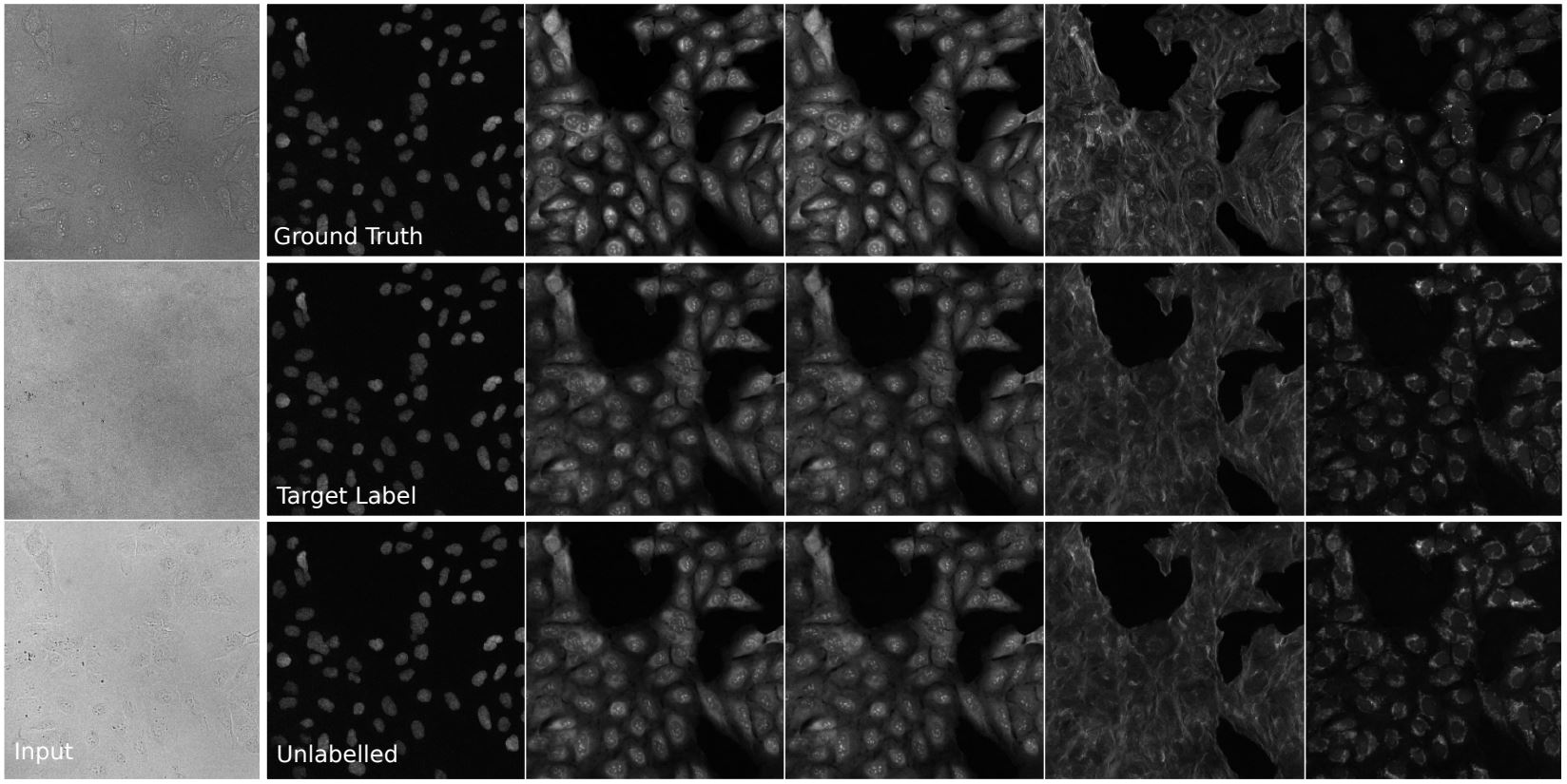
- The model is trained on a subset of the JUMP-CP Target2 dataset, using 3-channel brightfield images as input and 5-channel Cell Painting images as targets.
- Class labels are embedded via a learned projection head and used in the denoising process through classifier guidance, which steers the diffusion process toward desired phenotypic outputs.
- The framework supports both full-plate and active-subset training regimes to assess label quality and data sparsity effects.
- Performance is evaluated using image metrics (FID, SSIM), feature correlation with CellProfiler, and downstream target matching in mechanism-of-action prediction tasks.
Experimental results
Research questions
- RQ1Can discrete class labels improve the quality and biological relevance of image-to-image diffusion reconstructions in microscopy?
- RQ2Does incorporating perturbation labels enhance downstream drug profiling tasks such as mechanism-of-action prediction and clustering?
- RQ3How does the quality of training data—particularly the inclusion of inactive or noisy samples—affect the performance of class-guided diffusion models?
- RQ4To what extent do class-guided models outperform unguided image-to-image baselines in feature fidelity and image reconstruction metrics?
Key findings
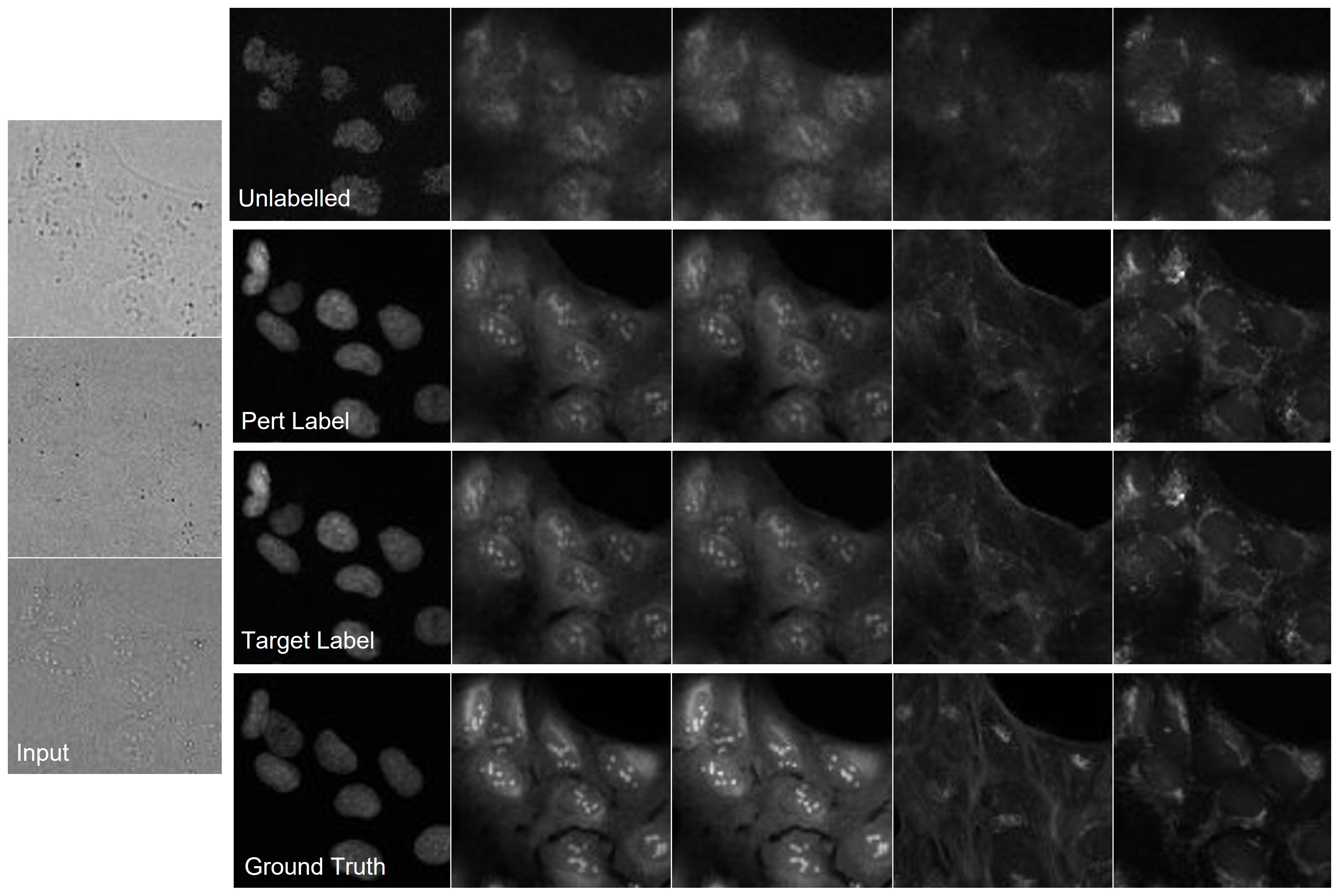
- When trained on the active subset of perturbations, the class-guided model achieved the highest correlation with ground-truth morphological features from CellProfiler, outperforming the unguided Palette model.
- The model improved structural similarity (SSIM) and target matching accuracy in mechanism-of-action prediction, even with a smaller training set, demonstrating robustness to data scarcity.
- Using perturbation labels as conditioning improved target matching by 15% compared to the unguided model, indicating better phenotypic generalization.
- The model trained on the full plate with perturbation labels achieved the lowest FID score (14.2), though it introduced some background noise, suggesting a trade-off between image fidelity and biological relevance.
- Classifier guidance improved target matching but slightly reduced image and feature quality, indicating a need for careful label selection.
- The results show that high-quality, biologically informative labels are critical—poor or uninformative labels can degrade image quality and mislead the model.
Better researchstarts right now
From reading papers to final review, dramatically reduce your research time.
No credit card · Free plan available
This review was created by AI and reviewed by human editors.