
[Paper Review] Classical-to-Quantum Transfer Learning for Spoken Command Recognition Based on Quantum Neural Networks
This paper proposes a hybrid classical-to-quantum transfer learning framework for spoken command recognition using a variational quantum circuit (VQC) integrated with a classical 1D CNN. Pre-trained classical features are transferred to the quantum component, enabling efficient fine-tuning on NISQ devices; simulations show the method achieves 94.58% accuracy with 0.00096 MB parameters—surpassing baseline CNN-QNN and approaching classical CNN-DNN performance despite minimal quantum parameters.
This work investigates an extension of transfer learning applied in machine learning algorithms to the emerging hybrid end-to-end quantum neural network (QNN) for spoken command recognition (SCR). Our QNN-based SCR system is composed of classical and quantum components: (1) the classical part mainly relies on a 1D convolutional neural network (CNN) to extract speech features; (2) the quantum part is built upon the variational quantum circuit with a few learnable parameters. Since it is inefficient to train the hybrid end-to-end QNN from scratch on a noisy intermediate-scale quantum (NISQ) device, we put forth a hybrid transfer learning algorithm that allows a pre-trained classical network to be transferred to the classical part of the hybrid QNN model. The pre-trained classical network is further modified and augmented through jointly fine-tuning with a variational quantum circuit (VQC). The hybrid transfer learning methodology is particularly attractive for the task of QNN-based SCR because low-dimensional classical features are expected to be encoded into quantum states. We assess the hybrid transfer learning algorithm applied to the hybrid classical-quantum QNN for SCR on the Google speech command dataset, and our classical simulation results suggest that the hybrid transfer learning can boost our baseline performance on the SCR task.
Motivation & Objective
- To address the inefficiency of training end-to-end hybrid classical-quantum neural networks from scratch on noisy intermediate-scale quantum (NISQ) devices.
- To explore whether pre-trained classical models can enhance the performance of quantum neural networks in spoken command recognition (SCR).
- To develop a transfer learning strategy that leverages classical feature extraction networks to initialize the classical component of a hybrid CNN-QNN model.
- To evaluate the robustness and effectiveness of the hybrid transfer learning approach under both noiseless and noisy quantum circuit conditions.
Proposed method
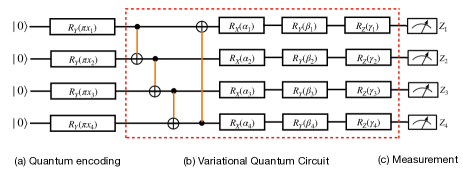
- A hybrid CNN-QNN architecture is designed, where a 1D CNN extracts classical speech features and a variational quantum circuit (VQC) performs classification using quantum states.
- The classical CNN component is initialized using a pre-trained CNN-DNN model, reducing the need for full retraining from scratch.
- Two transfer learning variants are implemented: CNN-QNN_2 fixes the CNN and fine-tunes only the VQC parameters; CNN-QNN_3 jointly fine-tunes both CNN and VQC components.
- Quantum state encoding maps low-dimensional classical features into quantum embeddings using 8 channel wires and 4 repeated VQC layers, resulting in 96 trainable parameters.
- Simulations are conducted on the Google Speech Commands dataset using both noiseless and noisy quantum circuits emulated via Pennylane-Qiskit with real IBM Q 20-qubit device noise profiles.
- Model performance is evaluated using cross-entropy loss and classification accuracy on test sets, comparing against classical baselines and prior QNN models.
Experimental results
Research questions
- RQ1Can pre-trained classical deep learning models be effectively transferred to initialize the classical component of a hybrid classical-quantum neural network for spoken command recognition?
- RQ2Does hybrid classical-to-quantum transfer learning improve classification accuracy and reduce model complexity compared to training a hybrid CNN-QNN from scratch?
- RQ3How does the performance of the hybrid transfer learning framework scale under noisy quantum circuit conditions typical of NISQ devices?
- RQ4Can the proposed method achieve competitive performance with significantly fewer parameters than classical DNN baselines?
Key findings
- The CNN-QNN_2 model, which fixes the pre-trained CNN and fine-tunes only the VQC, achieves 94.58% test accuracy with only 0.00096 MB parameters—slightly outperforming the classical CNN-DNN (94.42% accuracy) while using vastly fewer parameters.
- The CNN-QNN_3 model, which jointly fine-tunes both CNN and VQC components, achieves the highest test accuracy of 94.87% under noiseless conditions, demonstrating the benefit of full parameter optimization.
- Under noisy quantum circuits, the CNN-QNN_2 model maintains strong performance with 93.38% accuracy and 0.274 cross-entropy loss, remaining competitive with the classical CNN-DNN baseline (94.42% accuracy, 0.251 loss).
- The CNN-QNN_3 model achieves 93.84% accuracy under noisy conditions, showing that joint fine-tuning preserves performance despite noise, though not surpassing the classical baseline.
- The hybrid transfer learning approach significantly reduces the number of trainable parameters in the quantum component while maintaining or improving classification performance, indicating high efficiency for NISQ-era quantum machine learning.
- The results suggest that future fault-tolerant quantum computers could further enhance the performance of the hybrid transfer learning framework, especially for models like CNN-QNN_3 that jointly optimize classical and quantum components.

Read this paper
Open the full text in the Nubint reader and ask about any passage as you read.
Read this paper on NubintThis review was generated by AI from the original paper. Please check the paper before citing it.