
[Paper Review] Classification of symmetry-enriched topological quantum spin liquids
This paper presents a comprehensive framework to classify symmetry-enriched topological quantum spin liquids (SETQSLs) in two dimensions, accommodating arbitrary global symmetries—including lattice, internal, anti-unitary, and anyon-permuting symmetries—across all topological orders, Abelian and non-Abelian. The method uses anomaly indicators and Lieb-Schwinger-Mattis-type anomalies to distinguish SETQSLs with identical symmetry groups but different lattice realizations, successfully identifying previously inaccessible phases such as 'beyond-parton' $ζ_2$ SETQSLs.
We present a systematic framework to classify symmetry-enriched topological quantum spin liquids in two spatial dimensions. This framework can deal with all topological quantum spin liquids, which may be either Abelian or non-Abelian, chiral or non-chiral. It can systematically treat a general symmetry, which may include both lattice symmetry and internal symmetry, may contain anti-unitary symmetry, and may permute anyons. The framework applies to all types of lattices, and can systematically distinguish different lattice systems with the same symmetry group using their Lieb-Schultz-Mattis anomalies. We apply this framework to classify $U(1)_{2N}$ chiral states and non-Abelian Ising$^{(ν)}$ states enriched by a $p6 imes SO(3)$ or $p4 imes SO(3)$ symmetry, and $\mathbb{Z}_N$ topological orders and $U(1)_{2N} imes U(1)_{-2N}$ topological orders enriched by a $p6m imes SO(3) imes\mathbb{Z}_2^T$, $p4m imes SO(3) imes\mathbb{Z}_2^T$, $p6m imes\mathbb{Z}_2^T$ or $p4m imes\mathbb{Z}_2^T$ symmetry, where $p6$, $p4$, $p6m$ and $p4m$ are lattice symmetries, while $SO(3)$ and $\mathbb{Z}_2^T$ are spin rotation and time reversal symmetries, respectively. In particular, we identify symmetry-enriched topological quantum spin liquids that are not easily captured by the usual parton-mean-field approach, including examples with the familiar $\mathbb{Z}_2$ topological order.
Motivation & Objective
- To develop a systematic classification framework for symmetry-enriched topological quantum spin liquids (SETQSLs) in two spatial dimensions.
- To address the limitations of the parton-mean-field approach, especially for non-Abelian and higher-$N$ anyonic topological orders.
- To incorporate general symmetry groups, including space groups (e.g., $p6$, $p4m$), internal symmetries ($SO(3)$), and time-reversal ($\mathbb{Z}_2^T$), including anti-unitary and anyon-permuting symmetries.
- To distinguish between different lattice systems with the same global symmetry group using Lieb-Schultz-Mattis anomalies.
- To identify and classify previously inaccessible SETQSL phases, such as 'beyond-parton' $ζ_2$ topological orders.
Proposed method
- Utilizes a universal characterization of topological order, global symmetry, and their anomalies, including crystalline anomalies.
- Applies the crystalline equivalence principle to relate anomalies in different lattice systems with the same space group.
- Employs anomaly indicators derived from group cohomology and symmetry fractionalization classes to detect and classify SET phases.
- Uses Lieb-Schultz-Mattis (LSM) anomalies to distinguish SETQSLs with identical global symmetry but different lattice realizations.
- Constructs explicit symmetry fractionalization patterns and anyon permutation rules for various topological orders under different symmetry groups.
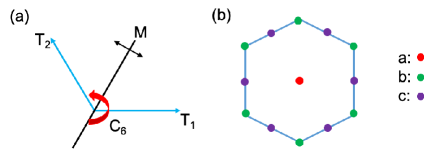
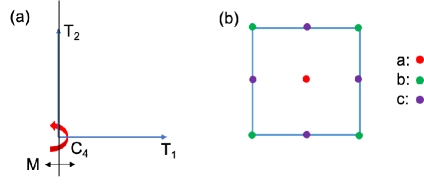
- Applies the framework to classify $U(1)_{2N}$, Ising ($\nu$), $\mathbb{Z}_N$, and $U(1)_{2N} \times U(1)_{-2N}$ topological orders under $p6\times SO(3)$, $p4\times SO(3)$, $p6m\times SO(3)\times\mathbb{Z}_2^T$, and $p4m\times \mathbb{Z}_2^T$ symmetries.
Experimental results
Research questions
- RQ1How can symmetry-enriched topological quantum spin liquids be systematically classified when both lattice and internal symmetries—especially anti-unitary and anyon-permuting ones—are present?
- RQ2What role do Lieb-Schultz-Mattis anomalies play in distinguishing SETQSLs with identical global symmetry groups but different lattice structures?
- RQ3Can the framework classify SETQSLs that are not accessible via the standard parton-mean-field approach, such as non-Abelian or higher-$N$ anyonic orders?
- RQ4What are the distinct symmetry fractionalization classes and anyon permutation patterns for $\mathbb{Z}_2$ topological order under $p4m\times \mathbb{Z}_2^T$ symmetry?
- RQ5How do anomaly indicators and group cohomology data determine the possible SET phases for $U(1)_{2N}$ and $U(1)_{2N}\times U(1)_{-2N}$ topological orders?
Key findings
- The framework successfully classifies $U(1)_{2N}$ chiral spin liquids and non-Abelian Ising ($\nu$) states under $p6\times SO(3)$ and $p4\times SO(3)$ symmetries, including cases with anyon permutation.
- It identifies 53 distinct symmetry fractionalization classes for $\mathbb{Z}_2$ topological order under $p4m\times \mathbb{Z}_2^T$ symmetry, including previously inaccessible 'beyond-parton' phases.
- The method distinguishes different lattice systems with the same global symmetry group via their Lieb-Schultz-Mattis anomalies, resolving ambiguities in SET classification.
- For $U(1)_{2N}\times U(1)_{-2N}$ topological orders, the framework reveals new SET phases under $p6m\times SO(3)\times\mathbb{Z}_2^T$ and $p4m\times \mathbb{Z}_2^T$ symmetries.
- The analysis shows that $\mathbb{Z}_N$ topological orders with $N\geq 3$ can be systematically classified using this anomaly-based approach, overcoming limitations of the parton method.
- The framework detects and classifies SET phases where time-reversal symmetry permutes anyons, such as in $p4m\times \mathbb{Z}_2^T$ systems, using anomaly indicators derived from $\mathbb{Z}_2$ cohomology.
Better researchstarts right now
From reading papers to final review, dramatically reduce your research time.
No credit card · Free plan available
This review was created by AI and reviewed by human editors.