
[Paper Review] CLCC: Contrastive Learning for Color Constancy
CLCC proposes a fully supervised contrastive learning framework for color constancy that improves robustness and accuracy by constructing illuminant-dependent features through novel raw-domain color augmentations. It achieves state-of-the-art performance on NUS-8 with 17.5% relative error reduction and 28.7% lower worst-case error in data-sparse regions, without increasing model complexity.
In this paper, we present CLCC, a novel contrastive learning framework for color constancy. Contrastive learning has been applied for learning high-quality visual representations for image classification. One key aspect to yield useful representations for image classification is to design illuminant invariant augmentations. However, the illuminant invariant assumption conflicts with the nature of the color constancy task, which aims to estimate the illuminant given a raw image. Therefore, we construct effective contrastive pairs for learning better illuminant-dependent features via a novel raw-domain color augmentation. On the NUS-8 dataset, our method provides $17.5\%$ relative improvements over a strong baseline, reaching state-of-the-art performance without increasing model complexity. Furthermore, our method achieves competitive performance on the Gehler dataset with $3 imes$ fewer parameters compared to top-ranking deep learning methods. More importantly, we show that our model is more robust to different scenes under close proximity of illuminants, significantly reducing $28.7\%$ worst-case error in data-sparse regions.
Motivation & Objective
- To address the challenge of learning spurious correlations in deep color constancy models that rely on scene content rather than illuminant features.
- To improve model robustness in data-sparse regions, especially under low-illumination conditions.
- To develop a contrastive learning framework tailored for color constancy, overcoming limitations of standard augmentations used in image classification.
- To achieve state-of-the-art performance without increasing model complexity or requiring additional data.
Proposed method
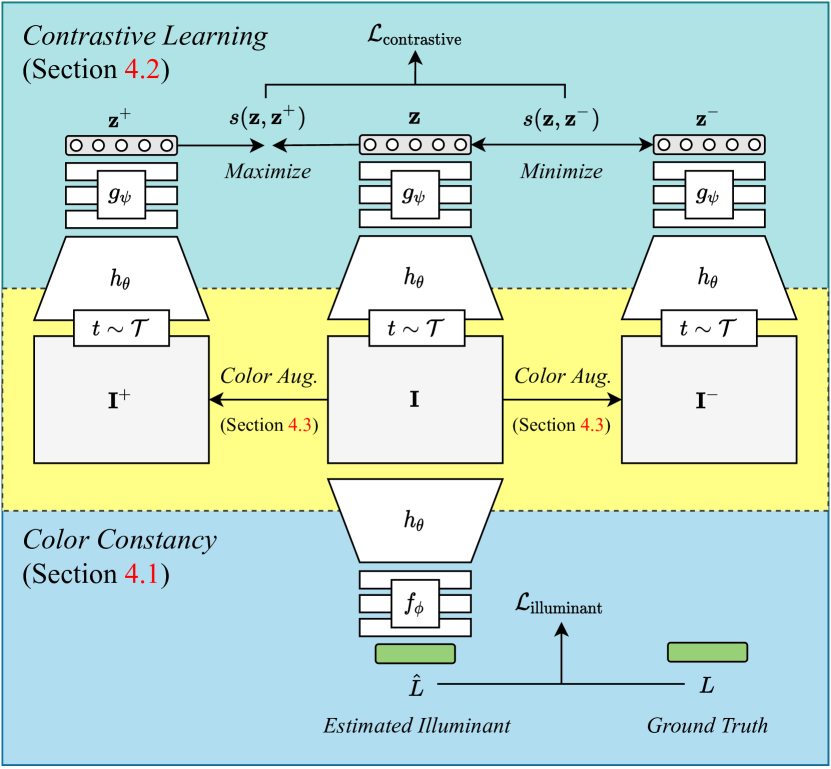
- CLCC constructs contrastive pairs using label information, ensuring positive pairs are from the same scene under different illuminants and negative pairs are from different scenes under the same illuminant.
- A novel raw-domain color augmentation is proposed, based on color domain knowledge, to generate realistic and informative contrastive samples while preserving linear relationships to scene radiance.
- The framework uses a fully supervised contrastive learning objective, where positive pairs are explicitly defined using illuminant and scene labels, enhancing feature discrimination.
- The method leverages a strong baseline (SqueezeNet-FC4) and applies contrastive learning without architectural changes, maintaining model complexity.
- Color augmentations include Full-Aug (full chromatic color mapping via color checker) and WB-Aug (white balance-based neutral color mapping), both designed to preserve illuminant sensitivity.
- The model is trained using a contrastive loss that pushes representations of the same scene under different illuminants apart, while pulling representations of different scenes under the same illuminant together.

Experimental results
Research questions
- RQ1Can fully supervised contrastive learning improve feature representations for color constancy by explicitly constructing positive and negative pairs based on illuminant and scene labels?
- RQ2Can novel, illuminant-aware color augmentations in the raw domain enhance contrastive learning for color constancy without violating linear radiance relationships?
- RQ3Does CLCC improve robustness in data-sparse regions, particularly for rare or extreme illuminants?
- RQ4Can CLCC achieve state-of-the-art performance without increasing model complexity or relying on auxiliary data?
Key findings
- CLCC achieves a 17.5% relative improvement in mean angular error on the NUS-8 dataset, reducing it from 2.23 to 1.84 compared to the SqueezeNet-FC4 baseline.
- On the Gehler dataset, CLCC achieves competitive performance with less than 0.1 performance gap behind the top method C4, despite using 3× fewer parameters.
- CLCC reduces the worst-case error by 28.7% in data-sparse regions (e.g., 16 data points in the pink cluster), from 3.24 to 2.31 on the Gehler dataset.
- The use of WB-Aug alone reduces mean angular error by 13.5% and worst-case error by 16.5% over the baseline, demonstrating effectiveness even without full color mapping.
- Full-Aug further improves performance, reducing mean angular error by an additional 5.1% compared to WB-Aug, showing the benefit of accurate chromatic color synthesis.
- CLCC outperforms FFCC-4 channels on all metrics when no auxiliary data is used, and shows better robustness with lower standard deviation in test error across clusters.
Read this paper
Open the full text in the Nubint reader and ask about any passage as you read.
Read this paper on NubintThis review was generated by AI from the original paper. Please check the paper before citing it.