
[Paper Review] Comets and Planetesimal Formation
This paper reviews planetesimal and comet formation, focusing on dust grain growth to pebbles and subsequent planetesimal formation via gravitational collapse mechanisms like the streaming instability (SI). It compares models—gravitational coagulation versus SI-driven collapse—using data from Rosetta, New Horizons, and KBO surveys, concluding that SI best explains observed structural and thermal properties of comets and binary KBOs.
In this chapter, we review the processes involved in the formation of planetesimals and comets. We will start with a description of the physics of dust grain growth and how this is mediated by gas-dust interactions in planet-forming disks. We will then delve into the various models of planetesimal formation, describing how these planetesimals form as well as their resulting structure. In doing so, we focus on and compare two paradigms for planetesimal formation: the gravitational collapse of particle over-densities (which can be produced by a variety of mechanisms) and the growth of particles into planetesimals via collisional and gravitational coagulation. Finally, we compare the predictions from these models with data collected by the Rosetta and New Horizons missions and that obtained via observations of distant Kuiper Belt Objects.
Motivation & Objective
- To synthesize current understanding of planetesimal and comet formation from dust grains to km-sized bodies.
- To resolve the long-standing problem of how sub-micron grains grow to form planetesimals in protoplanetary disks.
- To compare gravitational coagulation and gravitational collapse models (especially the streaming instability) against observational data.
- To evaluate the consistency of theoretical models with in-situ mission data (Rosetta, New Horizons) and distant KBO surveys (OSSOS).
- To assess the role of laboratory experiments and numerical simulations in constraining formation mechanisms.
Proposed method
- Uses analytical models and numerical simulations to study dust grain growth and particle dynamics in protoplanetary disks.
- Applies the particle stopping time formalism (t_stop = aρ_s / (ρ_g v_th)) to model aerodynamic coupling between solids and gas.
- Evaluates the streaming instability (SI) as a mechanism for concentrating pebbles into overdensities that undergo gravitational collapse.
- Compares predictions of SI-driven collapse with those of gravitational coagulation in terms of size distribution and structural properties.
- Integrates observational data from Rosetta (comet 67P), New Horizons (Arrokoth), and OSSOS to test model outcomes.
- Uses laboratory experiments on particle sticking and collisional behavior to inform model parameters and validate assumptions.
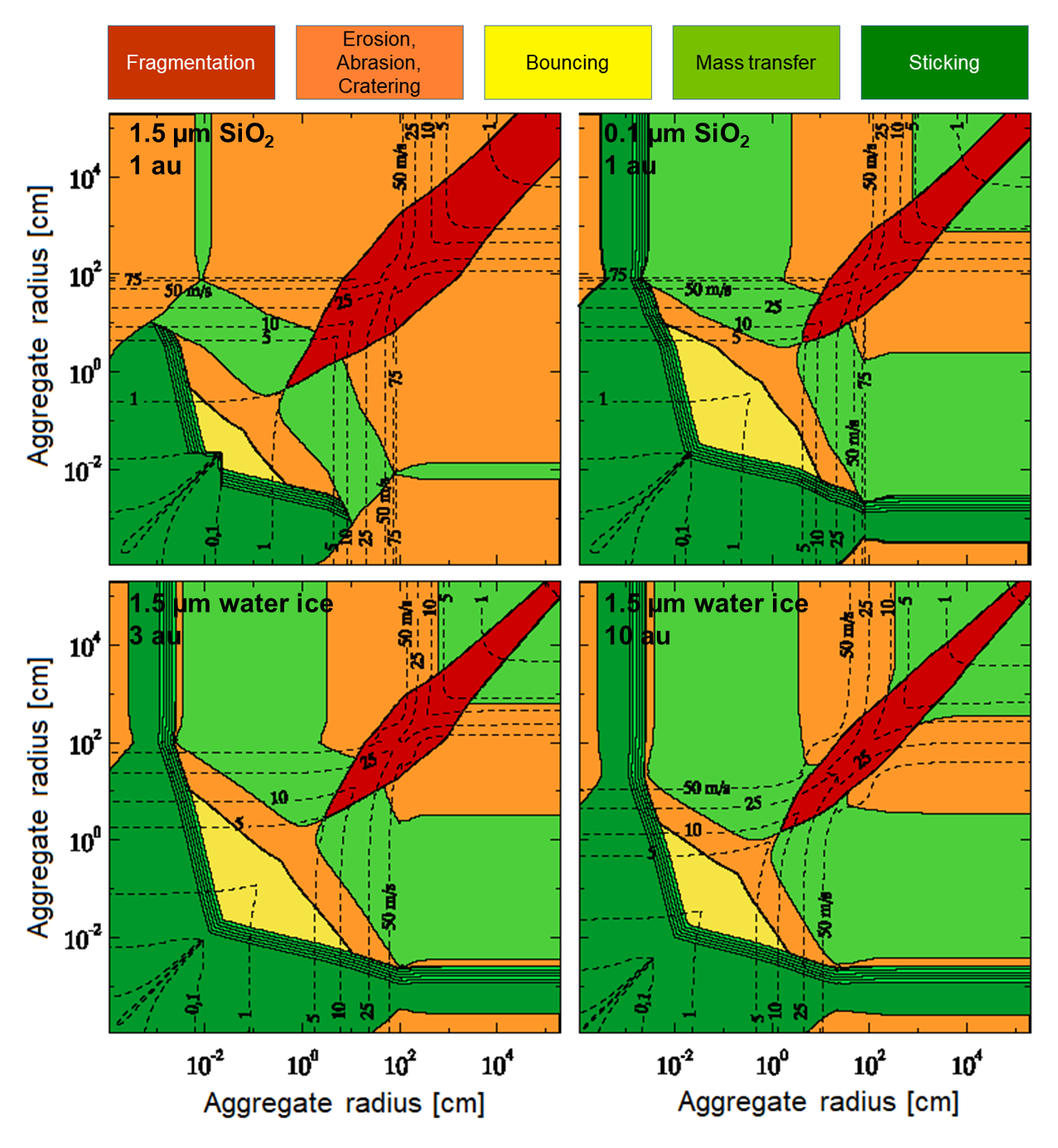
Experimental results
Research questions
- RQ1How do sub-micron dust grains grow to mm–cm-sized pebbles in protoplanetary disks?
- RQ2What mechanisms enable pebbles to further collapse into km-sized planetesimals?
- RQ3How do the structural and thermal properties of comets (evidenced by Rosetta) constrain planetesimal formation models?
- RQ4To what extent do the orbital and physical properties of Kuiper Belt Object binaries support the streaming instability over gravitational coagulation?
- RQ5What role do laboratory experiments play in validating theoretical models of planetesimal formation?
Key findings
- The streaming instability (SI) is strongly supported by Rosetta data, which show cometary nuclei with porous, volatile-rich structures consistent with gravitational collapse of pebble clouds.
- Kuiper Belt Object binary systems exhibit orbital characteristics that match SI simulations better than gravitational coagulation models.
- The discrepancy in size distributions between SI simulations and observations may stem from numerical resolution limits or incomplete parameter space sampling.
- Laboratory experiments confirm that fluffy, porous aggregates can survive collisions and retain volatile inventory, supporting the SI formation pathway.
- Next-generation telescopes (ALMA, JWST) and surveys (Vera C. Rubin Observatory) are expected to significantly expand observational constraints on planetesimal formation.
- The combination of improved numerical models, new missions (Lucy, Psyche), and multi-wavelength observations is driving rapid progress toward resolving planetesimal formation mechanisms.
Read this paper
Open the full text in the Nubint reader and ask about any passage as you read.
Read this paper on NubintThis review was generated by AI from the original paper. Please check the paper before citing it.