
[Paper Review] Composite Fermi Liquid at Zero Magnetic Field in Twisted MoTe$_2$
The paper demonstrates a zero-field composite Fermi liquid (CFL) phase in twisted MoTe2 at half filling, supported by ED and iDMRG studies, and provides a zero-field CFL wavefunction and experimental signatures distinguishing it from a Fermi liquid.
The pursuit of exotic phases of matter outside of the extreme conditions of a quantizing magnetic field is a long-standing quest of solid state physics. Recent experiments have observed spontaneous valley polarization and fractional Chern insulators in zero magnetic field in twisted bilayers of MoTe_{2}, at partial filling of the topological valence band (ν=-2/3 and -3/5). We study the topological valence band at half filling, using exact diagonalization and density matrix renormalization group calculations. We discover a composite Fermi liquid (CFL) phase even at zero magnetic field that covers a large portion of the phase diagram near twist angle ∼3.6°. The CFL is a non-Fermi liquid phase with metallic behavior despite the absence of Landau quasiparticles. We discuss experimental implications including the competition between the CFL and a Fermi liquid, which can be tuned with a displacement field. The topological valence band has excellent quantum geometry over a wide range of twist angles and a small bandwidth that is, remarkably, reduced by interactions. These key properties stabilize the exotic zero field quantum Hall phases. Finally, we present an optical signature involving "extinguished" optical responses that detects Chern bands with ideal quantum geometry.
Motivation & Objective
- Motivate search for exotic zero-field quantum Hall-like phases in twisted TMDs without external magnetic fields.
- Identify and characterize a gapless CFL phase at half filling in twisted MoTe2 near a 3.6° twist angle.
- Show how quantum geometry and interaction-driven bandwidth suppression stabilize zero-field CFLs.
- Provide a concrete zero-field CFL wavefunction construction and connect to experimental observables.
Proposed method
- Use exact diagonalization (ED) and density matrix renormalization group (DMRG) to study the top valence band at half filling.
- Project the interacting Hamiltonian into the nearly flat C=1 top valence band with gate-screened Coulomb interactions.
- Compute the many-body spectrum, ground-state degeneracies, and structure factors to identify CFL signatures.
- Construct a zero-field CFL wavefunction inspired by LLL-like structures and a band-parton interpretation.
- Compare low-energy spectra to the lowest Landau level (LLL) at half filling to establish CFL identity.
- Propose optical and transport probes based on the ideal quantum geometry of the band.
Experimental results
Research questions
- RQ1Can a gapless composite Fermi liquid exist at zero magnetic field in a realistic moiré TMD system?
- RQ2How does the zero-field CFL compete with a Fermi liquid and with layer/polarization instabilities under displacement fields?
- RQ3What are the explicit wavefunctions and experimental signatures that distinguish a zero-field CFL from conventional Fermi liquids?
- RQ4How do quantum geometry and interaction-driven bandwidth renormalization stabilize zero-field topological phases in twisted MoTe2?
Key findings
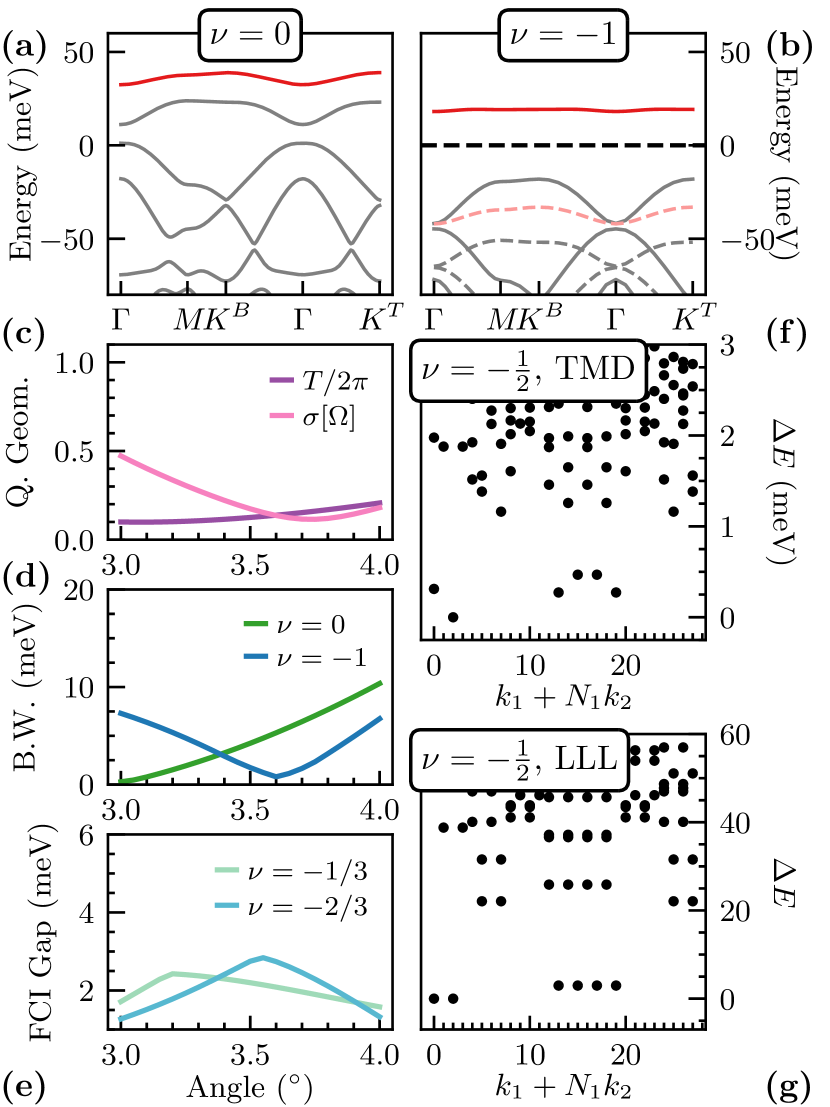
- A CFL phase is observed at ν = −1/2 (and also ν = −3/4 in SM) near θ ≈ 3.6° in twisted MoTe2, evidenced by CFL-like low-energy spectra and structure factors.
- The CFL ground state shares a one-to-one spectral correspondence with the half-filled LLL under Coulomb interactions, across system sizes N_e = 8–14.
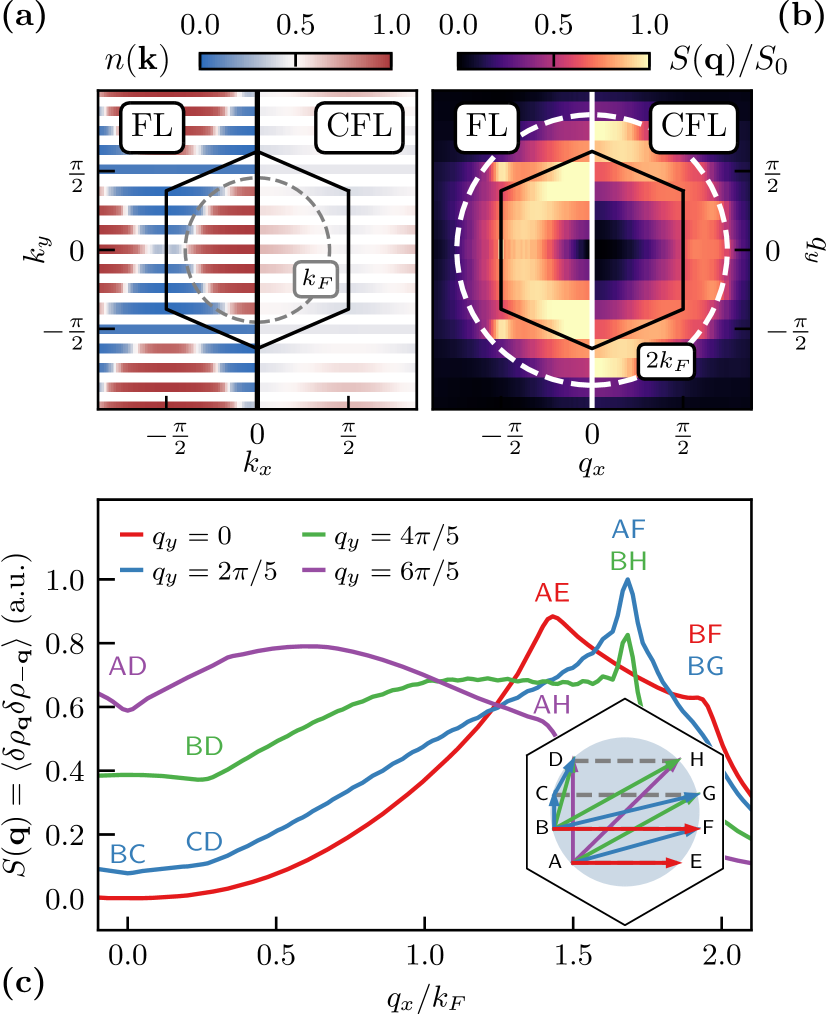
- iDMRG reveals quasi-uniform occupation with no electron Fermi surface, indicating non-Fermi liquid composite fermions.
- The structure factor S(q) shows features consistent with scattering across a composite Fermi sea, matching expectations for a CFS.
- An explicit zero-field CFL wavefunction is proposed, combining a flux-feeling part with a band-projected CF determinant and a zeta_l(r) factor.
- The top valence band exhibits nearly ideal quantum geometry with small T and Berry curvature deviations, aiding stabilization of zero-field quantum Hall-like phases.
- Optical signatures include extinguished circular dichroism for left-circular transitions due to vortexable Chern bands, providing a direct probe of ideal geometry.
Better researchstarts right now
From reading papers to final review, dramatically reduce your research time.
No credit card · Free plan available
This review was created by AI and reviewed by human editors.