
[Paper Review] Compressible quantum phases from conformal field theories in 2+1 dimensions
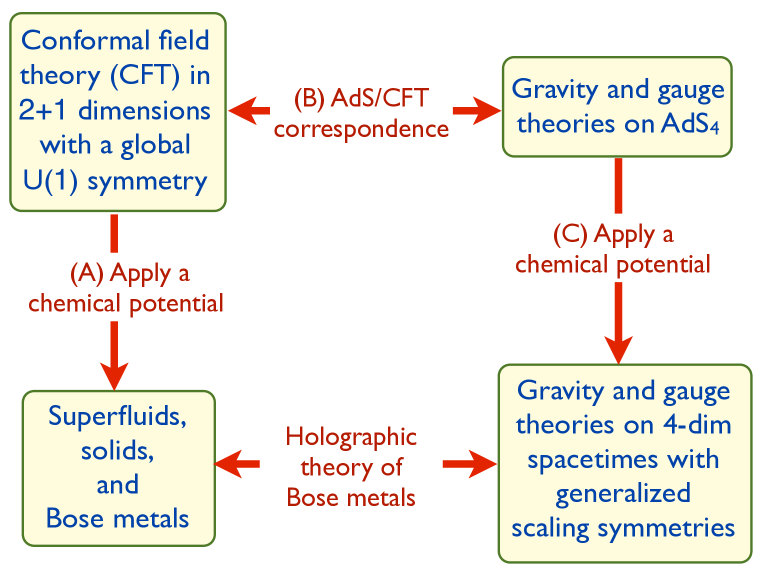
This paper demonstrates that doping 2+1 dimensional conformal field theories (CFT3s) with a chemical potential via S duality leads to compressible quantum phases, including superfluids, solids, and 'Bose metals'—non-Fermi liquids with gauge-charged Fermi surfaces. Monopole operators act as order parameters for solids, with their magnetic charge determining the unit cell size and ensuring integer charge per unit cell, while Bose metals emerge even in purely bosonic CFT3s due to emergent fermionic excitations.
Conformal field theories (CFTs) with a globally conserved U(1) charge Q can be deformed into compressible phases by modifying their Hamiltonian, H, by a chemical potential H -> H - μQ. We study 2+1 dimensional CFTs upon which an explicit S duality mapping can be performed. We find that this construction leads naturally to compressible phases which are superfluids, solids, or non-Fermi liquids which are more appropriately called `Bose metals' in the present context. The Bose metal preserves all symmetries and has Fermi surfaces of gauge-charged fermions, even in cases where the parent CFT can be expressed solely by bosonic degrees of freedom. Monopole operators are identified as order parameters of the solid, and the product of their magnetic charge and Q determines the area of the unit cell. We discuss implications for holographic theories on asymptotically AdS4 spacetimes: S duality and monopole/dyon fields play important roles in this connection.
Motivation & Objective
- To understand the nature of ground states in doped 2+1D conformal field theories (CFT3s) with global U(1) symmetry.
- To investigate how S duality transformations in CFT3s lead to compressible phases such as superfluids, solids, and Bose metals.
- To identify monopole operators as order parameters for solid phases and determine their role in establishing periodic charge density modulation.
- To show that Bose metal phases—non-Fermi liquids with gauge-charged Fermi surfaces—can emerge even in purely bosonic CFT3s, via emergent fermionic degrees of freedom.
- To connect these findings to holographic duals in asymptotically AdS4 spacetimes, emphasizing the role of monopole/dyon fields and S duality.
Proposed method
- Applying a chemical potential to CFT3s to deform them into compressible phases, modifying the Hamiltonian as H → H − μQ.
- Performing explicit S duality transformations on two simple CFT3s: the XY model and the abelian CP^{N-1} model, both with abelian gauge fields and global U(1) symmetry.
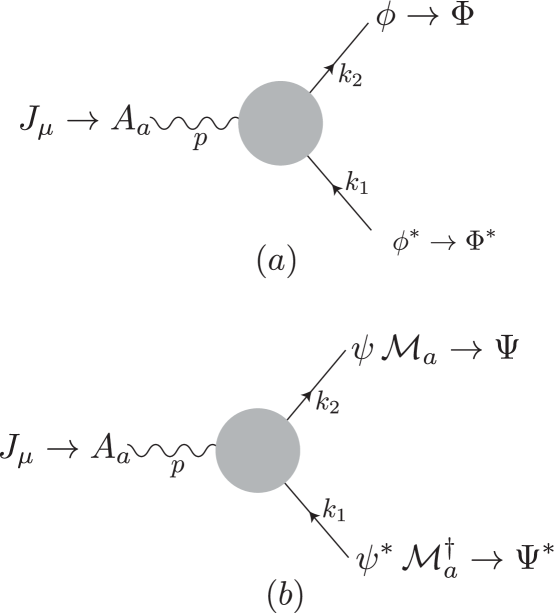
- Using dual lattice formulations and introducing auxiliary gauge fields a_μ and b_μ to map the original CFT to a U(1) × U(1) gauge theory with charged matter fields.
- Introducing monopole and dyon operators via operator insertions with specific η1, η2 parameters to probe duality mappings and identify order parameters.
- Analyzing the resulting actions after integrating out gauge fields and promoting discrete variables to continuous fields, leading to effective field theories with Higgsed and emergent gauge sectors.
- Using the duality framework to identify correlators of monopole operators with specific electric and magnetic charges, linking them to physical order parameters.
Experimental results
Research questions
- RQ1How do S duality transformations in 2+1D CFT3s with global U(1) symmetry lead to compressible quantum phases upon doping with a chemical potential?
- RQ2What is the role of monopole operators as order parameters for solid phases in doped CFT3s, and how do they determine the unit cell structure?
- RQ3Can Bose metal phases—non-Fermi liquids with gauge-charged Fermi surfaces—arise in purely bosonic CFT3s, and if so, how are they stabilized?
- RQ4How do the magnetic charges of monopole condensates relate to the number of doped charges per unit cell in solid phases?
- RQ5What is the connection between these doped CFT3 phases and holographic duals in asymptotically AdS4 spacetimes, particularly regarding electric flux and monopole tunneling?
Key findings
- Doping CFT3s with a chemical potential leads to compressible phases, including superfluids (U(1) symmetry breaking), solids (monopole condensation), and Bose metals (gauge-charged Fermi surfaces).
- Monopole operators serve as order parameters for solid phases, with their magnetic charge determining the unit cell size such that an integer number of doped charges per unit cell is enforced.
- The product of the monopole's magnetic charge and the global U(1) charge Q determines the area of the unit cell, ensuring charge quantization in the solid phase.
- Bose metal phases emerge even in purely bosonic CFT3s (e.g., abelian CP^{N-1} model), hosting Fermi surfaces of emergent gauge-charged fermions despite the absence of fundamental fermions.
- The duality framework identifies specific operator insertions (via η1, η2) that map to physical observables such as z1z2M_b^2 (monopole flux) and z2*z1 (electric charge), confirming the duality mappings.
- In holographic contexts, these phases are linked to electric flux passing through horizons, with monopole tunneling events in the bulk generating Friedel-like oscillations on the boundary, signaling underlying Fermi surfaces.
Better researchstarts right now
From reading papers to final review, dramatically reduce your research time.
No credit card · Free plan available
This review was created by AI and reviewed by human editors.