
[论文解读] Contextuality in entanglement-assisted one-shot classical communication
该论文表明,在噪声条件下,准备上下文性(而非纠缠或 Kochen-Specker 上下文性)是推动纠缠辅助单次经典通信中量子优势的关键因素。它证明了基于加权最大可预测性超图不变量的噪声鲁棒非上下文性不等式,足以使单次成功概率超越经典极限。
We consider the problem of entanglement-assisted one-shot classical communication. In the zero-error regime, entanglement can increase the one-shot zero-error capacity of a family of classical channels following the strategy of Cubitt et al., Phys. Rev. Lett. 104, 230503 (2010). This strategy uses the Kochen-Specker theorem which is applicable only to projective measurements. As such, in the regime of noisy states and/or measurements, this strategy cannot increase the capacity. To accommodate generically noisy situations, we examine the one-shot success probability of sending a fixed number of classical messages. We show that preparation contextuality powers the quantum advantage in this task, increasing the one-shot success probability beyond its classical maximum. Our treatment extends beyond Cubitt et al. and includes, for example, the experimentally implemented protocol of Prevedel et al., Phys. Rev. Lett. 106, 110505 (2011). We then show a mapping between this communication task and a corresponding nonlocal game. This mapping generalizes the connection with pseudotelepathy games previously noted in the zero-error case. Finally, after motivating a constraint we term context-independent guessing, we show that contextuality witnessed by noise-robust noncontextuality inequalities obtained in R. Kunjwal, Quantum 4, 219 (2020), is sufficient for enhancing the one-shot success probability. This provides an operational meaning to these inequalities and the associated hypergraph invariant, the weighted max-predictability, introduced in R. Kunjwal, Quantum 3, 184 (2019). Our results show that the task of entanglement-assisted one-shot classical communication provides a fertile ground to study the interplay of the Kochen-Specker theorem, Spekkens contextuality, and Bell nonlocality.
研究动机与目标
- 识别在零误差范围之外的纠缠辅助单次经典通信中实现量子优势的非经典资源。
- 将 Cubitt 等人先前仅限于投影测量和无噪声环境的策略,扩展至噪声环境和一般测量场景。
- 建立单次通信任务与非局域博弈之间的联系,推广伪telepathy 框架至更一般情形。
- 为噪声鲁棒非上下文性不等式及加权最大可预测性超图不变量提供操作性解释。
- 证明上下文性(而非仅纠缠或非局域性)是提升噪声信道中单次成功概率的关键资源。
提出的方法
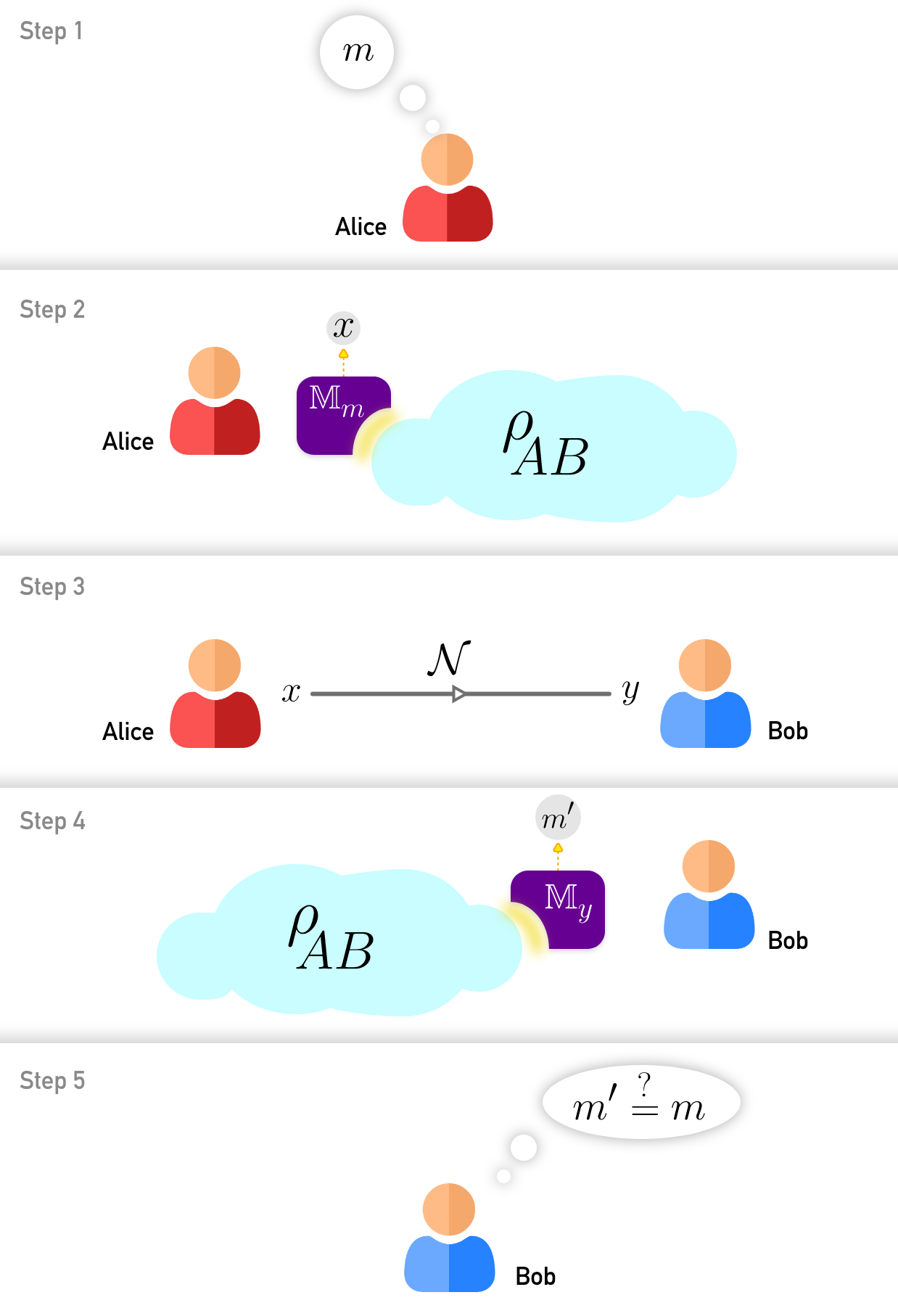
- 形式化了具有共同原因资源(纠缠)的单次经典通信,并在一般噪声态和测量下分析成功概率。
- 引入了上下文无关猜测(CIG)的概念,以在非上下文约束下建模经典策略。
- 使用超图理论工具定义加权最大可预测性,这是一种对噪声具有鲁棒性的上下文性度量。
- 将通信任务映射为非局域博弈,将伪telepathy 框架推广至噪声环境和非零误差设置。
- 将该框架应用于 Prevedel 等人(2011)的已知协议,表明量子优势在噪声下依然存在。
- 证明了通过加权最大可预测性违反噪声鲁棒非上下文性不等式,足以在成功概率上实现量子优势。
实验结果
研究问题
- RQ1当测量和态均存在噪声时,准备上下文性能否解释单次经典通信中的量子优势?
- RQ2此类任务中的量子优势是否对噪声具有鲁棒性?如果是,其背后的非经典资源是什么?
- RQ3单次通信与非局域博弈之间的联系能否超越零误差情形进行推广?
- RQ4加权最大可预测性超图不变量是否足以提升单次成功概率?
- RQ5非投影测量或可联合测量结构能否在此任务中催生新的量子优势形式?
主要发现
- 准备上下文性是实现纠缠辅助单次经典通信中量子优势的关键资源,即使在噪声条件下亦然。
- 当共享态违反噪声鲁棒非上下文性不等式(由加权最大可预测性所见证)时,单次成功概率可超越经典极限。
- 该框架将 Cubitt 等人的策略推广至非投影测量,使其适用于现实中的噪声场景。
- 建立了通信任务与非局域博弈之间的映射,将伪telepathy 关系推广至噪声和非零误差设置。
- 上下文无关猜测(CIG)的假设能够捕捉经典策略,并允许推导出经典成功概率的上界。
- 加权最大可预测性超图不变量具有操作意义:其违反足以在单次通信中实现量子优势。
![Figure 2: The channel hypergraph of the classical channel studied in Ref. [ Prevedel et al. (2011)Prevedel, Lu, Matthews, Kaltenbaek, and Resch ] with the encoding indicated by dashed edges. Here $X=\{00,01,10,11\}$ and $Y=\{(1,0),(1,1),(2,0),(2,1),(P,0),(P,1)\}$ . The support of input $01$ , for ex](https://ar5iv.labs.arxiv.org/html/2006.00469/assets/prevedelchannel.png)
更好的研究,从现在开始
从阅读论文到最终审阅,大幅缩短您的研究时间。
无需绑定信用卡
本解读由 AI 生成,并经人工编辑审核。