
[论文解读] Continuous-time Trajectory Estimation: A Comparative Study Between Gaussian Process and Spline-based Approaches
论文直接比较高斯过程(GP)与基于样条的连续时间轨迹估计,当模型和样条阶数对齐时,在线性与 SE(3) 场景中展示了相近的精度和可比的解算时间。
Continuous-time trajectory estimation is an attractive alternative to discrete-time batch estimation due to the ability to incorporate high-frequency measurements from asynchronous sensors while keeping the number of optimization parameters bounded. Two types of continuous-time estimation have become prevalent in the literature: Gaussian process regression and spline-based estimation. In this paper, we present a direct comparison between these two methods. We first compare them using a simple linear system, and then compare them in a camera and IMU sensor fusion scenario on SE(3) in both simulation and hardware. Our results show that if the same measurements and motion model are used, the two methods achieve similar trajectory accuracy. In addition, if the spline order is chosen so that the degree-of-differentiability of the two trajectory representations match, then they achieve similar solve times as well.
研究动机与目标
- 将连续时间轨迹估计作为离散时间批量估计的替代方法进行动机说明和形式化。
- 开发适用于 GP 基表示与样条基表示的广义运动先验。
- 在线性与 SE(3) 场景中使用仿真和硬件数据对 GP 与样条方法进行公平比较。
- 扩展 GP 运动先验,使其可用于样条估计,从而实现苹果对苹果的评估。
提出的方法
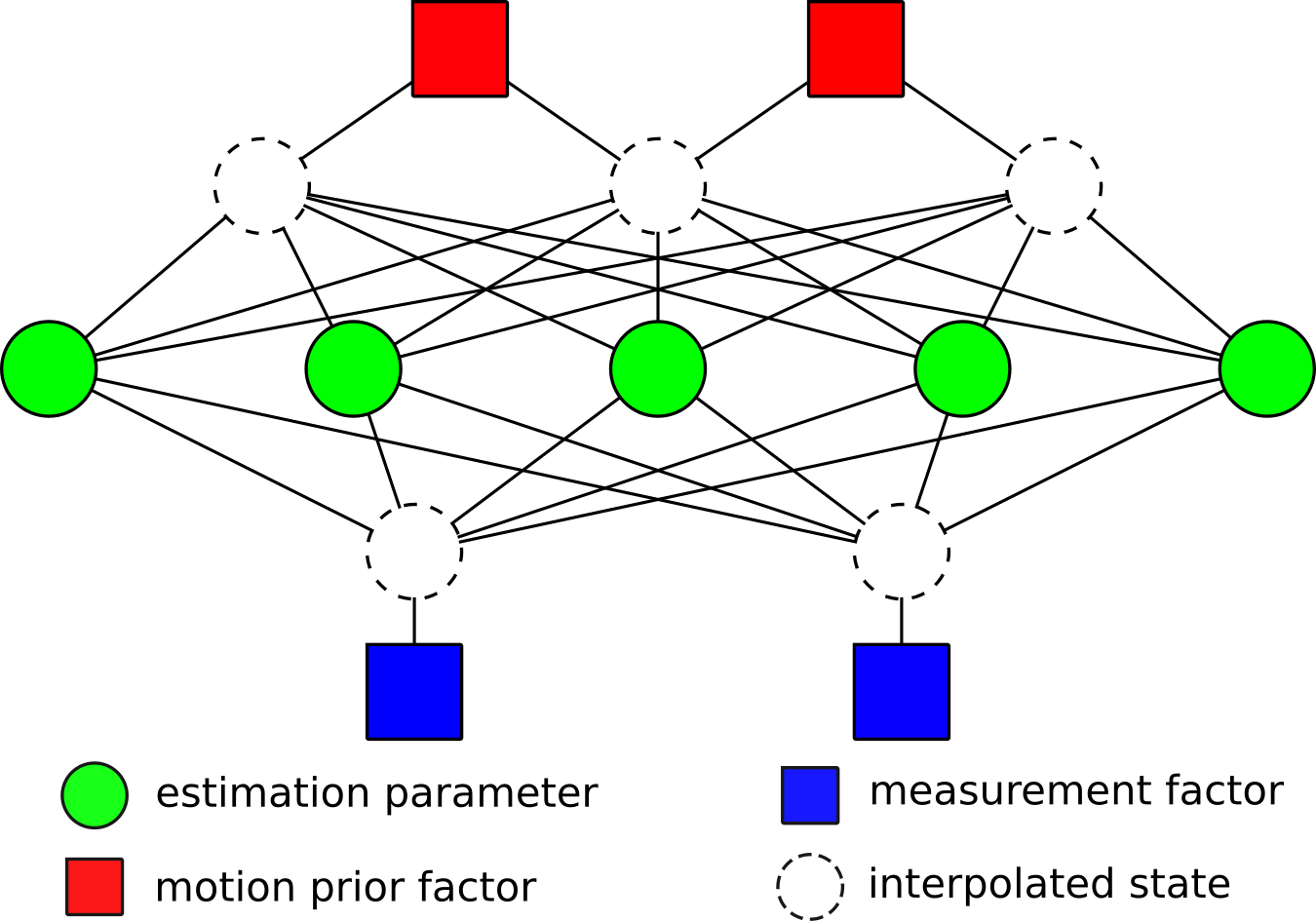
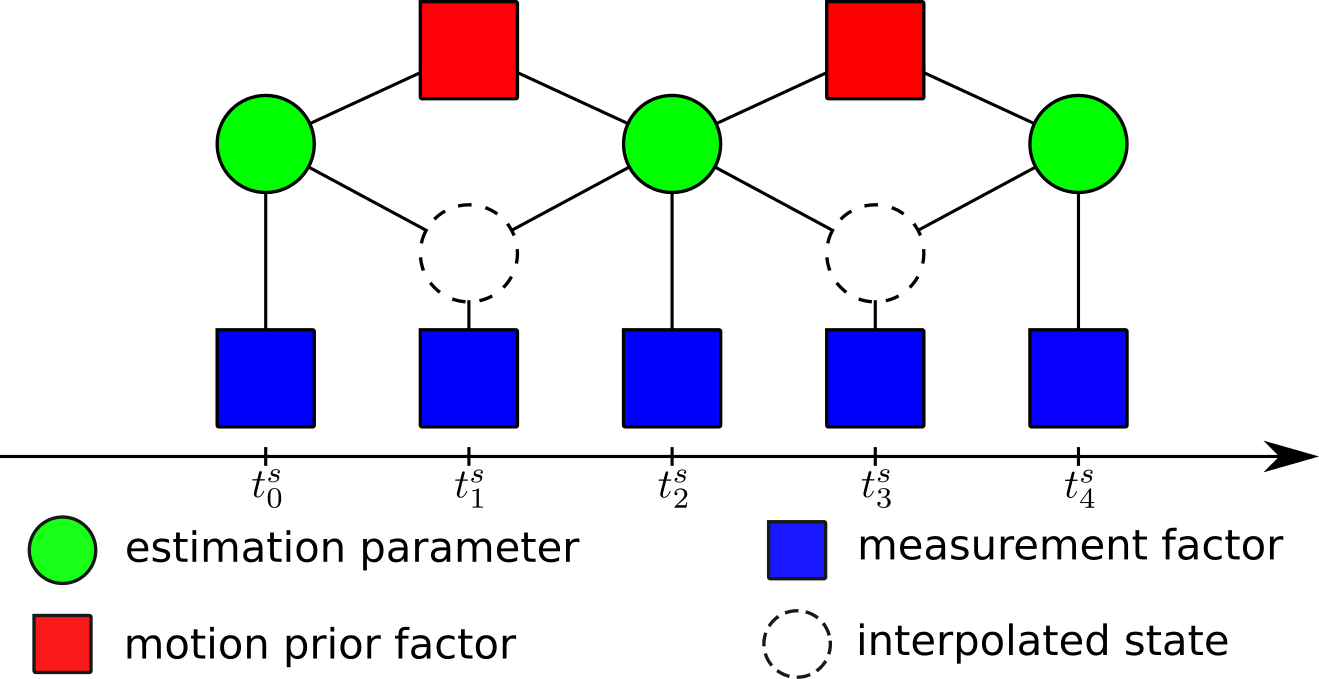
- 用估计参数和一个状态插值函数来表示轨迹,并将参数映射到随时间变化的状态。
- 推广线性系统和李群(SE(3))设定下的运动先验,包括 WNOJ/WNOA 模型及其李群代数表达。
- 推导线性系统和李群(包括方程(19)-(21)和(22)-(24))的 GP 插值公式。
- 推导向量空间和李群上的样条表示,包括 SE(3) 的累计形式与群积形式(方程(27)-(32))。
- 将估计表述为带有测量残差和运动先验项的非线性最小二乘问题(方程(5))。
- 通过两种情境比较基于 GP 的和基于样条的估计:一个线性 WNOJ 系统和 SE(3) 上的相机-惯性测量融合,使用仿真和硬件数据。
实验结果
研究问题
- RQ1当使用相同的测量和运动模型时,基于 GP 的连续时间轨迹估计与基于样条的连续时间轨迹估计是否会产生相似的轨迹精度?
- RQ2在 SE(3) 场景中,当匹配样条阶数以对齐可微分度时,GP 与样条表示的解算时间是否相近?
- RQ3在具有异步/高频测量的线性与 SE(3) 传感器融合问题中,GP 与样条估算器的表现如何?
主要发现
- 在使用相同的测量和运动模型时,GP 与样条方法能够获得相似的轨迹精度。
- 如果样条阶数被选择为使可微分度与 GP 表示相匹配,则这两种方法的解算时间相近。
- 研究覆盖线性和 SE(3) 情况,利用仿真和硬件数据来验证发现。
- 运动先验可以推广为同时用于 GP 与样条表示,从而实现公平比较。
更好的研究,从现在开始
从论文设计到论文写作,大幅缩短您的研究时间。
无需绑定信用卡
本解读由 AI 生成,并经人工编辑审核。