
[Paper Review] Cooperation between electron-phonon coupling and electronic interaction in bilayer nickelates La$_3$Ni$_2$O$_7$
This study reveals that electron-phonon coupling (EPC) alone cannot induce superconductivity in pressurized bilayer nickelate La₃Ni₂O₇, but when combined with electronic interactions, particularly out-of-plane breathing phonons coupling selectively to the Ni $d_{z^2}$ orbital, it significantly enhances $s_{\pm}$-wave pairing and raises the superconducting transition temperature ($T_c$) by 10–40%. The mechanism is orbital-selective and crucial for explaining the observed high-$T_c$ superconductivity (~80 K).
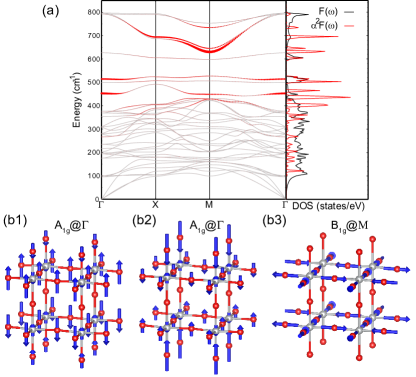
The recent observation of high-T$_c$ superconductivity in the bilayer nickelate La$_3$Ni$_2$O$_7$ under pressure has garnered significant interests. While researches have predominantly focused on the role of electron-electron interactions in the superconducting mechanism, the impact of electron-phonon coupling (EPC) has remained elusive. In this work, we perform first-principles calculations to study the phonon spectrum and electron-phonon coupling within La$_3$Ni$_2$O$_7$ under pressure and explore of the interplay between EPC and electronic interactions on the superconductivity by employing functional renormalization group approach. Our calculations reveal that EPC alone is insufficient to trigger superconductivity in La$_3$Ni$_2$O$_7$ under pressure. We identify unique out-of-plane and in-plane breathing phonon modes which selectively couple with the Ni $d_{z^2}$ and $d_{x^2-y^2}$ orbitals, showcasing an orbital-selective EPC. Within the bilayer two-orbital model, it is revealed that solely electronic interactions foster $s_{\pm}$-wave pairing characterized by notable frustration in the band space, leading to a low transition temperature. Remarkably, we find that this out-of-plane EPC can act in concert with electronic interactions to promote the onsite and interlayer pairing in the $d_{z^2}$ orbital, partially releasing the pairing frustration and thus elevating T$_c$. In contrast, the inclusion of in-plane EPC only marginally affects the superconductivity, distinct from the cuprates. Potential experimental implications in La$_3$Ni$_2$O$_7$ are also discussed.
Motivation & Objective
- To investigate the role of electron-phonon coupling (EPC) in high-$T_c$ superconductivity in bilayer nickelate La₃Ni₂O₇ under high pressure.
- To determine whether EPC alone can drive superconductivity or if it requires synergy with electronic interactions.
- To identify the specific phonon modes and orbital selectivity in EPC that influence pairing symmetry and $T_c$.
- To explore the interplay between EPC and electronic interactions using functional renormalization group (fRG) in a two-orbital model.
- To provide testable predictions for experimental verification of EPC effects in La₃Ni₂O₇
Proposed method
- First-principles density functional theory (DFT) calculations to determine the phonon spectrum and electron-phonon coupling constants in La₃Ni₂O₇ under pressure.
- Functional renormalization group (fRG) approach to study the interplay between electron-electron interactions and EPC in a bilayer two-orbital model.
- Analysis of orbital-selective EPC focusing on out-of-plane and in-plane breathing modes coupling to Ni $d_{z^2}$ and $d_{x^2-y^2}$ orbitals.
- Systematic variation of EPC strength and Hund’s coupling ($J_H$) to assess their impact on superconducting and charge-density wave (CDW) instabilities.
- Calculation of $T_c$ enhancement relative to purely electronic interaction (EI) case under varying EPC parameters.
- Comparison of EPC effects on $s_{\pm}$-wave pairing, including frustration release and transition temperature enhancement
Experimental results
Research questions
- RQ1Can electron-phonon coupling alone induce superconductivity in pressurized La₃Ni₂O₇?
- RQ2Which phonon modes in the bilayer structure exhibit orbital-selective coupling to Ni $d_{z^2}$ and $d_{x^2-y^2}$ orbitals?
- RQ3How does the interplay between electron-phonon coupling and electronic interactions affect the $s_{\pm}$-wave pairing and $T_c$?
- RQ4What is the relative contribution of out-of-plane vs. in-plane EPC to superconductivity enhancement?
- RQ5Can the observed high-$T_c$ superconductivity (~80 K) be explained by the synergy of EPC and electronic correlations?
Key findings
- Electron-phonon coupling (EPC) alone is insufficient to trigger superconductivity in pressurized La₃Ni₂O₇, as confirmed by DFT calculations.
- Out-of-plane breathing phonon modes selectively couple to the Ni $d_{z^2}$ orbital, while in-plane modes couple to $d_{x^2-y^2}$, demonstrating orbital-selective EPC.
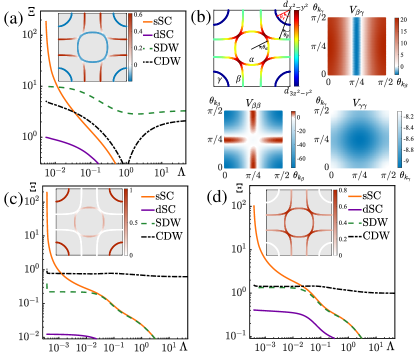
- In the absence of EPC, purely electronic interactions lead to $s_{\pm}$-wave pairing with significant pairing frustration, resulting in a low $T_c$.
- The inclusion of out-of-plane EPC reduces pairing frustration and enhances $T_c$ by 10–40% relative to the electronic interaction-only case for EPC constants $\lambda = 0.1\sim0.2$.
- In contrast, in-plane EPC has only a marginal effect on $T_c$, differing from the dominant role of in-plane phonons in cuprates.
- The observed $T_c$ enhancement is consistent with phonon hardening under pressure, which strengthens out-of-plane EPC and supports the high-$T_c$ superconductivity at ~80 K.
Better researchstarts right now
From reading papers to final review, dramatically reduce your research time.
No credit card · Free plan available
This review was created by AI and reviewed by human editors.