
[Paper Review] Cosmic Simulations of Axion String-Wall Networks: Probing Dark Matter and Gravitational Waves for Discovery
This study uses 3D lattice simulations to model gravitational wave (GW) emissions from axion string-wall networks in the early universe, focusing on QCD axions and axion-like particles (ALPs). It finds that GWs from strings alone are undetectable, but for models with multiple domain walls ($N_{ m DW} > 1$), detectable GW signals emerge in the nano-Hertz to kilo-Hertz band, especially when a bias term stabilizes the walls.
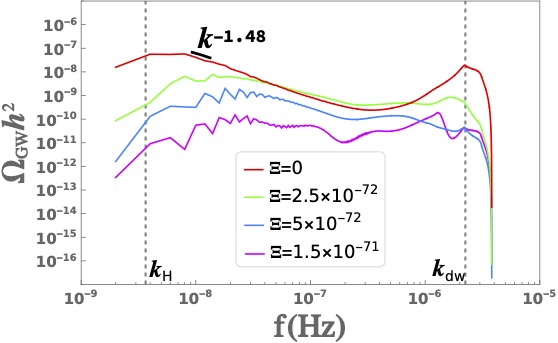
We simultaneously study gravitational waves (GWs) and free axions emitted from axionic string-wall networks in the early universe using advanced 3D lattice simulations. Our simulations start before the Peccei-Quinn phase transition and end with the destruction of string-wall networks below the QCD scale. The axion dark matter (DM) relic abundance radiated from string-wall networks are updated and refined for the scenarios of $N_{ m DW}>1$. In this scenario, we observe that the GW spectrum is almost independent of the bias term and $N_{ m DW}$, and $Ω_{ m GW}h^2\propto f^{1.29}(f^{-0.43})$ in the IR and middle-frequency regions. After considering the constraints from DM relic abundance, we found that the QCD axion model predicts undetectable GW emissions, and the axion-like particles model allows for a detectable GW signal in the nano-Hertz to the milli-Hertz frequency range corresponding to axion masses range from KeV to TeV. For $N_{ m DW}=1$, the GW energy density appears undetectable for QCD axions and axion-like particles.
Motivation & Objective
- To investigate gravitational wave (GW) emissions from axion string-wall networks in the early universe using advanced 3D lattice simulations.
- To determine whether GWs from axion strings and domain walls (DWs) are detectable by current and future GW experiments.
- To examine the role of the domain wall number $N_{ m DW}$ and the bias term in shaping the GW spectrum.
- To assess the detectability of GWs from QCD axions versus axion-like particles (ALPs) in the nano-Hertz to kilo-Hertz frequency range.
- To validate the scaling behavior of string networks and the GW energy density scaling with axion decay constant $f_a$
Proposed method
- Performing 3D lattice simulations of the Peccei-Quinn (PQ) symmetry breaking process, starting before the PQ phase transition and evolving through the QCD era.
- Tracking the time evolution of axion string and domain wall networks, including comoving area density and string separation, to verify scaling behavior.
- Calculating the gravitational wave energy density spectrum $\Omega_{\rm GW}h^2$ using the stress-energy tensor of the string-wall system and redshifting to today's values.
- Comparing GW spectra for $N_{\rm DW} = 1$ (QCD axion model) and $N_{\rm DW} > 1$ (ALP models with bias term), with the bias term explicitly modeled to stabilize DWs.
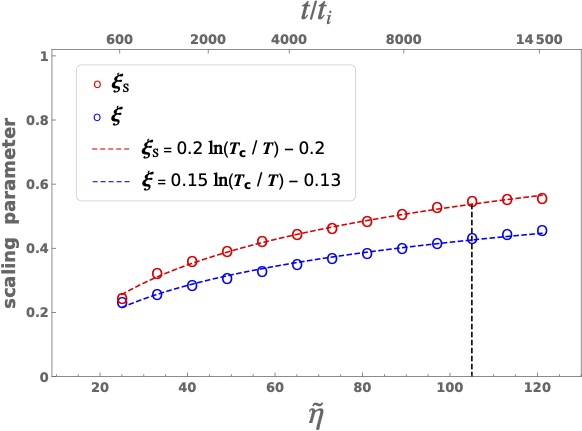
- Using two independent methods to compute the scaling parameter: mean string separation evolution and the standard scaling model, achieving consistent results.
- Applying redshift evolution to the GW spectrum from the final time to today, using the Hubble parameter and scale factor evolution
Experimental results
Research questions
- RQ1What is the amplitude and frequency spectrum of gravitational waves emitted by axion string-wall networks in the early universe?
- RQ2How does the domain wall number $N_{ m DW}$ affect the detectability of gravitational wave signals from axion networks?
- RQ3Can gravitational waves from axion strings and domain walls be detected by current or future experiments such as PTA, LISA, or LIGO?
- RQ4How does the presence of a bias term in the potential affect the longevity and GW emission of domain walls?
- RQ5Does the GW energy density scale as $\Omega_{\rm GW}h^2 \propto (v/M_{\rm pl})^4$ as predicted by analytic models?
Key findings
- For $N_{ m DW} = 1$ (QCD axion model), the peak gravitational wave energy density today is $(\Omega_{\rm GW}h^2)_{\rm QCD} = 5.36 \times 10^{-12}$, which is undetectable by current and future GW experiments.
- For $N_{ m DW} > 1$, the GW spectrum is primarily determined by the coefficient of the bias term in the potential, which stabilizes domain walls and enhances GW emission.
- In the ALP model with $N_{ m DW} > 1$, the peak gravitational wave energy density is $(\Omega_{\rm GW}h^2)_{\rm add} = 3.81 \times 10^{-10}$ during the additional PQ era, indicating a potentially detectable signal.
- The GW spectrum for $N_{ m DW} > 1$ features a detectable peak in the nano-Hertz to kilo-Hertz frequency range, especially when the bias term is non-zero.
- The simulations confirm that the string network enters a scaling regime with a scaling parameter $\xi_{\rm s} = 0.99$, consistent with theoretical expectations.
- The ratio $(\Omega_{\rm GW}h^2)_{\rm add}/(\Omega_{\rm GW}h^2)_{\rm QCD} \approx (v_{\rm add}/v_{\rm re})^4$ confirms the analytic scaling $\Omega_{\rm GW}h^2 \propto (v/M_{\rm pl})^4$ for string-dominated emission.
Read this paper
Open the full text in the Nubint reader and ask about any passage as you read.
Read this paper on NubintThis review was generated by AI from the original paper. Please check the paper before citing it.