
[Paper Review] Critical role of vertical radiative cooling contrast in triggering episodic deluges in small-domain hothouse climates
This study demonstrates that episodic deluges in small-domain hothouse climates are primarily triggered by a strong vertical radiative cooling contrast, not lower-tropospheric radiative heating as previously proposed. The mechanism relies on upper-tropospheric radiative cooling being approximately twice as strong as lower-tropospheric heating, enabling convective inhibition to build and release periodically, with deluge timing governed by radiative and reevaporation cooling timescales.
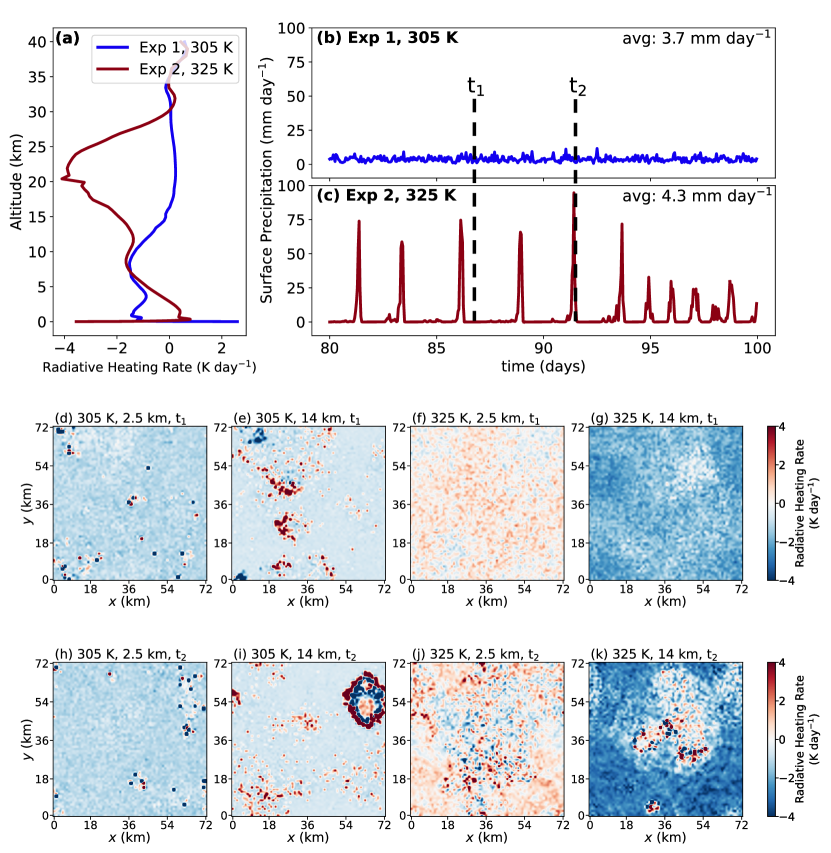
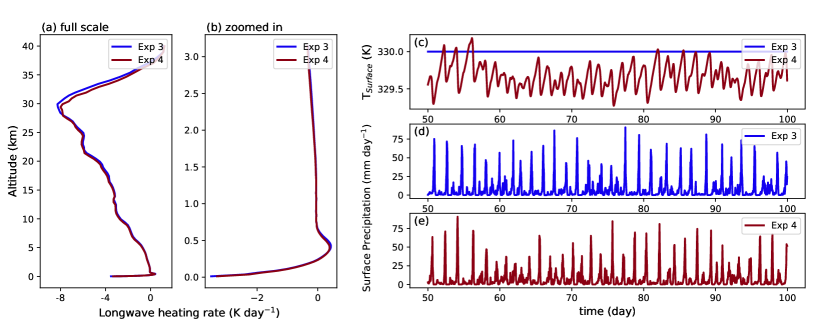
Seeley and Wordsworth (2021) showed that in small-domain cloud-resolving simulations the pattern of precipitation transforms in extremely hot climates ($\ge$ 320 K) from quasi-steady to organized episodic deluges, with outbursts of heavy rain alternating with several dry days. They proposed a mechanism for this transition involving increased water vapor absorption of solar radiation leading to net lower-tropospheric radiative heating. This heating inhibits lower-tropospheric convection and decouples the boundary layer from the upper troposphere during the dry phase, allowing lower-tropospheric moist static energy to build until it discharges, resulting in a deluge. We perform cloud-resolving simulations in polar night and show that the same transition occurs, implying that some revision of their mechanism is necessary. We show that episodic deluges can occur even if the lower-tropospheric radiative heating rate is negative, as long as the magnitude of the upper-tropospheric radiative cooling is about twice as large. We find that in the episodic deluge regime the mean precipitation can be inferred from the atmospheric column energy budget and the period can be predicted from the time for radiation and reevaporation to cool the lower atmosphere.
Motivation & Objective
- To investigate the physical mechanism behind the transition from quasi-steady to episodic deluge precipitation patterns in small-domain, hot climates.
- To test whether lower-tropospheric radiative heating is necessary for episodic deluge formation, as previously suggested.
- To examine the role of vertical radiative cooling contrast and convective inhibition (CIN) in organizing episodic convection.
- To determine if the timing and amplitude of deluges can be predicted from atmospheric energy budgets and radiative cooling timescales.
Proposed method
- Conducted cloud-resolving simulations using the System for Atmospheric Modeling (SAM) in a small domain (72 km × 72 km) under polar night conditions to isolate radiative effects.
- Varied surface temperature to simulate hothouse climates (≥320 K) and analyzed radiative heating/cooling profiles across the troposphere.
- Tracked the evolution of convective inhibition (CIN) and convective available potential energy (CAPE) to assess conditions for convection onset.
- Quantified the time required for radiative and reevaporation processes to cool the lower troposphere, linking it to deluge recurrence periods.
- Analyzed horizontal homogeneity of radiative heating rates to assess its role in synchronizing convection across grid points.
- Used atmospheric column energy budget to infer mean precipitation in the episodic deluge regime.
Experimental results
Research questions
- RQ1Is lower-tropospheric radiative heating necessary for the onset of episodic deluges in hothouse climates?
- RQ2What role does the vertical gradient of radiative cooling play in triggering episodic convection?
- RQ3Can episodic deluges occur when lower-tropospheric heating is negative, provided upper-tropospheric cooling is sufficiently strong?
- RQ4To what extent does the timing of deluges depend on radiative and reevaporation cooling timescales?
- RQ5How does horizontal uniformity of radiative heating influence the spatial and temporal coordination of convection?
Key findings
- Episodic deluges can occur even when lower-tropospheric radiative heating is negative, provided the upper-tropospheric radiative cooling rate is approximately twice as strong.
- The period of episodic deluges is primarily determined by the time required for radiative and reevaporation processes to cool the lower troposphere sufficiently to break convective inhibition.
- The mean precipitation in the episodic deluge regime can be inferred from the atmospheric column energy budget.
- Horizontal homogeneity of radiative heating rates is critical for synchronizing convection across grid points, enabling macroscopic episodic behavior.
- The transition to episodic deluges is not dependent on lower-tropospheric heating but rather on the strength and vertical contrast of radiative cooling.
- The mechanism is robust across different cloud-resolving models and remains valid under polar night conditions, indicating a fundamental role of radiative cooling contrast.
Better researchstarts right now
From reading papers to final review, dramatically reduce your research time.
No credit card · Free plan available
This review was created by AI and reviewed by human editors.