
[Paper Review] FuXi: A cascade machine learning forecasting system for 15-day global weather forecast
FuXi is a cascaded, pre-trained ML weather forecasting system that delivers 15-day global forecasts at 0.25° resolution, achieving ECMWF ensemble-like performance and extending skillful lead times for Z500 and T2M.
Over the past few years, due to the rapid development of machine learning (ML) models for weather forecasting, state-of-the-art ML models have shown superior performance compared to the European Centre for Medium-Range Weather Forecasts (ECMWF)'s high-resolution forecast (HRES) in 10-day forecasts at a spatial resolution of 0.25 degree. However, the challenge remains to perform comparably to the ECMWF ensemble mean (EM) in 15-day forecasts. Previous studies have demonstrated the importance of mitigating the accumulation of forecast errors for effective long-term forecasts. Despite numerous efforts to reduce accumulation errors, including autoregressive multi-time step loss, using a single model is found to be insufficient to achieve optimal performance in both short and long lead times. Therefore, we present FuXi, a cascaded ML weather forecasting system that provides 15-day global forecasts with a temporal resolution of 6 hours and a spatial resolution of 0.25 degree. FuXi is developed using 39 years of the ECMWF ERA5 reanalysis dataset. The performance evaluation, based on latitude-weighted root mean square error (RMSE) and anomaly correlation coefficient (ACC), demonstrates that FuXi has comparable forecast performance to ECMWF EM in 15-day forecasts, making FuXi the first ML-based weather forecasting system to accomplish this achievement.
Motivation & Objective
- Motivate the use of cascaded machine learning models to reduce accumulation errors in long-range weather forecasts.
- Develop FuXi, a cascade ML forecast system producing 15-day forecasts at 0.25° resolution using ERA5 data.
- Show that FuXi can match ECMWF ensemble performance and extend skillful lead times for key variables.
- Demonstrate how FuXi ensemble forecasts provide uncertainty estimates comparable to ECMWF ensemble.
Proposed method
- Use 39 years of ERA5 reanalysis data at 0.25° and 6-hourly cadence to train FuXi.
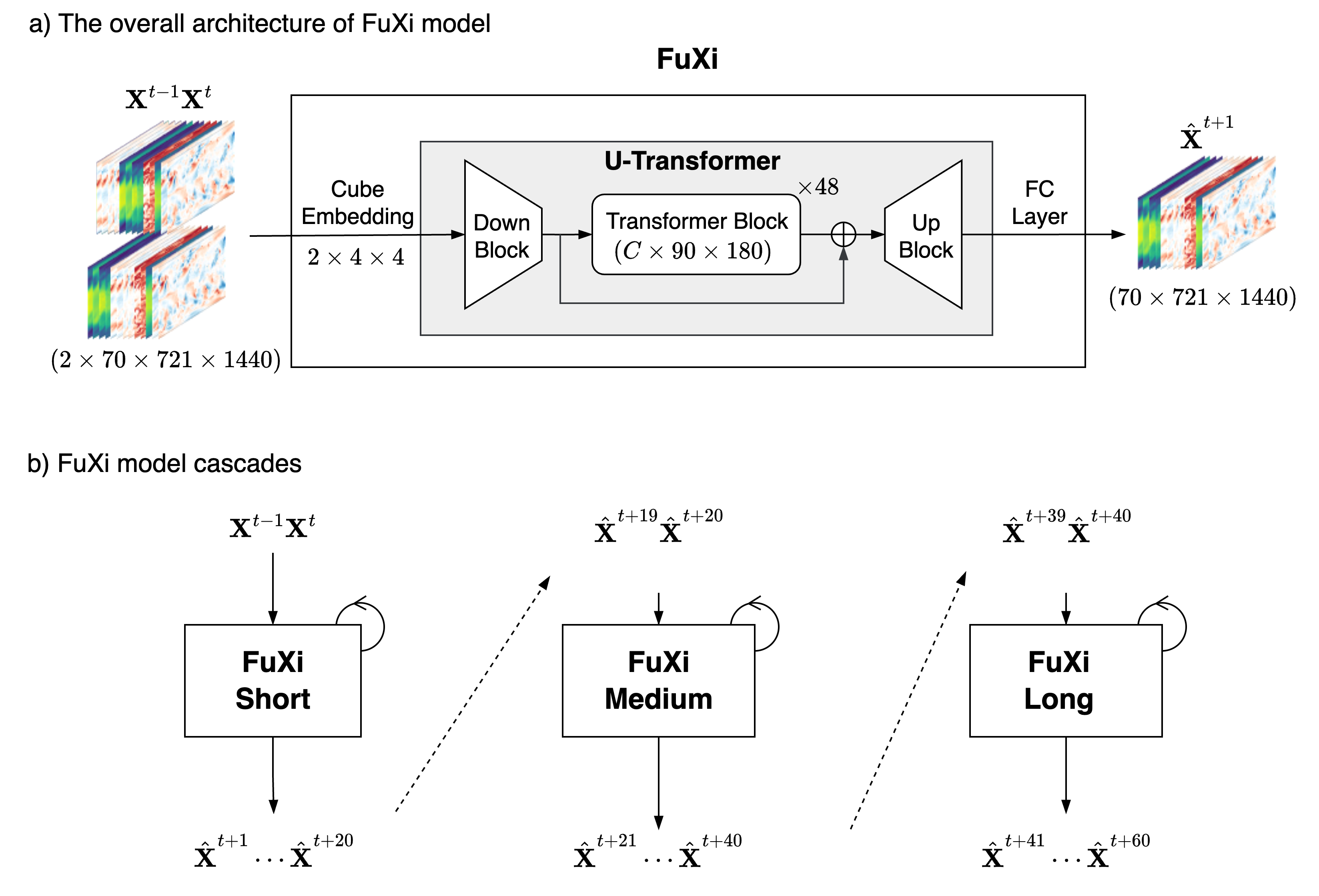
- Construct FuXi as a cascade of three specialized models: FuXi-Short (0–5 days), FuXi-Medium (5–10 days), FuXi-Long (10–15 days).
- Base FuXi architecture combines cube embedding, U-Transformer with 48 Swin Transformer V2 blocks, and a final FC layer.
- Train via two-stage process: one-step pre-training (predict single 6-hour step) and fine-tuning of cascaded models with autoregressive curriculum.
- Improve stability and reduce accumulation error using autoregressive multi-step loss during training.
- Create a 50-member FuXi ensemble by perturbing initial conditions with Perlin noise and applying Monte Carlo dropout.
Experimental results
Research questions
- RQ1Can a cascaded ML architecture reduce long-lead forecast accumulation errors and match ECMWF ensemble performance for 15-day forecasts?
- RQ2What is the forecast lead time extension achievable for Z500 and T2M compared to ECMWF HRES?
- RQ3Does a FuXi ensemble provide competitive forecast uncertainty relative to the ECMWF ensemble?
- RQ4How does FuXi perform relative to deterministic benchmarks (HRES, EM) across multiple variables and lead times?
Key findings
- FuXi's cascaded architecture yields 15-day forecasts at 0.25° that are comparable to the ECMWF ensemble mean (EM).
- FuXi extends skillful ACC (ACC > 0.6) lead times to 10.5 days for Z500 and 14.5 days for T2M.
- FuXi outperforms ECMWF HRES in 15-day forecasts across multiple variables, with ACC and RMSE advantages increasing with lead time.
- FuXi ensemble forecasts achieve CRPS performance comparable to ECMWF ensemble within 9 days for several fields, indicating useful uncertainty estimates.

Better researchstarts right now
From reading papers to final review, dramatically reduce your research time.
No credit card · Free plan available
This review was created by AI and reviewed by human editors.