
[论文解读] Criticality and entanglement in non-unitary quantum circuits and tensor networks of non-interacting fermions
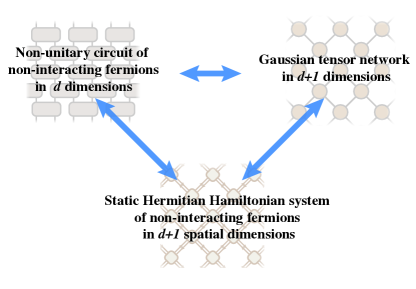
本文建立了 d 个空间维度中非幺正量子线路与 d+1 维度中具有静态无序的幺正、非相互作用费米子系统之间完整的对应关系。它表明,随机非幺正线路中的临界纠缠相变源于 Altland-Zirnbauer 对称性类 DIII 中的稳定金属临界性,为通过无序费米子系统分类和理解纠缠相变提供了一个统一框架。
Models for non-unitary quantum dynamics, such as quantum circuits that include projective measurements, have been shown to exhibit rich quantum critical behavior. There are many complementary perspectives on this behavior. For example, there is a known correspondence between d-dimensional local non-unitary quantum circuits and tensor networks on a D=(d+1)-dimensional lattice. Here, we show that in the case of systems of non-interacting fermions, there is furthermore a full correspondence between non-unitary circuits in d spatial dimensions and unitary non-interacting fermion problems with static Hermitian Hamiltonians in D=(d+1) spatial dimensions. This provides a powerful new perspective for understanding entanglement phases and critical behavior exhibited by non-interacting circuits. Classifying the symmetries of the corresponding non-interacting Hamiltonian, we show that a large class of random circuits, including the most generic circuits with randomness in space and time, are in correspondence with Hamiltonians with static spatial disorder in the ten Altland-Zirnbauer symmetry classes. We find the criticality that is known to occur in all of these classes to be the origin of the critical entanglement properties of the corresponding random non-unitary circuit. To exemplify this, we numerically study the quantum states at the boundary of Haar-random Gaussian fermionic tensor networks of dimension D=2 and D=3. We show that the most general such tensor network ensemble corresponds to a unitary problem of non-interacting fermions with static disorder in Altland-Zirnbauer symmetry class DIII, which for both D=2 and D=3 is known to exhibit a stable critical metallic phase. Tensor networks and corresponding random non-unitary circuits in the other nine Altland-Zirnbauer symmetry classes can be obtained from the DIII case by implementing Clifford algebra extensions for classifying spaces.
研究动机与目标
- 建立 d 维度中非相互作用费米子的非幺正量子线路与 d+1 维度中幺正、无序费米子哈密顿量之间的完整对应关系。
- 利用十种 Altland-Zirnbauer 对称性类对随机非幺正线路中的纠缠相和临界行为进行分类。
- 表明随机高斯张量网络中观察到的临界纠缠源于对称性类 DIII 中的稳定金属相。
- 通过映射到具有已知临界行为的无序费米子系统,为理解纠缠相变提供统一框架。
提出的方法
- 将费米子张量网络中的每个高斯张量映射为具有单一散射中心的幺正散射问题,利用协方差矩阵导出的转移矩阵。
- 构建一个编码张量网络动力学的转移矩阵形式,并将其映射为具有静态无序的非相互作用费米子哈密顿量。
- 识别转移矩阵的对称性,将对应系统归类为十种 Altland-Zirnbauer 对称性类中的一种,特别关注 DIII 类。
- 通过引入正生成元的 Clifford 代数扩展,系统地生成对应于所有十种对称性类的张量网络系综。
- 在 D=2 和 D=3 的 Haar-随机高斯张量网络上进行数值模拟,计算纠缠熵、关联函数和互信息。
- 应用重整化群和场论技术,解析理解 DIII 金属相中关联函数的对数修正。
实验结果
研究问题
- RQ1如何将 d 维度中非相互作用费米子的非幺正量子线路映射为 d+1 维度中的幺正、无序费米子系统?
- RQ2随机非幺正线路中临界纠缠的起源是什么?它与无序费米子系统的对称性类有何关联?
- RQ3为何最一般的高斯张量网络系综对应于对称性类 DIII?这对纠缠标度有何影响?
- RQ4转移矩阵的对称性如何决定纠缠临界性的普适类?
- RQ5能否通过使用 Clifford 代数扩展的张量网络构造,实现 Altland-Zirnbauer 对称性类的完整十重分类?
主要发现
- 在 D=2 和 D=3 的 Haar-随机高斯张量网络中,临界纠缠相对应于 Altland-Zirnbauer 对称性类 DIII 中的稳定金属相。
- 临界相中的纠缠熵表现出与 DIII 金属相一致的对数修正,表明存在非平凡的临界点。
- 数值结果表明,临界相中的互信息和关联函数表现出对数修正的标度行为,与 DIII 类场论的预测相符。
- 转移矩阵形式将每个高斯张量映射为保持粒子-空穴对称性的幺正散射问题,证实了 DIII 分类。
- 通过引入正生成元扩展 Clifford 代数,作者构建了对应于所有十种 Altland-Zirnbauer 对称性类的张量网络系综,推广了 DIII 情况。
- 本研究确立了非幺正线路中的临界性并非随机性的副产品,而是与 DIII 类中拓扑保护的金属相紧密相关的稳健特征。
更好的研究,从现在开始
从阅读论文到最终审阅,大幅缩短您的研究时间。
无需绑定信用卡
本解读由 AI 生成,并经人工编辑审核。