
[Paper Review] Cross-cap defects and fault-tolerant logical gates in the surface code and the honeycomb Floquet code
This paper introduces fault-tolerant logical gates in topological quantum codes—specifically the $\mathbb{Z}_2$ toric code and honeycomb Floquet code—by embedding them on non-orientable surfaces like the real projective plane ($\mathbb{RP}^2$) and Klein bottle. It demonstrates that cross-caps induce emergent symmetries enabling constant-depth, local-unitary realizations of logical gates such as the Hadamard and Clifford gates, reducing error propagation and avoiding the distance-halving issue of prior folded surface codes.
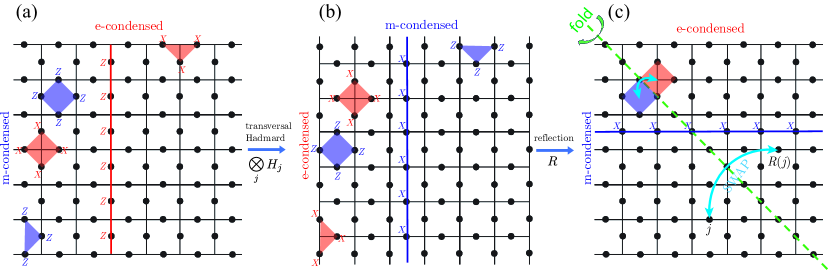
We consider the $\mathbb{Z}_2$ toric code, surface code and Floquet code defined on a non-orientable surface, which can be considered as families of codes extending Shor's 9-qubit code. We investigate the fault-tolerant logical gates of the $\mathbb{Z}_2$ toric code in this setup, which corresponds to $e\leftrightarrow m$ exchanging symmetry of the underlying $\mathbb{Z}_2$ gauge theory. We find that non-orientable geometry provides a new way the emergent symmetry acts on the code space, and discover the new realization of the fault-tolerant Hadamard gate of 2d $\mathbb{Z}_2$ toric code on a surface with a single cross-cap, dubbed a non-orientable toric code. This Hadamard gate can be realized by a constant-depth local unitary circuit modulo non-locality caused by a cross-cap. Via folding, the non-orientable surface code can be turned into a bilayer local quantum code, where the folded cross-cap is equivalent to a bi-layer twist terminated on a gapped boundary and the logical Hadamard only contains local gates with intra-layer couplings. We further obtain the complete logical Clifford gate set for a stack of non-orientable surface codes. We then construct the honeycomb Floquet code in the presence of a single cross-cap, and find that the period of the sequential Pauli measurements acts as a $HZ$ logical gate on the single logical qubit, where the cross-cap enriches the dynamics compared with the orientable case. We find that the dynamics of the honeycomb Floquet code is precisely described by a condensation operator of the $\mathbb{Z}_2$ gauge theory, and illustrate the exotic dynamics of our code in terms of a condensation operator supported at a non-orientable surface.
Motivation & Objective
- To develop fault-tolerant logical gates for topological stabilizer and Floquet codes on non-orientable manifolds.
- To overcome the distance-halving problem in folded surface codes by using cross-caps to enable constant-depth logical gates.
- To realize the logical Hadamard gate via stabilizer pumping circuits on an $\mathbb{RP}^2$ code with non-local connectivity.
- To extend the construction to generate the full logical Clifford gate set on $\mathbb{RP}^2$ and Klein-bottle codes.
- To show that the period of sequential Pauli measurements in the honeycomb Floquet code acts as a $HZ$ logical gate due to condensation of fermionic anyons on non-orientable geometry.
Proposed method
- Constructing the $\mathbb{RP}^2$ code as a non-orientable variant of the surface code with a single cross-cap connecting opposite edges.
- Implementing the logical Hadamard gate via a stabilizer pumping circuit that is constant-depth modulo non-locality from the cross-cap.
- Folding the $\mathbb{RP}^2$ code into a bilayer system to localize gate operations using a layer-exchanging defect at the cross-cap.
- Mapping the dynamics of the honeycomb Floquet code with a cross-cap to a condensation operator of the $\mathbb{Z}_2$ gauge theory, which acts as a $HZ$ gate.
- Using the Arf-Brown-Kervaire invariant to compute the action of the condensation operator on the Hilbert space, yielding a $\mathrm{diag}(e^{2\pi i/8}, e^{-2\pi i/8})$ matrix for $\mathbb{RP}^2$, corresponding to a $\mathbb{Z}_8$ classification.
- Deriving the enriched dynamics of the honeycomb Floquet code on non-orientable surfaces as a result of fermionic duals and topological invariants.
Experimental results
Research questions
- RQ1How can logical gates be realized fault-tolerantly in topological codes on non-orientable surfaces like $\mathbb{RP}^2$?
- RQ2Can the Hadamard gate be implemented via a constant-depth circuit on a non-orientable surface code without distance reduction?
- RQ3What is the role of the cross-cap in modifying the emergent symmetry and dynamics of the $\mathbb{Z}_2$ toric code?
- RQ4How does the measurement period of the honeycomb Floquet code act as a logical gate on a non-orientable surface?
- RQ5What is the field-theoretic interpretation of the enhanced symmetry and period in the honeycomb Floquet code with a cross-cap?
Key findings
- The logical Hadamard gate on the $\mathbb{RP}^2$ code is realized via a stabilizer pumping circuit that is constant-depth modulo non-locality from the cross-cap, avoiding the factor-of-two distance reduction seen in folded surface codes.
- The folded $\mathbb{RP}^2$ code realizes the logical Hadamard gate using only intra-layer couplings away from the cross-cap, unlike inter-layer couplings in the folded surface code.
- The full logical Clifford gate set, including CNOT and $S$ gates, is constructed for the $\mathbb{RP}^2$ code and the Klein-bottle code using a single cross-cap.
- The honeycomb Floquet code with a single cross-cap exhibits a period-4 dynamics instead of period-2, corresponding to a $HZ$ logical gate with action $\mathrm{diag}(e^{2\pi i/8}, e^{-2\pi i/8})$ on the code space.
- The dynamics of the honeycomb Floquet code on a non-orientable surface is described by a condensation operator of the $\mathbb{Z}_2$ gauge theory, which evaluates the partition function of the Kitaev chain on a Pin$^{-}$-structure, yielding an eighth root of unity phase.
- The condensation operator acts as a generator of the $\mathbb{Z}_8$ classification of fermionic invertible phases on non-orientable surfaces, explaining the extended period and enriched symmetry.

Better researchstarts right now
From reading papers to final review, dramatically reduce your research time.
No credit card · Free plan available
This review was created by AI and reviewed by human editors.