
[Paper Review] Dark matter, fine-tuning and $(g-2)_μ$ in the pMSSM
This paper identifies minimal-fine-tuning supersymmetric spectra in the phenomenological MSSM that simultaneously explain the observed dark matter relic density, the muon anomalous magnetic moment discrepancy $(g-2)_\mu$, and satisfy LHC and direct detection constraints. It finds that spin-dependent dark matter-nucleon scattering experiments like PICO-500 will probe all viable solutions, especially those with low electroweak fine-tuning and bino-like LSPs with small higgsino components.
In this paper we analyze spectra in the phenomenological supersymmetric Standard Model that simultaneously result in the right dark-matter relic density $Ω_{ m DM} h^2$, offer an explanation for the $(g-2)_μ$ discrepancy $Δa_μ$ and are minimally fine-tuned. We discuss the LHC phenomenology resulting from these spectra and the sensitivity of dark-matter direct detection experiments to these spectra. We find that the latter type of experiments with sensitivity to the spin-dependent dark-matter-nucleon scattering cross section $σ_{ m SD,p}$ will probe all of our found solutions.
Motivation & Objective
- To identify supersymmetric spectra in the pMSSM that simultaneously satisfy the observed dark matter relic density $\Omega_{\rm DM}h^{2}$, the $(g-2)_\mu$ discrepancy, and LHC constraints.
- To constrain the model parameter space to spectra with minimal electroweak fine-tuning ($\Delta_{\rm EW}$).
- To assess the LHC phenomenology and direct detection sensitivity of viable spectra, particularly for spin-dependent scattering.
Proposed method
- The analysis uses the phenomenological MSSM (pMSSM) with 19 free parameters, assuming degenerate first- and second-generation sfermion masses and vanishing trilinear couplings for light generations.
- It computes the muon anomalous magnetic moment $a_\mu$ using one-loop contributions from charginos and neutralinos, including Higgs and Higgsino exchanges.
- The relic density $\Omega_{\rm DM}h^{2}$ is calculated via micrOMEGAs, including coannihilation and s-channel resonances.
- Electroweak fine-tuning is quantified via the $\Delta_{\rm EW}$ measure, defined as the maximum relative sensitivity of the Higgs mass to soft-breaking parameters.
- LHC constraints are applied using existing searches for charginos and neutralinos, particularly $\widetilde{\chi}^{0}_{2}\widetilde{\chi}^{\pm}_{1}$ final states.
- Direct detection cross sections $\sigma_{\rm SD,p}$ and $\sigma_{\rm SI,p}$ are computed and compared to projected sensitivities of PICO-40L and PICO-500.
Experimental results
Research questions
- RQ1Which pMSSM spectra simultaneously explain the correct dark matter relic density, the $(g-2)_\mu$ anomaly, and satisfy LHC constraints with minimal fine-tuning?
- RQ2How does the composition of the lightest supersymmetric particle (LSP) affect the spin-dependent dark matter-nucleon scattering cross section $\sigma_{\rm SD,p}$?
- RQ3To what extent are future direct detection experiments like PICO-500 sensitive to the viable solutions identified in the parameter space?
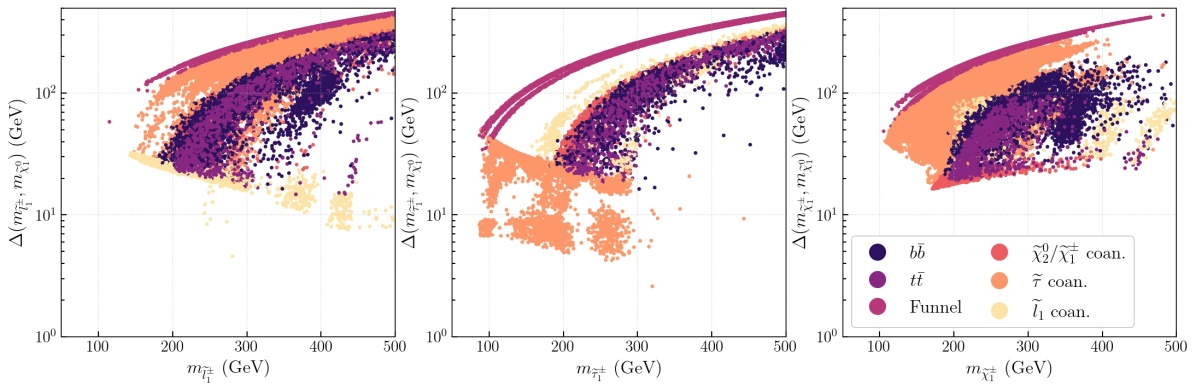
- RQ4How do coannihilation mechanisms and resonance regions influence the relic density and fine-tuning in the model?
- RQ5What is the role of the higgsino component in the LSP for mediating the $(g-2)_\mu$ correction and fine-tuning?
Key findings
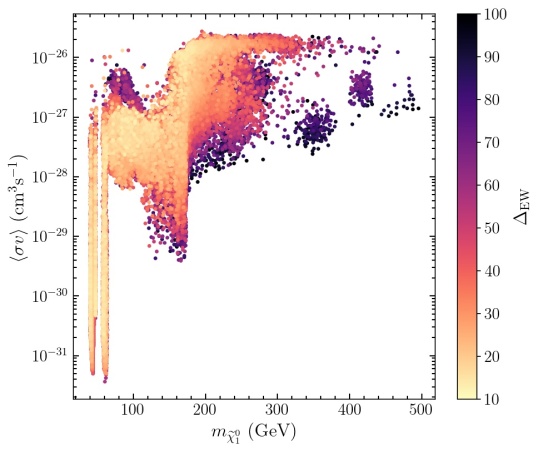
- The LSP in all viable spectra is predominantly bino-like with a small higgsino component, leading to a strong correlation between $\sigma_{\rm SD,p}$ and electroweak fine-tuning $\Delta_{\rm EW}$.
- The minimal electroweak fine-tuning $\Delta_{\rm EW}$ across all solutions is approximately 14.2, with values ranging up to 100.
- Spin-dependent direct detection experiments such as PICO-500 will probe all solutions with $\Delta_{\rm EW} < 62$, and LUX-ZEPLIN will exclude all with $\Delta_{\rm EW} < 100$.
- LHC searches are most sensitive to spectra with light $\widetilde{\chi}^{0}_{2}/\widetilde{\chi}^{\pm}_{1}$ states and significant wino components, but have limited reach in the generic bino-higgsino regime.
- Coannihilation with a light stau is particularly challenging for LHC searches, suggesting the need for dedicated $\widetilde{\tau}^{\pm}$ searches without mass degeneracy assumptions.
- The requirement of explaining $\Delta a_\mu$ excludes LSPs with a heavy higgsino component around 600 GeV, which constrains the $\sigma_{\rm SD,p}$–$\Delta_{\rm EWler$ correlation.
Read this paper
Open the full text in the Nubint reader and ask about any passage as you read.
Read this paper on NubintThis review was generated by AI from the original paper. Please check the paper before citing it.