
[Paper Review] Deep Learning for Mean Field Games and Mean Field Control with Applications to Finance
This paper proposes three deep learning-based methods—direct optimization, Deep BSDE, and Deep Galerkin Method (DGM)—to solve mean field control (MFC) and mean field game (MFG) problems in high-dimensional finance applications. It demonstrates their effectiveness on models of optimal execution, systemic risk, and trade crowding, showing that neural networks can accurately approximate solutions to complex PDEs and FBSDEs with non-local interactions.
Financial markets and more generally macro-economic models involve a large number of individuals interacting through variables such as prices resulting from the aggregate behavior of all the agents. Mean field games have been introduced to study Nash equilibria for such problems in the limit when the number of players is infinite. The theory has been extensively developed in the past decade, using both analytical and probabilistic tools, and a wide range of applications have been discovered, from economics to crowd motion. More recently the interaction with machine learning has attracted a growing interest. This aspect is particularly relevant to solve very large games with complex structures, in high dimension or with common sources of randomness. In this chapter, we review the literature on the interplay between mean field games and deep learning, with a focus on three families of methods. A special emphasis is given to financial applications.
Motivation & Objective
- To address the curse of dimensionality in mean field control and game problems arising in financial engineering and macroeconomics.
- To develop scalable numerical methods based on deep learning for solving high-dimensional MFC and MFG systems with non-local interactions and common noise.
- To demonstrate the practical viability of deep learning techniques on stylized but realistic financial models, including optimal execution and systemic risk.
- To bridge theoretical mean field frameworks with practical computational tools by leveraging neural networks to approximate value functions, controls, and distributions.
- To provide a unified numerical framework for solving MFG/MFC systems through three distinct deep learning paradigms: direct cost minimization, stochastic shooting, and residual minimization of PDEs.
Proposed method
- Uses a direct deep learning approach to minimize the cost functional by parameterizing the control policy as a neural network, trained via stochastic gradient descent.
- Employs a Deep BSDE method to solve McKean-Vlasov forward-backward stochastic differential equations (MKV FBSDEs), where the initial backward variable and the Z-component are approximated by neural networks.
- Applies the Deep Galerkin Method (DGM) to solve the coupled system of forward Kolmogorov and Hamilton-Jacobi-Bellman PDEs arising in MFGs, minimizing residual errors over space-time grids.
- Implements penalization techniques to enforce initial and terminal conditions, and uses Monte Carlo sampling to estimate non-local terms like the mean field interaction $\bar{\mu}_t$.
- Uses an exponential activation on the final layer of the density network to ensure non-negativity of the distribution function $m(t, \cdot)$.
- Adapts the methods to handle time-dependent PDE systems and non-Markovian structures, including quadratic variation terms in inventory dynamics.
Experimental results
Research questions
- RQ1Can deep learning effectively solve high-dimensional mean field control and game problems in finance that are intractable with classical numerical methods?
- RQ2How do different deep learning architectures—direct policy optimization, Deep BSDE, and DGM—compare in solving MFC and MFG systems with non-local interactions?
- RQ3To what extent can neural networks approximate the value function, optimal control, and distribution dynamics in MFG models of optimal execution and systemic risk?
- RQ4Can deep learning methods handle complex financial models involving common noise, delays, and default-time interactions while maintaining numerical stability and accuracy?
- RQ5What are the empirical performance characteristics of these methods on stylized but realistic financial models, such as the price impact model and the crowded trade model?
Key findings
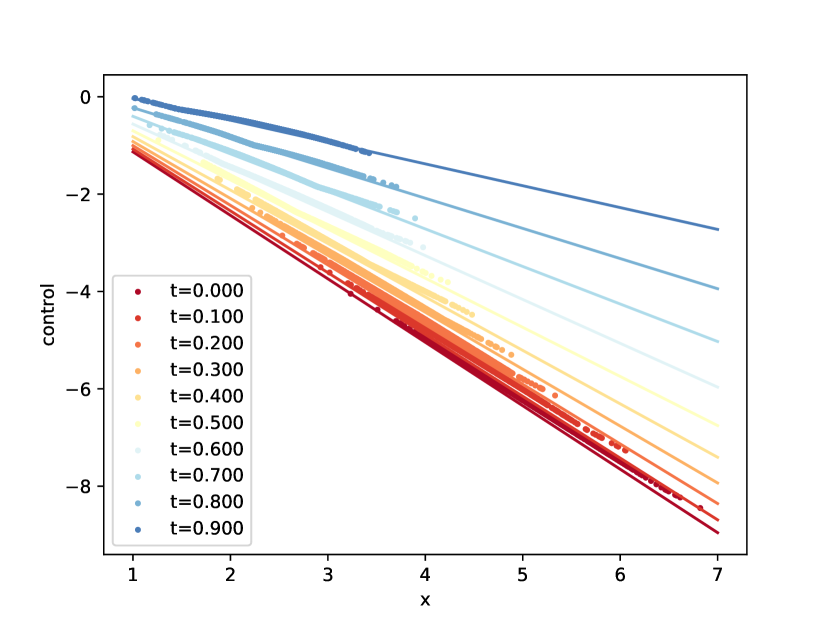
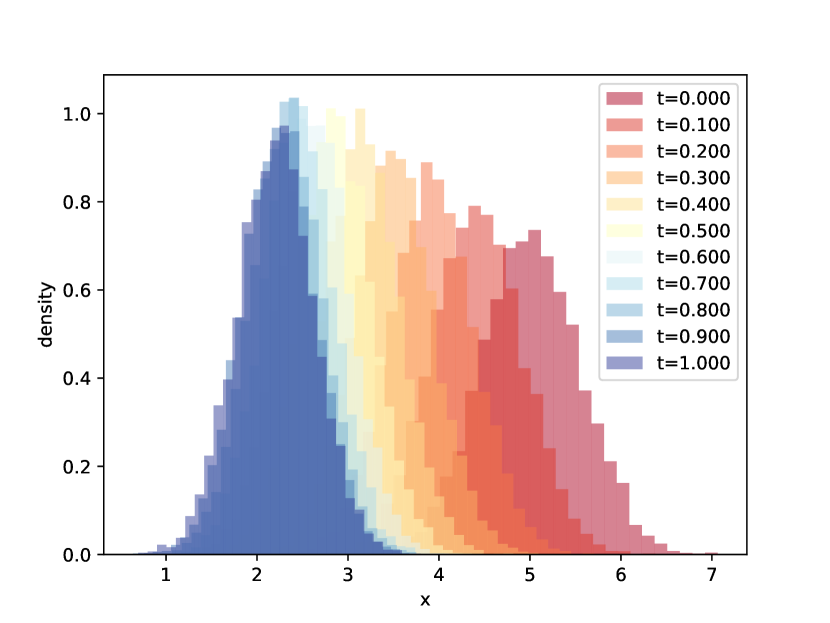
- The DGM method successfully solved the MFG system for the trade crowding model, accurately capturing the concentration of the inventory distribution $m(t, \cdot)$ near zero over time.
- The neural network approximation of the optimal control $\alpha^*$ closely matched the semi-explicit analytical solution, with the learned control showing a linear dependence on inventory, as expected.
- The use of an exponential activation in the final layer of the density network ensured that the learned distribution remained non-negative, a critical constraint in probability density estimation.
- The method achieved stable convergence using penalized initial and terminal conditions, with Monte Carlo sampling effectively estimating the non-local mean field interaction $\bar{\mu}_t$.
- The numerical results confirmed theoretical expectations: the distribution evolves to concentrate near zero, and the optimal control is linear in inventory, validating the model's consistency.
- The framework demonstrated robustness on a price impact model with quadratic variation in inventory dynamics, showing that neural networks can handle complex dynamics without requiring major architectural changes.
Read this paper
Open the full text in the Nubint reader and ask about any passage as you read.
Read this paper on NubintThis review was generated by AI from the original paper. Please check the paper before citing it.