
[Paper Review] Description-Based Text Similarity
This paper introduces a novel retrieval task—finding sentences that instantiate abstract descriptions—using a contrastive dual-encoder model trained on synthetic <description, sentence> pairs generated via GPT-3. The model achieves 85.4% precision@1, significantly outperforming state-of-the-art sentence encoders like E5 (73.6%), demonstrating that task-specific data curation from LLMs enables superior semantic retrieval for abstract query types.
Identifying texts with a given semantics is central for many information seeking scenarios. Similarity search over vector embeddings appear to be central to this ability, yet the similarity reflected in current text embeddings is corpus-driven, and is inconsistent and sub-optimal for many use cases. What, then, is a good notion of similarity for effective retrieval of text? We identify the need to search for texts based on abstract descriptions of their content, and the corresponding notion of \emph{description based similarity}. We demonstrate the inadequacy of current text embeddings and propose an alternative model that significantly improves when used in standard nearest neighbor search. The model is trained using positive and negative pairs sourced through prompting a LLM, demonstrating how data from LLMs can be used for creating new capabilities not immediately possible using the original model.
Motivation & Objective
- To address the gap in semantic retrieval for abstract, high-level descriptions of content, which current models fail to handle effectively.
- To define a well-structured and consistent similarity notion based on 'instance-of' relationships between abstract descriptions and their textual instantiations.
- To improve retrieval performance for information-seeking queries that require finding specific content instances matching a conceptual description, rather than lexical or surface-level similarity.
- To explore the feasibility of using LLMs not only for distillation but also for generating specialized training data to create retrieval models with capabilities beyond the original LLM.
Proposed method
- Leveraged GPT-3 to generate diverse, high-quality positive and negative <abstract description, sentence> pairs, where the sentence is an instantiation of the description.
- Constructed a contrastive dual-encoder model with separate encoders for descriptions and sentences, trained to minimize the distance between positive pairs and maximize it for negative pairs.
- Used a two-stage data filtering process: first, crowd-sourced validation via MTurk to select sentences fitting the description (valid) or not (invalid), ensuring high-quality training data.
- Trained the model on a curated dataset of 201 test queries, each with 12 valid and 12 invalid sentences, combined with 9.55M Wikipedia sentences to form the retrieval index.
- Evaluated the model using precision@k, valid-recall@k, and invalid-recall@k, with results reported on a held-out test set of abstract descriptions.
- Applied standard nearest-neighbor search using learned embeddings to retrieve sentences from a large Wikipedia index.
Experimental results
Research questions
- RQ1Can a retrieval model trained on LLM-generated <description, sentence> pairs outperform general-purpose sentence encoders for abstract description-based retrieval?
- RQ2Is the 'instance-of' relationship between abstract descriptions and their textual instantiations a well-defined and consistent similarity notion suitable for semantic retrieval?
- RQ3To what extent can LLMs be used to generate high-quality, diverse, and reliable training data for specialized retrieval tasks?
- RQ4Does a model trained on a curated, task-specific dataset surpass general-purpose models in precision and recall for abstract query retrieval?
Key findings
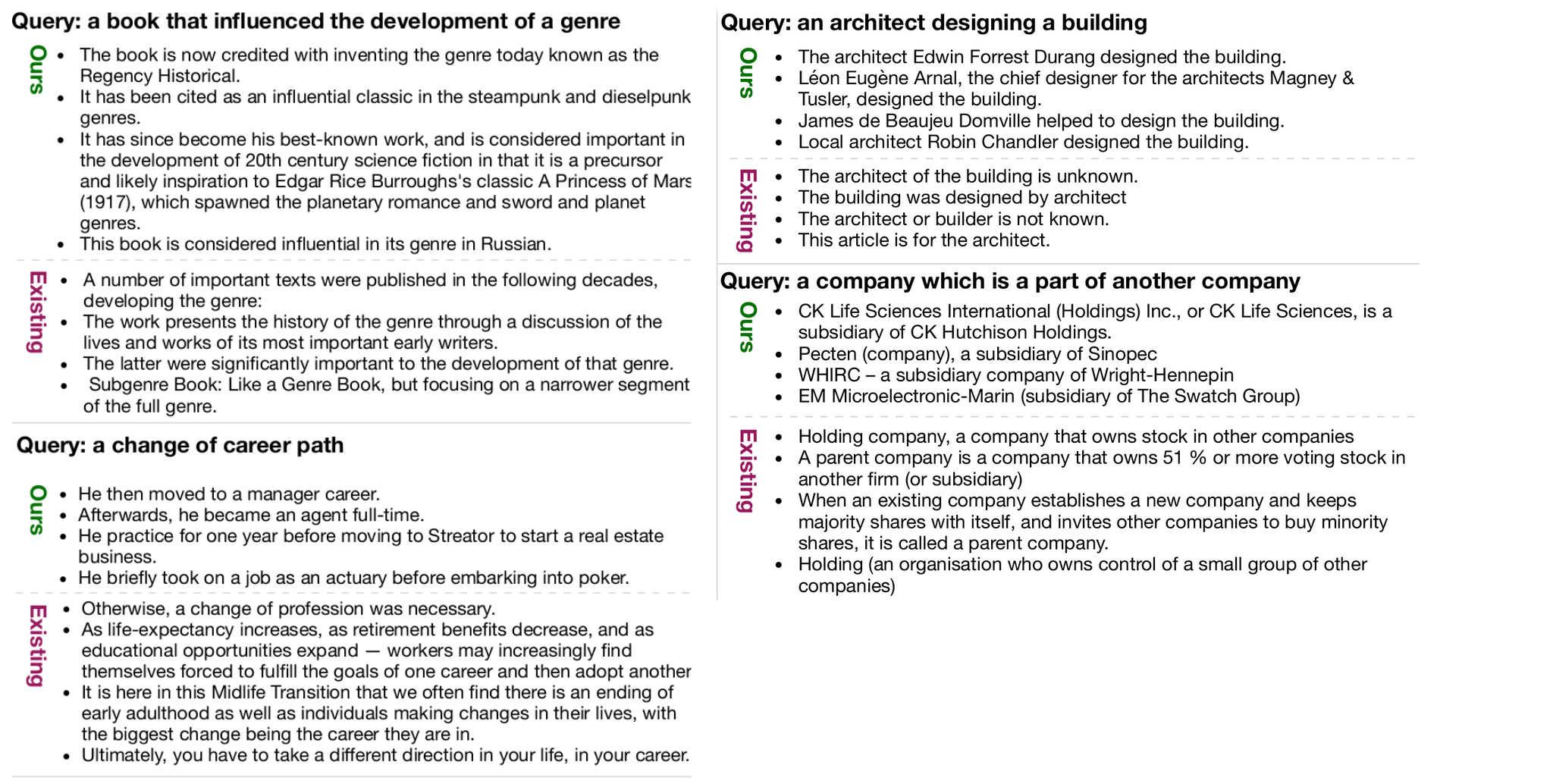
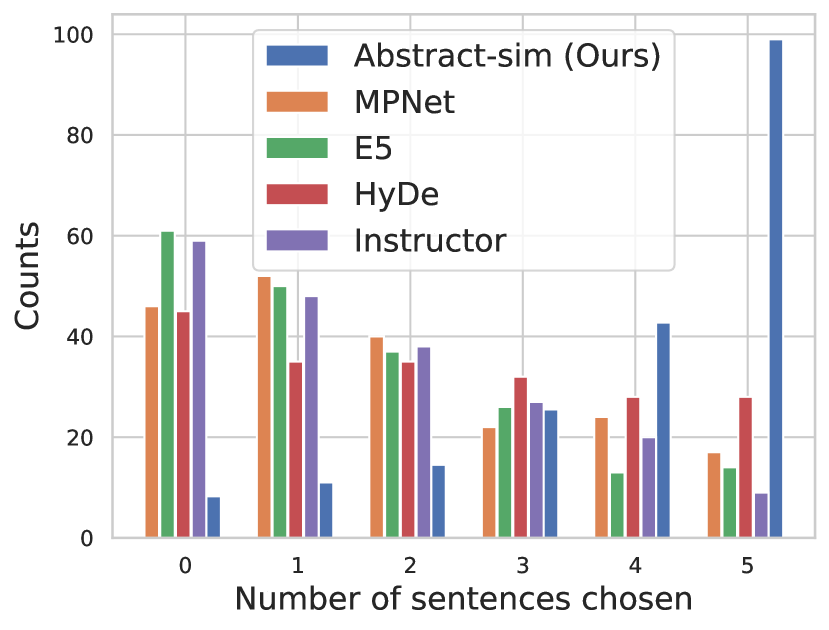
- The proposed model achieves 85.4% precision@1, a 11.8 percentage point improvement over the strongest baseline, E5, which achieved 73.6%.
- The performance gap is largest at k=1 and diminishes with increasing k, indicating strong top-1 retrieval quality for abstract descriptions.
- The model achieves the highest invalid-recall@k among all baselines, demonstrating a strong ability to avoid retrieving sentences that do not match the description.
- Despite lower valid-recall@k compared to some baselines, the model's superior precision and low false-positive rate make it more reliable for real-world information-seeking tasks.
- The results confirm that standard sentence encoders are ill-suited for abstract description retrieval due to their vague and inconsistent similarity definitions.
- The study demonstrates that LLMs can be effectively used to generate high-quality, task-specific training data, enabling models to learn retrieval capabilities not natively supported by the LLM itself.
Read this paper
Open the full text in the Nubint reader and ask about any passage as you read.
Read this paper on NubintThis review was generated by AI from the original paper. Please check the paper before citing it.