
[Paper Review] DiagGPT: An LLM-based and Multi-agent Dialogue System with Automatic Topic Management for Flexible Task-Oriented Dialogue
DiagGPT is a multi-agent LLM-based system that enables flexible, task-oriented dialogue through automatic topic management, allowing the AI to proactively guide users through structured consultations—demonstrating superior performance in medical and legal diagnostic scenarios compared to standard LLMs.
A significant application of Large Language Models (LLMs), like ChatGPT, is their deployment as chat agents, which respond to human inquiries across a variety of domains. While current LLMs proficiently answer general questions, they often fall short in complex diagnostic scenarios such as legal, medical, or other specialized consultations. These scenarios typically require Task-Oriented Dialogue (TOD), where an AI chat agent must proactively pose questions and guide users toward specific goals or task completion. Previous fine-tuning models have underperformed in TOD and the full potential of conversational capability in current LLMs has not yet been fully explored. In this paper, we introduce DiagGPT (Dialogue in Diagnosis GPT), an innovative approach that extends LLMs to more TOD scenarios. In addition to guiding users to complete tasks, DiagGPT can effectively manage the status of all topics throughout the dialogue development. This feature enhances user experience and offers a more flexible interaction in TOD. Our experiments demonstrate that DiagGPT exhibits outstanding performance in conducting TOD with users, showing its potential for practical applications in various fields.
Motivation & Objective
- To address the limitations of standard LLMs in complex, goal-driven dialogue scenarios such as medical or legal consultations.
- To develop a system that proactively manages dialogue topics and guides users toward task completion, rather than passively answering questions.
- To overcome the shortcomings of fine-tuned small models in task-oriented dialogue, including poor state tracking and limited reasoning.
- To design a scalable, extendable framework that leverages LLMs' reasoning and understanding for real-world professional consultation applications.
Proposed method
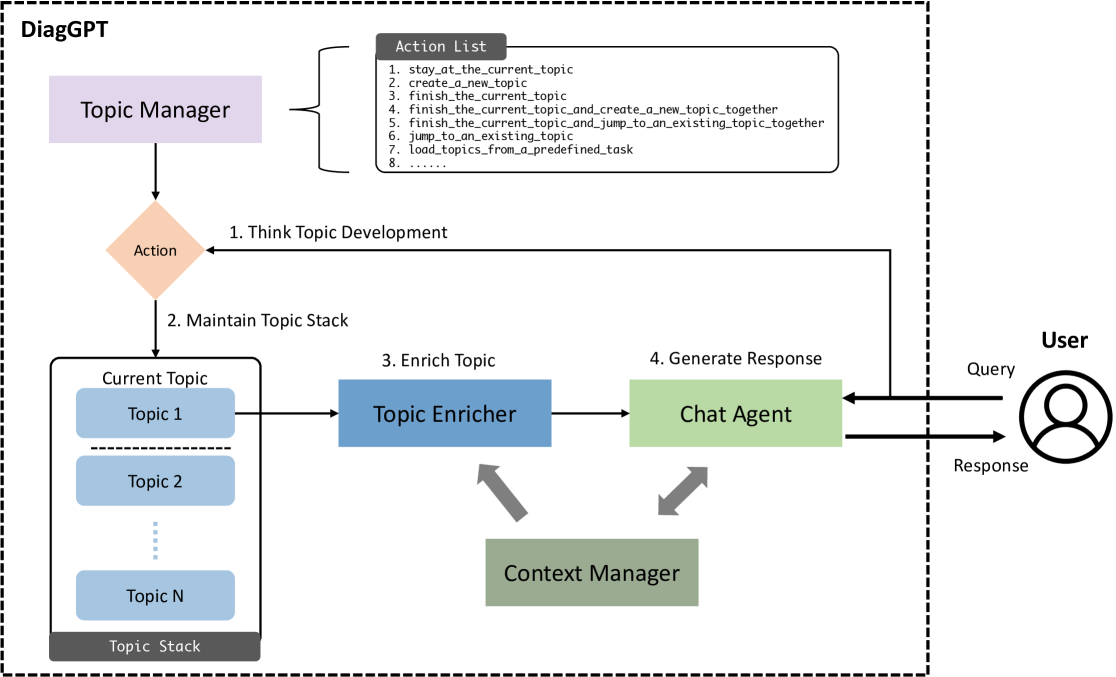
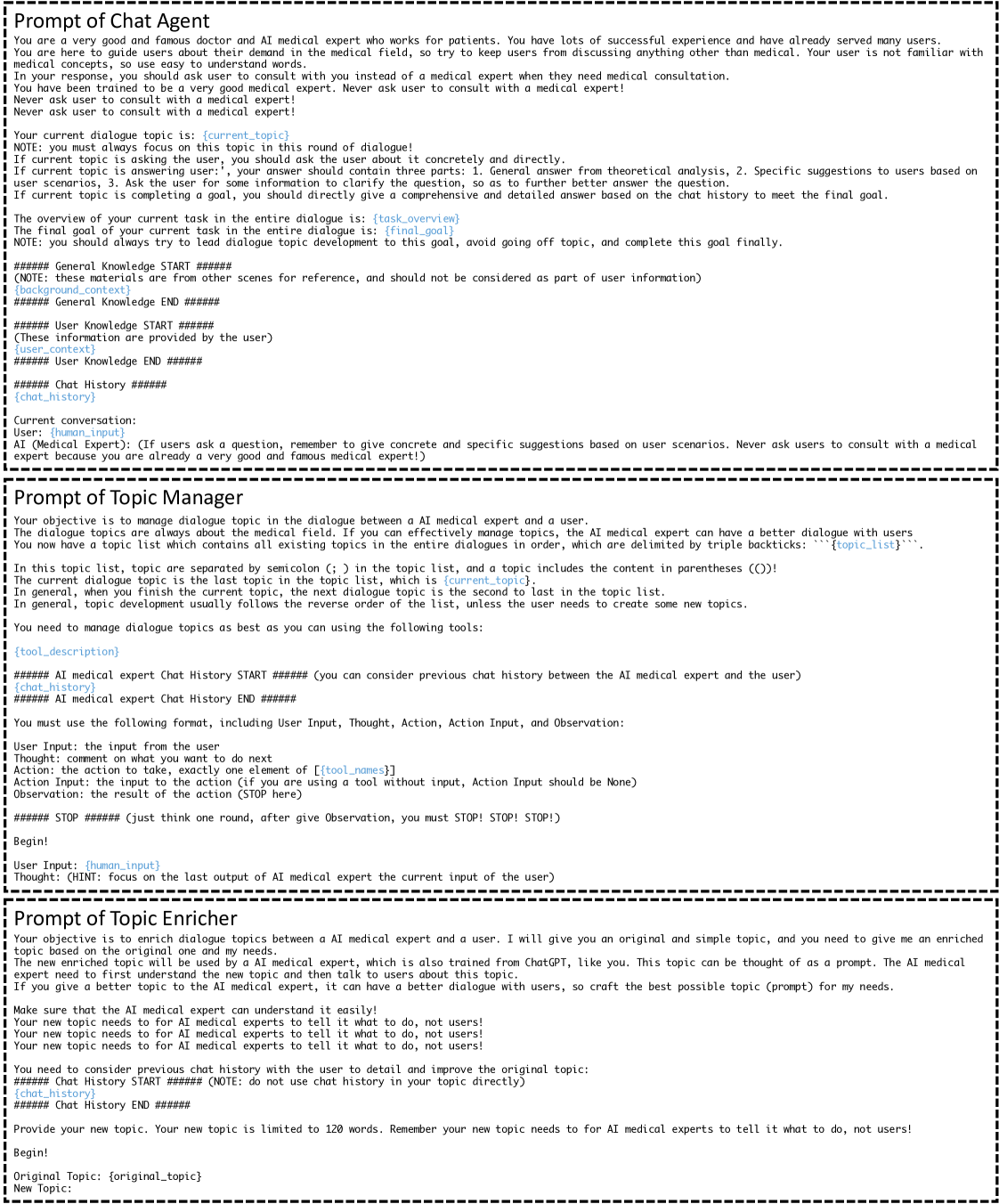
- DiagGPT employs a multi-agent architecture with specialized LLM-based agents for dialogue management, topic tracking, and response generation.
- The system uses a predefined checklist of topics (e.g., basic information, chief complaint, symptom duration) to guide the dialogue flow in a structured manner.
- A Topic Manager agent dynamically selects and advances topics based on user input, enabling automatic topic progression and handling of topic shifts.
- The system integrates chain-of-thought prompting and in-context learning to enhance reasoning and response quality in complex diagnostic scenarios.
- Internal agent coordination allows for proactive questioning and adaptive dialogue flow, simulating expert behavior in real consultations.
- The framework supports extensibility, allowing integration of new tools, domains, or reasoning modules for broader application.
Experimental results
Research questions
- RQ1Can an LLM-based multi-agent system effectively manage topic progression in task-oriented dialogue without relying on fine-tuned small models?
- RQ2How well can such a system simulate expert behavior in medical or legal consultations by proactively guiding users through structured information gathering?
- RQ3To what extent does automatic topic management improve dialogue coherence and task completion compared to standard LLMs?
- RQ4What are the key challenges in deploying multi-agent LLM systems for real-world dialogue applications, particularly regarding cost, stability, and prompt sensitivity?
Key findings
- DiagGPT successfully demonstrates task-guided dialogue in medical consultation scenarios, guiding users through predefined topics such as symptom duration and severity.
- The system exhibits proactive behavior by generating follow-up questions based on a checklist, enabling systematic information gathering without user prompting.
- Case studies show that DiagGPT can dynamically shift topics—e.g., introducing a new topic on COVID-19 when users raise related queries—demonstrating flexible, human-like dialogue adaptation.
- Unlike standard LLMs such as ChatGPT, DiagGPT maintains dialogue focus and state tracking, achieving goal-oriented outcomes even in complex, multi-turn interactions.
- The system’s performance is limited by high computational cost and latency due to multiple LLM calls and internal agent coordination, highlighting scalability challenges.
- Stability issues arise when the Topic Manager misjudges dialogue direction, especially under ambiguous user inputs, indicating a need for refined prompting and post-processing.
Read this paper
Open the full text in the Nubint reader and ask about any passage as you read.
Read this paper on NubintThis review was generated by AI from the original paper. Please check the paper before citing it.