
[Paper Review] Diagnostics of mixed-state topological order and breakdown of quantum memory
The paper defines intrinsic diagnostics for the breakdown of topological quantum memory under local errors, showing three information-theoretic measures (quantum relative entropy, coherent information, and topological entanglement negativity) undergo a common transition in the 2D Toric code, and maps them to a statistical-mechanics framework that bounds and saturates decoding thresholds.
Topological quantum memory can protect information against local errors up to finite error thresholds. Such thresholds are usually determined based on the success of decoding algorithms rather than the intrinsic properties of the mixed states describing corrupted memories. Here we provide an intrinsic characterization of the breakdown of topological quantum memory, which both gives a bound on the performance of decoding algorithms and provides examples of topologically distinct mixed states. We employ three information-theoretical quantities that can be regarded as generalizations of the diagnostics of ground-state topological order, and serve as a definition for topological order in error-corrupted mixed states. We consider the topological contribution to entanglement negativity and two other metrics based on quantum relative entropy and coherent information. In the concrete example of the 2D Toric code with local bit-flip and phase errors, we map three quantities to observables in 2D classical spin models and analytically show they all undergo a transition at the same error threshold. This threshold is an upper bound on that achieved in any decoding algorithm and is indeed saturated by that in the optimal decoding algorithm for the Toric code.
Motivation & Objective
- Provide intrinsic characterization of the breakdown of topological quantum memory under local errors.
- Identify an error-rate-driven transition in mixed-state topological order using intrinsic diagnostics.
- Establish upper bounds on decoding performance and relate them to intrinsic state properties.
- Demonstrate consistency of three diagnostics in a concrete model (2D Toric code).
- Show mappings to classical spin models and dualities that connect to optimal decoding thresholds.
Proposed method
- Define the error-corrupted mixed state by applying local noise channels to a topologically ordered ground state.
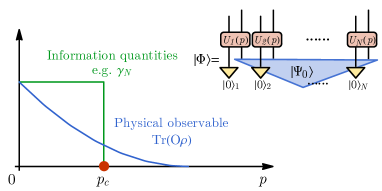
- Introduce three diagnostics: quantum relative entropy between corrupted and anyon-created states, coherent information, and topological entanglement negativity.
- Use Rényi generalizations of these diagnostics and map their n-th moments to (n-1)-flavor Ising spin statistical mechanical models.
- Show that the diagnostics correspond to different probes of ferromagnetic order and undergo a transition at the same critical error rate.
- Demonstrate a duality between the mapped statistical model and the RBIM that governs decoding transitions.
- Discuss how the n→1 limit relates to standard notions of partial trace and entropy in the context of error correction.
Experimental results
Research questions
- RQ1Do the three information-theoretic diagnostics (relative entropy, coherent information, and topological negativity) exhibit the same critical error rate in the presence of local errors?
- RQ2How can the error-corrupted mixed state be characterized intrinsically to bound decoding thresholds and reveal topologically distinct mixed states?
- RQ3Can the n-th Rényi versions of these diagnostics be mapped to a 2D (n-1)-flavor Ising spin model and what does that imply for phase transitions?
- RQ4Does the decoding threshold saturate the intrinsic upper bound implied by these diagnostics, and is this connected to optimal decoding?
Key findings
- Three diagnostics (D^(n), I_c^(n), and E_A^(2n)) show a transition at a finite error rate in the 2D Toric code under incoherent bit-flip and phase errors.
- Each diagnostic maps to observables in an (n-1)-flavor Ising model and undergoes a simultaneous paramagnetic-to-ferromagnetic transition.
- The corresponding statistical mechanical model is dual to the random-bond Ising model that governs a previously proposed decoding transition, implying the decoding threshold is saturated by optimal decoding.
- The transition represents a breakdown of mixed-state topological order, with the intrinsic critical error rate providing an upper bound on algorithmic decoding performance.
- In the n→1 limit, the results recover the standard coherence/relative-entropy-based perspective on quantum memory protection and error correction.
Better researchstarts right now
From reading papers to final review, dramatically reduce your research time.
No credit card · Free plan available
This review was created by AI and reviewed by human editors.