
[Paper Review] Directly imaging spin polarons in a kinetically frustrated Hubbard system
This study directly images itinerant spin polarons in a kinetically frustrated triangular lattice Fermi-Hubbard system using ultracold atoms, revealing antiferromagnetic correlations around hole dopants and ferromagnetic correlations around particle dopants. The results demonstrate robust quasiparticle formation via kinetic frustration, even at high temperatures and in the absence of superexchange, challenging prior assumptions about quasiparticle coherence in frustrated Mott insulators.
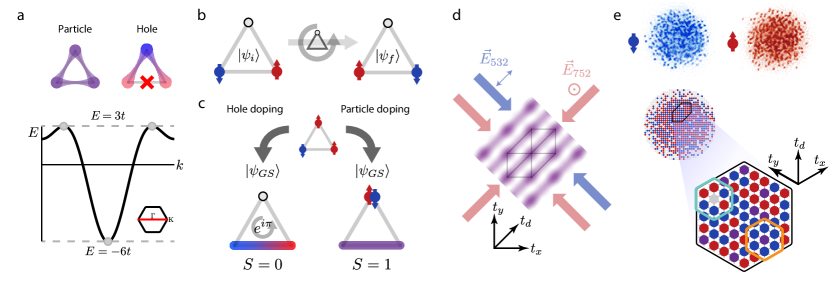
The emergence of quasiparticles in quantum many-body systems underlies the rich phenomenology in many strongly interacting materials. In the context of doped Mott insulators, magnetic polarons are quasiparticles that usually arise from an interplay between the kinetic energy of doped charge carriers and superexchange spin interactions. However, in kinetically frustrated lattices, itinerant spin polarons - bound states of a dopant and a spin-flip - have been theoretically predicted even in the absence of superexchange coupling. Despite their important role in the theory of kinetic magnetism, a microscopic observation of these polarons is lacking. Here we directly image itinerant spin polarons in a triangular lattice Hubbard system realised with ultracold atoms, revealing enhanced antiferromagnetic correlations in the local environment of a hole dopant. In contrast, around a charge dopant, we find ferromagnetic correlations, a manifestation of the elusive Nagaoka effect. We study the evolution of these correlations with interactions and doping, and use higher-order correlation functions to further elucidate the relative contributions of superexchange and kinetic mechanisms. The robustness of itinerant spin polarons at high temperature paves the way for exploring potential mechanisms for hole pairing and superconductivity in frustrated systems. Furthermore, our work provides microscopic insights into related phenomena in triangular lattice moiré materials.
Motivation & Objective
- To experimentally observe itinerant spin polarons in a kinetically frustrated triangular lattice Hubbard system.
- To investigate the interplay between kinetic frustration and magnetic correlations in doped Mott insulators.
- To distinguish the roles of superexchange versus kinetic mechanisms in polaron formation.
- To probe the robustness of quasiparticles in the absence of superexchange coupling at high temperatures.
- To provide microscopic insights into emergent phenomena in triangular lattice moiré materials and high-temperature superconductors.
Proposed method
- Realizing a triangular lattice Fermi-Hubbard system with ultracold 40K atoms in an optical lattice with tunable interactions and tunneling.
- Using in situ single-site resolved fluorescence imaging to detect individual spin-up and spin-down atoms, including dopants and their local spin environments.
- Measuring spin-spin correlation functions (three- and four-point correlators) to identify polaronic structures and magnetic order around dopants.
- Applying a loss imaging fidelity correction (≈0.96) to experimental data to account for detection inefficiencies in the DQMC-theory comparison.
- Performing dynamical quantum Monte Carlo (DQMC) simulations to model the many-body system and compare with experimental data across varying U/t, T/t, and doping levels.
- Using higher-order correlation functions to disentangle contributions from superexchange and kinetic mechanisms in polaron formation.
Experimental results
Research questions
- RQ1Can itinerant spin polarons be directly imaged in a kinetically frustrated Hubbard system without superexchange coupling?
- RQ2How do spin correlations evolve around hole and particle dopants in a triangular lattice Mott insulator?
- RQ3What is the relative contribution of superexchange versus kinetic frustration to polaron formation in frustrated lattices?
- RQ4How robust are quasiparticles in the absence of long-range magnetic order and at high temperatures?
- RQ5To what extent do the observed correlations in ultracold atoms mirror those in moiré materials and high-temperature superconductors?
Key findings
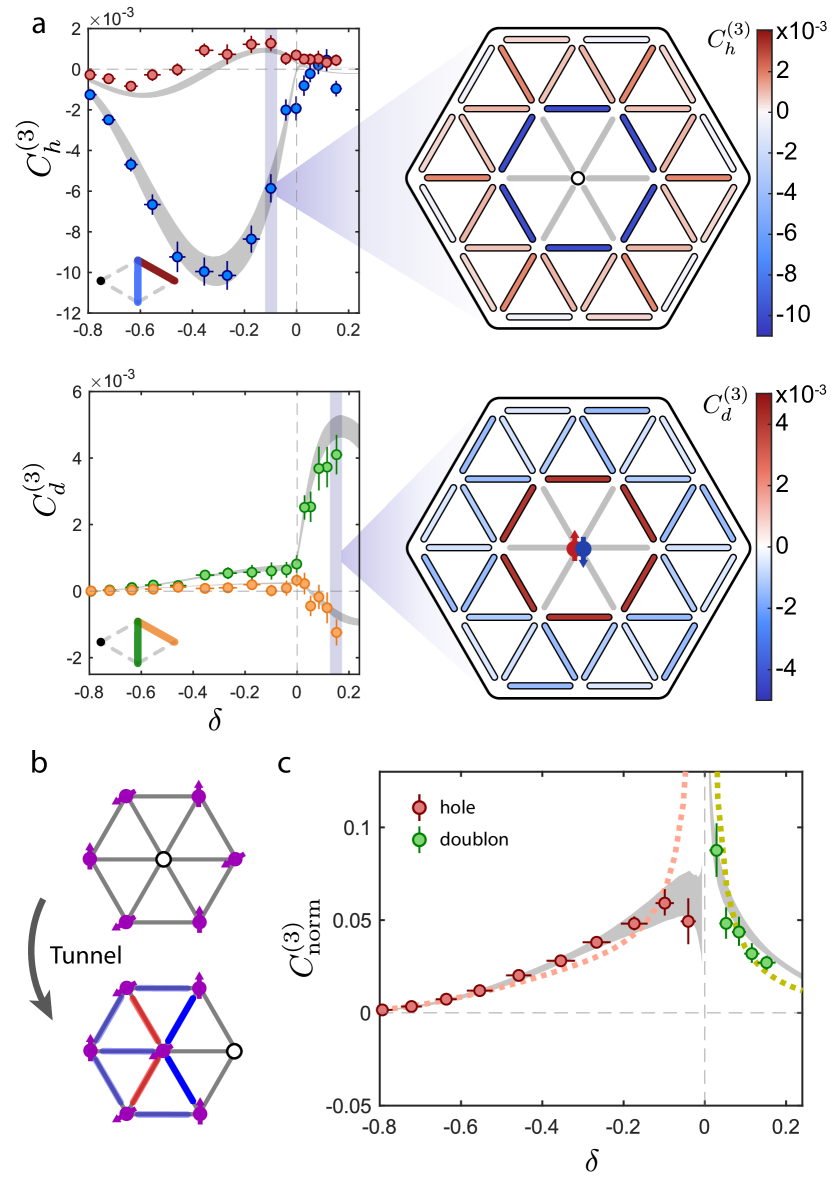
- Direct imaging reveals antiferromagnetic spin correlations in the local environment of hole dopants, confirming the formation of itinerant spin polarons.
- Particle dopants induce ferromagnetic spin correlations, providing experimental evidence for the Nagaoka effect in a triangular lattice.
- Spin polarons remain robust at high temperatures (T/t ≈ 0.95), even when superexchange energy scale is suppressed, indicating kinetic frustration drives quasiparticle formation.
- The three-point spin correlator $ C^{(3)}_{h} $ reaches a minimum at doping ≈ -0.3, while $ C^{(3)}_{d} $ peaks at ≈ +0.15, indicating distinct polaronic behavior for holes and particles.
- DQMC simulations corrected for imaging fidelity show excellent agreement with experimental data, validating the theoretical model of kinetic frustration as the dominant mechanism.
- The onset of sharp features in $ C^{(3)} $ near half-filling becomes more pronounced with increasing interaction strength (U/t), indicating enhanced polaronic character at strong correlations.
Better researchstarts right now
From reading papers to final review, dramatically reduce your research time.
No credit card · Free plan available
This review was created by AI and reviewed by human editors.