
[Paper Review] Distributed Optimal Control and Application to Consensus of Multi-Agent Systems
This paper proposes a distributed optimal control framework for consensus in discrete-time linear heterogeneous multi-agent systems by minimizing weighted state errors through Riccati equation-based controllers and observers that incorporate historical state information. The method achieves faster convergence than traditional consensus algorithms without requiring computation of Laplacian eigenvalues, and the global cost function is asymptotically optimal.
This paper develops a novel approach to the consensus problem of multi-agent systems by minimizing a weighted state error with neighbor agents via linear quadratic (LQ) optimal control theory. Existing consensus control algorithms only utilize the current state of each agent, and the design of distributed controller depends on nonzero eigenvalues of the communication topology. The presented optimal consensus controller is obtained by solving Riccati equations and designing appropriate observers to account for agents' historical state information. It is shown that the corresponding cost function under the proposed controllers is asymptotically optimal. Simulation examples demonstrate the effectiveness of the proposed scheme, and a much faster convergence speed than the conventional consensus methods. Moreover, the new method avoids computing nonzero eigenvalues of the communication topology as in the traditional consensus methods.
Motivation & Objective
- Address the limitation of existing consensus algorithms that rely only on current state information and require computation of nonzero eigenvalues of the communication topology’s Laplacian matrix.
- Develop a distributed control protocol for heterogeneous multi-agent systems that leverages historical state data to improve convergence speed and stability.
- Ensure the global cost function under the proposed controller is asymptotically optimal through linear quadratic (LQ) optimal control theory.
- Eliminate the need for eigenvalue computation in the design of consensus controllers, reducing computational burden in large-scale networks.
- Design an observer-based controller that estimates state errors using past information, enabling faster and more robust consensus.
Proposed method
- Formulate the consensus problem as a distributed optimal control task by minimizing a weighted sum of state errors between each agent and its neighbors.
- Design a state feedback controller using solutions to the Algebraic Riccati Equation (ARE) derived from LQ optimal control theory.
- Incorporate an observer to estimate the state error vector using historical state information, improving convergence speed beyond current-state-only methods.
- Construct the observer gain via optimization of a cost function, ensuring asymptotic stability of the error dynamics.
- Decompose the global system into local controller and observer structures, enabling fully distributed implementation without centralized coordination.
- Ensure the closed-loop system matrix has a spectral radius less than one, guaranteeing asymptotic consensus and stability.
Experimental results
Research questions
- RQ1Can a distributed optimal control framework be designed for multi-agent consensus that leverages historical state information to improve convergence speed?
- RQ2How can the LQ optimal control framework be adapted to heterogeneous multi-agent systems with different system dynamics?
- RQ3What is the impact of incorporating observer-based state estimation using past data on the convergence rate of consensus algorithms?
- RQ4Can the proposed method achieve asymptotic optimality of the global cost function without requiring computation of the Laplacian matrix’s nonzero eigenvalues?
- RQ5How does the proposed controller compare in convergence speed and stability to traditional consensus methods relying only on current-state feedback?
Key findings
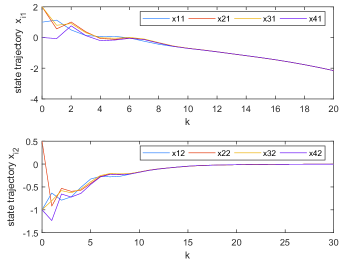
- The proposed controller achieves consensus in 12 steps in Example 1, compared to 25 steps using the traditional method (M1), demonstrating a significant improvement in convergence speed.
- The spectral radius of the closed-loop system matrix under the proposed method (M2) is 0.7876, compared to 0.8777 under the traditional method (M1), indicating faster convergence dynamics.
- The norm of the first agent’s state under M2 remains below 2.0 at step 20, while under M1 it grows to 3.9881, confirming superior transient performance.
- Observer error vectors converge to zero within 15 steps, validating the stability and accuracy of the state estimation mechanism.
- The method avoids computing nonzero eigenvalues of the Laplacian matrix, significantly reducing computational complexity in large-scale networks.
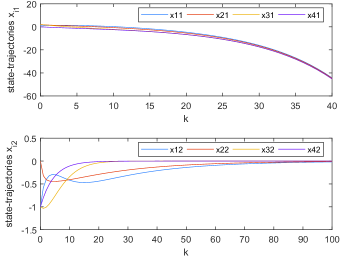
- In Example 2, all agents achieve consensus to zero within 10 steps, and observer error systems are asymptotically stable, confirming robustness and effectiveness.
Read this paper
Open the full text in the Nubint reader and ask about any passage as you read.
Read this paper on NubintThis review was generated by AI from the original paper. Please check the paper before citing it.