
[Paper Review] DrBERT: A Robust Pre-trained Model in French for Biomedical and Clinical domains
This paper introduces DrBERT, the first RoBERTa-based pre-trained language model for French in biomedical and clinical domains, trained on a large open medical corpus (NACHOS). It demonstrates that continual pre-training on public biomedical web data can outperform models trained on private clinical data, achieving state-of-the-art performance across multiple French medical NLP tasks while releasing both models and data under open licenses.
In recent years, pre-trained language models (PLMs) achieve the best performance on a wide range of natural language processing (NLP) tasks. While the first models were trained on general domain data, specialized ones have emerged to more effectively treat specific domains. In this paper, we propose an original study of PLMs in the medical domain on French language. We compare, for the first time, the performance of PLMs trained on both public data from the web and private data from healthcare establishments. We also evaluate different learning strategies on a set of biomedical tasks. In particular, we show that we can take advantage of already existing biomedical PLMs in a foreign language by further pre-train it on our targeted data. Finally, we release the first specialized PLMs for the biomedical field in French, called DrBERT, as well as the largest corpus of medical data under free license on which these models are trained.
Motivation & Objective
- To develop the first specialized pre-trained language model for French in the biomedical and clinical domain.
- To evaluate and compare different pre-training strategies—training from scratch, continual pre-training, and hybrid approaches—on medical NLP tasks.
- To release the largest open-access French medical text corpus (NACHOS) and open-source DrBERT models under permissive licenses.
- To assess the effectiveness of cross-lingual knowledge transfer by fine-tuning English biomedical models (e.g., PubMedBERT) on French data.
- To benchmark performance across both public and private medical NLP tasks, including named entity recognition, part-of-speech tagging, and multi-label classification.
Proposed method
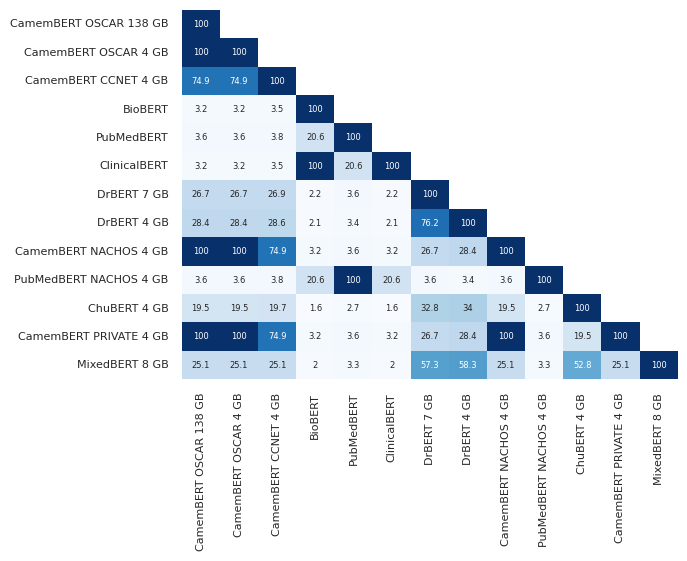
- Pre-trained RoBERTa-based models on a large-scale, publicly available French biomedical corpus (NACHOS), crawled from multiple online sources.
- Evaluated multiple pre-training strategies: training from scratch on NACHOS, continual pre-training on existing models (e.g., CamemBERT), and fine-tuning PubMedBERT on French medical data.
- Constructed a comprehensive benchmark of 12 diverse medical NLP tasks, including multi-label classification, NER, POS tagging, and natural language inference.
- Used domain-specific data from hospital reports (ChuBERT) and public biomedical web sources (NACHOS) for comparative analysis.
- Applied dynamic masking and optimized training hyperparameters (batch size, learning rate, sequence length) to improve model convergence and performance.
- Released all models and training scripts under the MIT license and the NACHOS corpus under CC0 1.0, ensuring full reproducibility and accessibility.
Experimental results
Research questions
- RQ1Can pre-training on publicly available biomedical web data in French achieve performance comparable to or better than models trained on private clinical data from healthcare institutions?
- RQ2Does continual pre-training of an existing English biomedical model (e.g., PubMedBERT) on French medical data yield better results than fine-tuning a general-domain French model like CamemBERT?
- RQ3How do DrBERT models perform across a diverse set of French medical NLP tasks compared to both general-domain and English biomedical models?
- RQ4To what extent does domain-specific pre-training improve performance on syntactic and semantic tasks in the French biomedical domain?
- RQ5Can cross-lingual knowledge transfer from English biomedical models significantly enhance performance on French downstream tasks?
Key findings
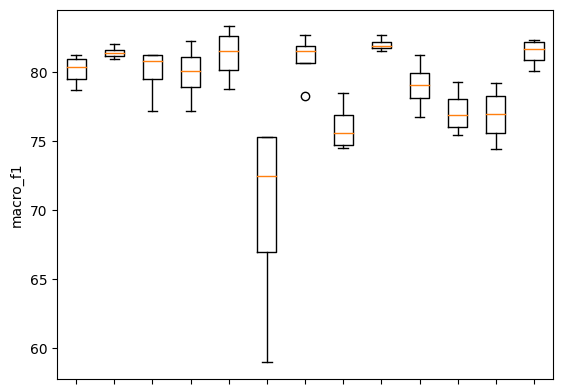
- DrBERT models pre-trained on the NACHOS corpus outperformed both CamemBERT and English biomedical models (BioBERT, PubMedBERT, ClinicalBERT) on all evaluated French medical NLP tasks.
- Models trained on public biomedical web data (NACHOS) achieved performance comparable to or better than models trained on private clinical data from hospital reports, despite the latter being more specialized.
- Continual pre-training of PubMedBERT on French NACHOS data (PubMedBERT NACHOS small) yielded state-of-the-art results, demonstrating effective cross-lingual knowledge transfer.
- The performance drop on general-domain tasks (e.g., XNLI) was significant for specialized models like ChuBERT, indicating limited generalization capability.
- The environmental cost of training the 7 DrBERT models was substantial, totaling 25,500 GPU hours and equivalent to 376.45 kg CO2eq, highlighting high computational demands.
Read this paper
Open the full text in the Nubint reader and ask about any passage as you read.
Read this paper on NubintThis review was generated by AI from the original paper. Please check the paper before citing it.