
[Paper Review] Dry-to-Wet Soil Gradients Enhance Convection and Rainfall over Subtropical South America
This study reveals that dry-to-wet soil moisture (SM) gradients of tens of kilometers enhance convection and rainfall over subtropical South America by generating mesoscale circulations that trigger deep convection over drier soils. The sign of the soil moisture-precipitation (SM-PPT) feedback depends critically on background wind: weak winds lead to negative feedback (rainfall confined to dry patches), while strong winds enable propagation and positive feedback (rainfall downwind), highlighting a key challenge for convective-scale modeling.
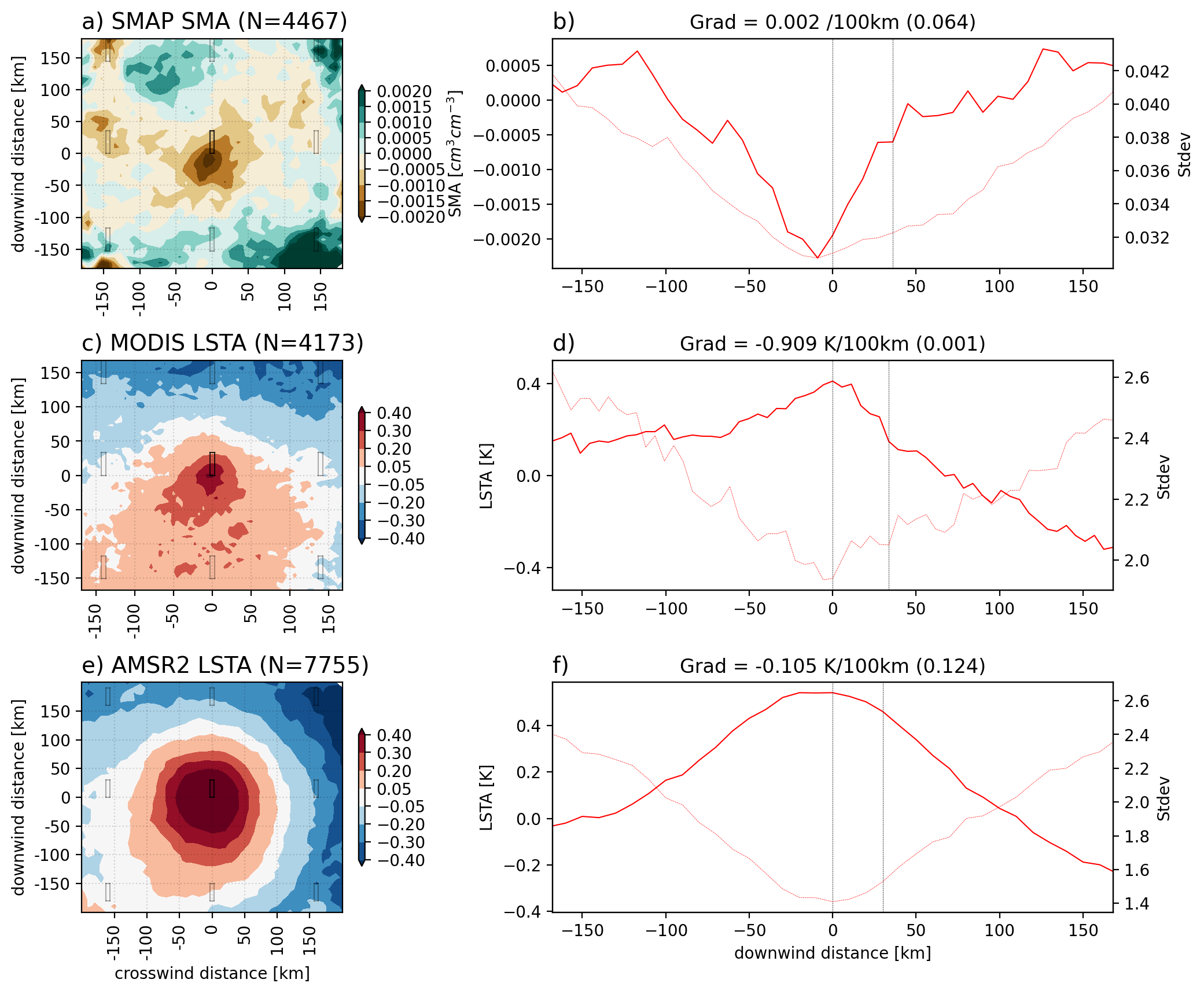
Soil moisture-precipitation (SM-PPT) feedbacks at the mesoscale represent a major challenge for numerical weather prediction, especially for subtropical regions that exhibit large variability in surface SM. How does surface heterogeneity, specifically mesoscale gradients in SM and land surface temperature (LST), affect convective initiation (CI) over South America? Using satellite data, we track nascent, daytime convective clouds and quantify the underlying antecedent (morning) surface heterogeneity. We find that convection initiates preferentially on the dry side of strong SM/LST boundaries with spatial scales of tens of kilometers. The strongest alongwind gradients in LST anomalies at 30 km length scale underlying the CI location occur during weak background low-level wind (<2.5m/s), high convective available potential energy (>1500J/kg) and low convective inhibition (<250J/kg) over sparse vegetation. At 100 km scale, strong gradients occur at the CI location during convectively unfavorable conditions and strong background flow. The location of PPT is strongly sensitive to the strength of the background flow. The wind profile during weak background flow inhibits propagation of convection away from the dry regions leading to negative SM-PPT feedback whereas strong background flow is related to longer lifecycle and rainfall hundreds of kilometers away from the CI location. Thus, the sign of the SM-PPT feedback is dependent on the background flow. This work presents the first observational evidence that CI over subtropical South America is associated with dry soil patches on the order of tens of kilometers. Convection-permitting numerical weather prediction models need to be examined for accurately capturing the effect of SM heterogeneity in initiating convection over such semi-arid regions.
Motivation & Objective
- To understand how mesoscale soil moisture (SM) and land surface temperature (LST) heterogeneity influence convective initiation (CI) in subtropical South America.
- To quantify the role of background wind, CAPE, and CIN in modulating SM-PPT feedbacks at convective scales.
- To assess the sensitivity of convection and rainfall to spatial scale (30 km vs. 100 km) of SM/LST gradients.
- To evaluate the impact of vegetation cover and topography on mesoscale circulation and CI over heterogeneous surfaces.
- To provide observational evidence for SM-PPT feedback sign dependence on background flow, critical for improving convection-permitting models.
Proposed method
- Tracked nascent daytime convective clouds using satellite data to identify convective initiation (CI) locations across subtropical South America.
- Analyzed antecedent morning surface heterogeneity using 30 km and 100 km spatial scales for SM and LST anomalies.
- Utilized multi-satellite datasets: GPM-IMERG for precipitation, SMAP for microwave SM, MODIS and AMSR2 for LST, ERA5 for wind, CAPE, and CIN.
- Computed alongwind gradients in LST anomalies (LSTA) and assessed their correlation with CI occurrence under varying background wind conditions.
- Classified conditions into weak (≤2.5 m/s) and strong (>2.5 m/s) background wind regimes to evaluate feedback sign.
- Mapped PPT anomalies over 24 hours post-CI to assess propagation and feedback strength.

Experimental results
Research questions
- RQ1Does convection preferentially initiate over dry soil patches adjacent to wetter regions in subtropical South America?
- RQ2How do SM/LST gradients of 30 km and 100 km scales influence mesoscale circulation and CI likelihood?
- RQ3What is the role of background wind speed in determining the sign of the SM-PPT feedback?
- RQ4How do vegetation cover and topography modulate the effectiveness of SM heterogeneity in triggering convection?
- RQ5To what extent does convective propagation from dry to wet regions alter the spatial pattern of rainfall and feedback sign?
Key findings
- Convection initiates preferentially on the dry side of strong SM/LST gradients, particularly at 30 km spatial scales under weak background wind (<2.5 m/s).
- The strongest alongwind LST gradients (30 km scale) occur during conditions of high CAPE (>1500 J/kg) and low CIN (<250 J/kg), favoring CI over sparse vegetation.
- At 100 km scale, strong gradients can initiate convection even under strong background wind (>2.5 m/s) by generating mesoscale circulations that overcome mixing effects.
- In complex terrain, 100 km-scale SM patchiness can induce upslope flow that enhances convection over the eastern Andes and Brazilian Highlands, opposing downslope winds.
- Under weak background wind, convection remains anchored to the dry patch, resulting in negative SM-PPT feedback (rainfall over dry soil).
- Under strong background wind, convective systems propagate hundreds of kilometers downwind, leading to positive SM-PPT feedback and rainfall far from the CI location.
Better researchstarts right now
From reading papers to final review, dramatically reduce your research time.
No credit card · Free plan available
This review was created by AI and reviewed by human editors.