
[论文解读] Effective bi-layer model Hamiltonian and density-matrix renormalization group study for the high-Tc superconductivity in La$_{3}$Ni$_{2}$O$_{7}$ under high pressure
本文提出一种有效的双层双轨道模型用于高压下的La3Ni2O7,并在最小设置上应用DMRG,显示竞争的CDW趋势和自旋成对配对相关性,表明层内和层间配对通道。
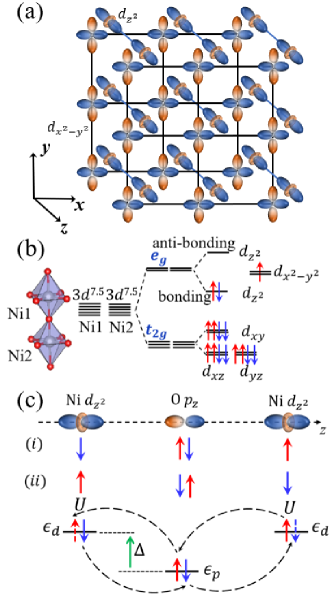
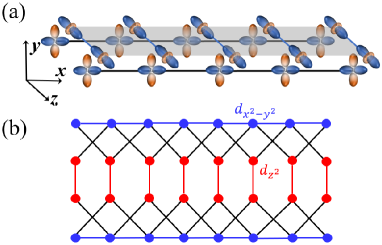
High-Tc superconductivity with possible $T_{c}\approx 80K$ has been reported in the single crystal of $ ext{La}_{3} ext{Ni}_{2} ext{O}_{7}$ under high pressure. Based on the electronic structure given from the density functional theory calculations, we propose an effective bi-layer model Hamiltonian including both $3d_{z^{2}}$ and $3d_{x^{2}-y^{2}}$ orbital electrons of the nickel cations. The main feature of the model is that the $3d_{z^{2}}$ electrons form inter-layer $σ$-bonding and anti-bonding bands via the apical oxygen anions between the two layers, while the $3d_{x^{2}-y^{2}}$ electrons hybridize with the $3d_{z^{2}}$ electrons within each NiO$_2$ plane. The chemical potential difference of these two orbital electrons ensures that the $3d_{z^{2}}$ orbitals are close to half-filling and the $3d_{x^{2}-y^{2}}$ orbitals are near quarter-filling. The strong on-site Hubbard repulsion of the $3d_{z^{2}}$ orbital electrons gives rise to an effective inter-layer antiferromagnetic spin super-exchange $J$. Applying pressure can self-dope holes on the $3d_{z^{2}}$ orbitals with the same amount of electrons doped on the $3d_{x^{2}-y^{2}}$ orbitals. By performing numerical density-matrix renormalization group calculations on a minimum setup and focusing on the limit of large $J$ and small doping of $3d_{z^{2}}$ orbitals, we find the superconducting instability on both the $3d_{z^{2}}$ and $3d_{x^{2}-y^{2}}$ orbitals by calculating the equal-time spin singlet pair-pair correlation function. Our numerical results have provided useful insights in the high-Tc superconductivity in single crystal La$_3$Ni$_2$O$_7$ under high pressure.
研究动机与目标
- 通过轨道分辨的双层框架推动在高压下寻找La3Ni2O7的高Tc超导性。
- 基于DFT见解,构建一个包含3d_{z^2}和3d_{x^2−y^2}轨道的有效双层模型。
- 通过数值DMRG在简化几何中研究基态性质和可能的超导不稳定性。
提出的方法
- 推导一个有效双层哈密顿量,包含层间3d_{z^2} sigma键合和层内3d_{x^2−y^2}物理,并对3d_{z^2}设定强的就地U。
- 包括层间交换J在3d_{z^2}自旋之间以及一个有限的混杂t_{x^{2}-y^{2},z^{2}},使两轨道在同一层内耦合。
- 将 t_{z^{2}} 设为能量单位,t_{x^{2}-y^{2}}=0.8 且 t_{x^{2}-y^{2},z^{2}}=0.4;忽略z^2的层内跳跃并禁止z^2的双占用。
- 在最小的一维设置(L=32)上应用DMRG来计算电荷密度、自旋密度和等时自旋-成对相关性 D(i,j)。
- 在大J和小 z^2 掺杂极限下分析以识别可能的CDW模式和超导不稳定性。
实验结果
研究问题
- RQ1在大J和低z^2掺杂区域提出的双层模型是否支持超导相关性?
- RQ2两轨道中电荷密度波模式的特征是什么,它们如何与潜在的配对通道相互作用?
- RQ3哪个轨道在主要驱动超导性,以及在本框架中配对的性质(层内 vs 层间)?
- RQ4压力诱导的自掺杂如何影响3d_{z^2}与3d_{x^2−y^2}轨道之间的空穴/电子分布?
主要发现
- 在DMRG最小设置中,3d_{z^2}电子表现出波长为5的CDW有序,且3d_{x^2−y^2}电子大致波长为3。
- 在局部自旋密度保持短程且对两轨道在固定场下呈参量性,表明没有长程磁序。
- 等时自旋成对相关在两个轨道上呈代数衰减,3d_{z^2}的K_sc=1.51(1),3d_{x^2−y^2}的K_sc=0.74(7),这提示准长程超导趋势。
- 3d_{z^2}配对归因于层间单态形成,3d_{x^2−y^2}配对来自两个轨道之间的杂化。
- 层内配对对于3d_{x^2−y^2}较层间配对在3d_{z^2}上更强,这与通过与带状电子的杂化而获得相干性的配对情景一致。
更好的研究,从现在开始
从论文设计到论文写作,大幅缩短您的研究时间。
无需绑定信用卡
本解读由 AI 生成,并经人工编辑审核。