
[Paper Review] Efficient DCQO Algorithm within the Impulse Regime for Portfolio Optimization
This paper proposes an efficient digitized-counterdiabatic quantum optimization (DCQO) algorithm in the impulse regime—where counterdiabatic terms dominate—for portfolio optimization. By reducing circuit depth by factors of 2.5 to 40 and minimizing reliance on classical optimization, the method achieves higher solution accuracy on 20-qubit IonQ trapped-ion hardware, demonstrating significant improvements over standard QAOA and finite-time digitized-adiabatic approaches.
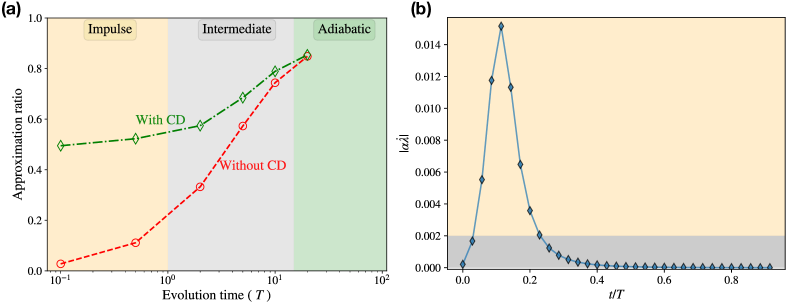
We propose a faster digital quantum algorithm for portfolio optimization using the digitized-counterdiabatic quantum optimization (DCQO) paradigm in the impulse regime, that is, where the counterdiabatic terms are dominant. Our approach notably reduces the circuit depth requirement of the algorithm and enhances the solution accuracy, making it suitable for current quantum processors. We apply this protocol to a real-case scenario of portfolio optimization with 20 assets, using purely quantum and hybrid classical-quantum paradigms. We experimentally demonstrate the advantages of our protocol using up to 20 qubits on an IonQ trapped-ion quantum computer. By benchmarking our method against the standard quantum approximate optimization algorithm and finite-time digitized-adiabatic algorithms, we obtain a significant reduction in the circuit depth by factors of 2.5 to 40, while minimizing the dependence on the classical optimization subroutine. Besides portfolio optimization, the proposed method is applicable to a large class of combinatorial optimization problems.
Motivation & Objective
- To address the high circuit depth and noise sensitivity of existing quantum algorithms for portfolio optimization on NISQ devices.
- To improve solution accuracy and reduce reliance on classical optimization subroutines in variational quantum algorithms.
- To implement and benchmark a fast, purely quantum DCQO protocol in the impulse regime for real-world combinatorial optimization.
- To demonstrate experimental viability on a 20-qubit IonQ trapped-ion processor using real financial data.
- To extend the applicability of DCQO to a broad class of constrained combinatorial optimization problems beyond finance.
Proposed method
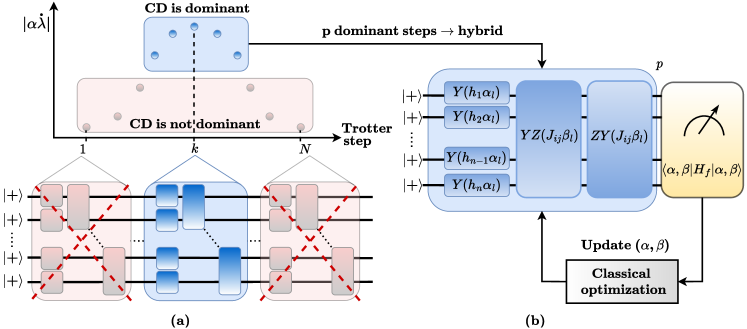
- The method employs digitized-counterdiabatic quantum optimization (DCQO) in the impulse regime, where counterdiabatic (CD) terms dominate over adiabatic evolution, enabling fast, non-adiabatic evolution.
- It introduces a modified definition of the approximation ratio to better evaluate solution quality under noisy, shallow-circuit conditions.
- The CD term is derived from the derivative of the path-ordered evolution, with $ H_{CD} = -2 ilde{ heta} \alpha_1 \left( \sum_i h_i Y_i + \sum_{i<j} J_{ij}(Y_i Z_j + Z_i Y_j) \right) $, where $ \alpha_1 $ depends on system parameters and the path function $ R(t) $.
- The algorithm is implemented using native IonQ gates—GPi, GPi2, and MS gates—via transpilation on Amazon Braket, with error mitigation via systematic bias correction.
- The protocol is tested both classically and experimentally on a 20-asset portfolio problem using purely quantum and hybrid classical-quantum (h-DCQO) variants.
- Circuit depth is minimized by leveraging the impulse regime, reducing the number of parametrized gates and avoiding deep PQC structures common in QAOA.
Experimental results
Research questions
- RQ1Can a DCQO algorithm in the impulse regime significantly reduce circuit depth while maintaining or improving solution accuracy in portfolio optimization?
- RQ2How does the performance of the impulse-regime DCQO compare to standard QAOA and finite-time digitized-adiabatic algorithms in terms of approximation ratio and circuit depth?
- RQ3To what extent can the classical optimization subroutine be minimized in hybrid quantum-classical algorithms through improved quantum control?
- RQ4Can the proposed DCQO protocol be successfully implemented and benchmarked on real 20-qubit trapped-ion hardware with real financial data?
- RQ5What is the scalability and robustness of the impulse-regime DCQO for larger combinatorial optimization problems?
Key findings
- The DCQO algorithm reduced circuit depth by factors of 2.5 to 40 compared to standard QAOA and finite-time digitized-adiabatic algorithms on the same 20-asset portfolio problem.
- The method achieved higher solution accuracy by minimizing the dependence on classical optimization subroutines, which are a major source of noise and convergence issues in variational algorithms.
- Experimental results on the IonQ trapped-ion processor confirmed the advantages of the impulse-regime DCQO, demonstrating feasibility on current NISQ hardware.
- The modified approximation ratio metric showed consistent improvement in solution quality under noisy, shallow-circuit conditions.
- The transpilation pipeline successfully mapped logical gates to IonQ’s native GPi, GPi2, and MS gates, with error mitigation applied via systematic bias correction.
- The protocol is generalizable to a broad class of combinatorial optimization problems beyond portfolio optimization.
Better researchstarts right now
From reading papers to final review, dramatically reduce your research time.
No credit card · Free plan available
This review was created by AI and reviewed by human editors.