
QUICK REVIEW
[论文解读] Efficient phase-space generation for hadron collider event simulation
Enrico Bothmann, J. T. Childers|arXiv (Cornell University)|Feb 21, 2023
Particle physics theoretical and experimental studies参考文献 39被引用 7
一句话总结
本论文提出 Chili,一种简单高效的多通道相空间积分器,用于强子对撞机事件模拟,结合了t通道产生与s通道衰变,并可选限制s通道拓扑,且实现了MPI并行化,在LHC样本场景中结合 Sherpa 进行了测试。
ABSTRACT
We present a simple yet efficient algorithm for phase-space integration at hadron colliders. Individual mappings consist of a single t-channel combined with any number of s-channel decays, and are constructed using diagrammatic information. The factorial growth in the number of channels is tamed by providing an option to limit the number of s-channel topologies. We provide a publicly available, parallelized code in C++ and test its performance in typical LHC scenarios.
研究动机与目标
- 动机与解决高维强子对撞机模拟中高效相空间积分的需求。
- 开发一个简单的、受图谱启发的相空间积分器,在保留多通道的关键特性同时控制组合复杂度。
- 提供一个公开的 C++ 实现(Chili),具备基于 Vegas 的积分和 MPI 并行化,以及 Python 绑定和 TensorFlow 接口以支持 ML 驱动的 pilot。
- 在典型的 LHC 类过程上展示 Chili 的性能,并讨论与 NLO 折扣方案及基于归一化流的积分器的集成。)
- method(译文)
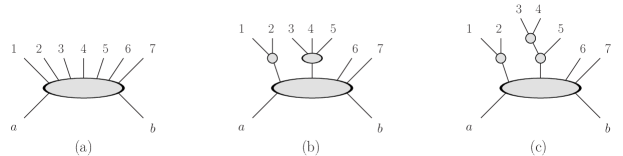
- 将 n 粒子相空间通过图解分解为 t 通道产生和 s 通道衰变,通过重复应用分解公式(Eq. 2)进行分解。
- 使用显式表达式构造 t-、s-通道的构建块以及 dΦn 元件(Eq. 5)和两体衰变映射(Eq. 7)的公式。
- 通过限制最大 s 通道拓扑数量来控制组合增长(Chili 与 Chili basic 的对比)。
- 为中间共振引入 Breit-Wigner 或 ds/sα 分布,并使用灵活的 p⊥、速率/角度映射以匹配实验切割。
- 与多通道算法(Kleiss-Pittau 方法)集成,并支持 Catani-Seymour 启发的 dipole 映射用于 NLO 的实际发射扣除(FF、FI/IF、II 配置)。
- 通过提供 t 通道核心映射,将 n 粒子相空间映射到 3n-4+2 维单位超立方体,并提供 Python/TensorFlow 接口,使其与归一化流基积分框架兼容。
提出的方法
- Decompose the n-particle phase-space using diagram-based factorization into t-channel production and s-channel decays via repeated application of the factorization formula (Eq. 2).
- Construct t- and s-channel building blocks with explicit expressions for dΦn elements (Eq. 5) and two-body decay mappings (Eq. 7).
- Control combinatorial growth by limiting the maximum number of s-channel topologies (Chili vs Chili basic).
- Incorporate Breit-Wigner or ds/sα distributions for intermediate resonances and flexible p⊥ and rapidity/angle mappings to match experimental cuts.
- Integrate with multi-channel algorithm (Kleiss-Pittau approach) and support Catani-Seymour dipole mappings for real-emission subtraction at NLO (FF, FI/IF, II configurations).
- Enable compatibility with normalizing-flow based integrators by providing a t-channel core mapping that maps the n-particle phase-space into a 3n-4+2 dimensional unit hypercube and offering Python/TensorFlow interfaces.]
- research_questions: [
实验结果
研究问题
- RQ1How can phase-space integration for hadron colliders be made simpler yet remain efficient by leveraging diagrammatic structure?
- RQ2What is the impact of restricting s-channel topologies on integration efficiency and accuracy across typical LHC processes?
- RQ3How can a standalone phase-space integrator be integrated with existing matrix-element generators and NLO subtraction schemes?
- RQ4Can the basic t-channel mapping serve effectively as a bridge to ML-based (normalizing-flow) integration frameworks?
- RQ5What performance gains (accuracy and speed) are achievable when comparing Chili to existing frameworks like Sherpa across a range of multiplicities and jet counts?
主要发现
- Chili achieves competitive Monte Carlo uncertainties and unweighting efficiencies relative to Sherpa for several LO processes up to multi-jet final states (as shown in the benchmark tables).
- The multi-channel approach, with optional limiting of s-channel topologies, provides a tunable balance between accuracy and computational cost suitable for high-multiplicity final states.
- The integration framework supports NLO dipole mappings and can interface with Sherpa’s Comix and Amegic generators, enabling real-emission NLO corrections via Catani-Seymour subtraction.”
- Chili provides Python bindings via nanobind and TensorFlow interfaces, enabling use with normalizing-flow based integrators (iFlow, MadNIS).
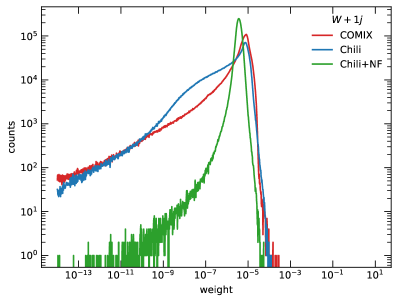
- Performance benchmarks show that Chili (with basic s-channel topology) maintains efficiency comparable to Sherpa across W, Z, h, t t̄, γ+jets, and QCD jet production in LO setups, and scales to boosted topologies with controlled MC uncertainties.
更好的研究,从现在开始
从论文设计到论文写作,大幅缩短您的研究时间。
无需绑定信用卡
本解读由 AI 生成,并经人工编辑审核。