
[论文解读] EGNet:Edge Guidance Network for Salient Object Detection
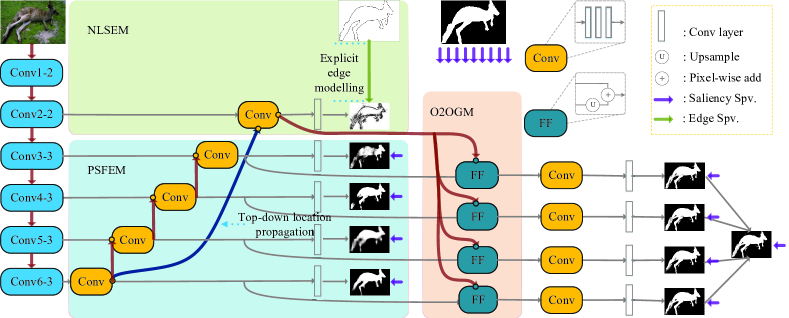
EGNet 将互补的显著边缘信息与显著对象信息整合在一个网络中,使用一个非局部边缘特征提取器和一对一引导融合来提高显著对象检测的边界保持与定位。
Fully convolutional neural networks (FCNs) have shown their advantages in the salient object detection task. However, most existing FCNs-based methods still suffer from coarse object boundaries. In this paper, to solve this problem, we focus on the complementarity between salient edge information and salient object information. Accordingly, we present an edge guidance network (EGNet) for salient object detection with three steps to simultaneously model these two kinds of complementary information in a single network. In the first step, we extract the salient object features by a progressive fusion way. In the second step, we integrate the local edge information and global location information to obtain the salient edge features. Finally, to sufficiently leverage these complementary features, we couple the same salient edge features with salient object features at various resolutions. Benefiting from the rich edge information and location information in salient edge features, the fused features can help locate salient objects, especially their boundaries more accurately. Experimental results demonstrate that the proposed method performs favorably against the state-of-the-art methods on six widely used datasets without any pre-processing and post-processing. The source code is available at http: //mmcheng.net/egnet/.
研究动机与目标
- 通过利用边缘线索和位置信息来保持显著对象边界。
- 建模两条互补信息流:显著对象特征和显著边缘特征。
- 开发一个通过一对一引导机制融合边缘信息与多分辨率对象特征以生成细化的显著性预测的单网络。
提出的方法
- 使用像 U-Net 的渐进式融合与侧路径和深度监督,提取多分辨率的显著对象特征。
- 引入一个非局部显著边缘特征模块,通过自顶向下的传播方案将局部边缘线索与全局位置信息融合。
- 用专门的边缘图Cross-Entropy 损失计算边缘监督。
- 提出一个一对一引导模块,将边缘特征与多分辨率对象特征融合,产生细化的显著性预测。
- 以来自边缘和对象通路的联合损失进行训练,包括深度监督和融合后的最终图。
实验结果
研究问题
- RQ1是否能够在单个网络中有效建模并融合显著边缘信息与位置信息与显著对象特征?
- RQ2与基线的多尺度融合相比,一对一引导融合是否提升边界准确性和定位?
- RQ3边缘线索如何影响显著性边界的清晰度以及在标准基准上的总体检测性能?
主要发现
- EGNet 在六个数据集上在多项指标上取得了最新的性能,无需预处理或后处理。
- 边缘与对象特征的显式建模与相互引导提升了边界质量和定位。
- 自顶向下的位置传播与一对一引导相比仅边缘或简单融合策略有显著提升。
- 边缘引导的特征相比 NLDF 风格的边缘惩罚,产生更锐利的对象边界和更好的显著性图。
- 消融研究表明提出的组件(边缘传播、一对一融合)对基线有显著改进。
更好的研究,从现在开始
从论文设计到论文写作,大幅缩短您的研究时间。
无需绑定信用卡
本解读由 AI 生成,并经人工编辑审核。