
[Paper Review] Electromagnetic high-frequency gravitational wave detection
This paper proposes electromagnetic detection of high-frequency gravitational waves (MHz–THz) using resonant cavity and LC circuit detectors originally designed for axion searches, leveraging the induced electromagnetic fields generated by gravitational waves in background electromagnetic fields. It demonstrates that existing and planned axion experiments can achieve competitive sensitivity to coherent gravitational waves, with projected limits approaching the astrophysically relevant range for sources like primordial black hole mergers and axion cloud superradiance.
Ultra-high frequency gravitational waves in the MHz to THz regime promise a unique possibility to probe the very early universe, particle physics at very high energies and exotic astrophysical objects - but achieving the sensitivity required for detection is an immense challenge. This is a brief summary of recent progress in electromagnetic high-frequency gravitational wave searches, which are based on classical electromagnetism in a space-time perturbed by gravitational waves. A particular focus is given to synergies with axion searches and atomic precision measurements. This article was prepared as proceedings for Moriond EW 2023.
Motivation & Objective
- To explore the feasibility of detecting high-frequency gravitational waves (MHz–THz) using electromagnetic detectors originally designed for axion searches.
- To establish the theoretical framework linking gravitational wave-induced electromagnetic responses to the effective current formalism in linearized gravity.
- To quantify the sensitivity of existing and planned axion haloscopes and microwave cavity experiments to coherent gravitational wave signals.
- To identify and address key challenges in detecting high-frequency GWs, including coherence, detector geometry, and gauge invariance.
- To highlight synergies between gravitational wave detection and precision measurements in particle physics and atomic physics.
Proposed method
- Derives the effective electromagnetic current induced by gravitational waves in a weakly perturbed Minkowski spacetime using linearized gravity and classical electromagnetism.
- Applies the effective current formalism to show that gravitational waves generate an electromagnetic response analogous to axion coupling in external magnetic fields.
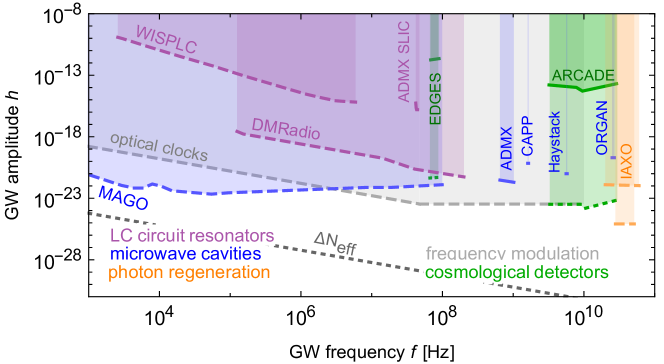
- Adapts the design of low-mass axion haloscopes (e.g., ABRACADABRA, ADMX SLIC, WISPLC, DMRadio) to detect gravitational waves via induced magnetic flux in resonant LC circuits.
- Uses microwave cavity resonators with high quality factor $ Q_{\rm em} $ to enhance the electromagnetic response to gravitational waves, modeling the coupling to cavity modes via a coupling coefficient $ \eta_n $.
- Recasts existing axion search bounds and sensitivities into gravitational wave strain limits by comparing the scaling of induced flux in axion and gravitational wave cases.
- Evaluates sensitivity to coherent gravitational wave signals by analyzing the parametric scaling of induced EM fields with frequency $ \omega $, detector size $ L $, and magnetic field $ B_0 $.
Experimental results
Research questions
- RQ1Can existing axion haloscopes be repurposed to detect high-frequency gravitational waves via electromagnetic induction?
- RQ2How does the geometry of resonant detectors (e.g., cylindrical symmetry) affect their sensitivity to gravitational wave-induced electromagnetic signals?
- RQ3What is the achievable sensitivity of microwave cavity experiments to coherent gravitational waves in the MHz–THz band?
- RQ4How do the scaling laws of induced electromagnetic fields in gravitational wave detection compare to those in axion detection?
- RQ5What are the key experimental and theoretical challenges in detecting high-frequency gravitational waves using electromagnetic methods?
Key findings
- Existing axion haloscopes such as ADMX SLIC can set competitive limits on gravitational wave strain, with recast bounds reaching $ h \sim 10^{-25} $ for coherent signals.
- The projected sensitivity of WISPLC and the DMRadio program is expected to reach $ h \sim 10^{-26} $ for coherent gravitational waves in the MHz–THz range.
- Cylindrical symmetry in LC circuits suppresses the leading-order gravitational wave response, but this can be overcome by breaking symmetry with pick-up loop configurations.
- Microwave cavity experiments achieve resonant enhancement of the induced electromagnetic field, scaling as $ E^{(\rm em)}_h \sim \eta_n Q_{\rm em} (\omega L) h B_0 $, enabling high sensitivity at high frequencies.
- Theoretical bounds from astrophysical environments such as cosmic magnetic fields (e.g., EDGES, ARCADE 2) are highly uncertain due to poor knowledge of magnetic field strength, with limits ranging from $ h \sim 10^{-25} $ to $ 10^{-23} $ depending on assumptions.
- Despite progress, even the most optimistic current proposals remain several orders of magnitude away from detecting realistic astrophysical or cosmological coherent gravitational wave signals.
Read this paper
Open the full text in the Nubint reader and ask about any passage as you read.
Read this paper on NubintThis review was generated by AI from the original paper. Please check the paper before citing it.