
[Paper Review] End-to-End Object Detection with Fully Convolutional Network
This paper proposes an end-to-end object detection framework using a fully convolutional network by introducing Prediction-aware One-To-One (POTO) label assignment and 3D Max Filtering (3DMF), eliminating the need for non-maximum suppression (NMS). The method achieves state-of-the-art performance, outperforming NMS-based detectors by 1.1% mAP on COCO and 6.0% mMR on CrowdHuman, with improved robustness in crowded scenes.
Mainstream object detectors based on the fully convolutional network has achieved impressive performance. While most of them still need a hand-designed non-maximum suppression (NMS) post-processing, which impedes fully end-to-end training. In this paper, we give the analysis of discarding NMS, where the results reveal that a proper label assignment plays a crucial role. To this end, for fully convolutional detectors, we introduce a Prediction-aware One-To-One (POTO) label assignment for classification to enable end-to-end detection, which obtains comparable performance with NMS. Besides, a simple 3D Max Filtering (3DMF) is proposed to utilize the multi-scale features and improve the discriminability of convolutions in the local region. With these techniques, our end-to-end framework achieves competitive performance against many state-of-the-art detectors with NMS on COCO and CrowdHuman datasets. The code is available at https://github.com/Megvii-BaseDetection/DeFCN .
Motivation & Objective
- To eliminate non-maximum suppression (NMS) from end-to-end training in fully convolutional object detectors.
- To address the challenge of duplicate predictions caused by one-to-many label assignment in anchor-free detectors.
- To improve feature discriminability and localization accuracy in crowded and complex scenes.
- To enable fully differentiable training by replacing heuristic post-processing with learnable, spatially-aware modules.
- To demonstrate that end-to-end training with POTO and 3DMF achieves competitive or superior performance compared to NMS-based state-of-the-art detectors.
Proposed method
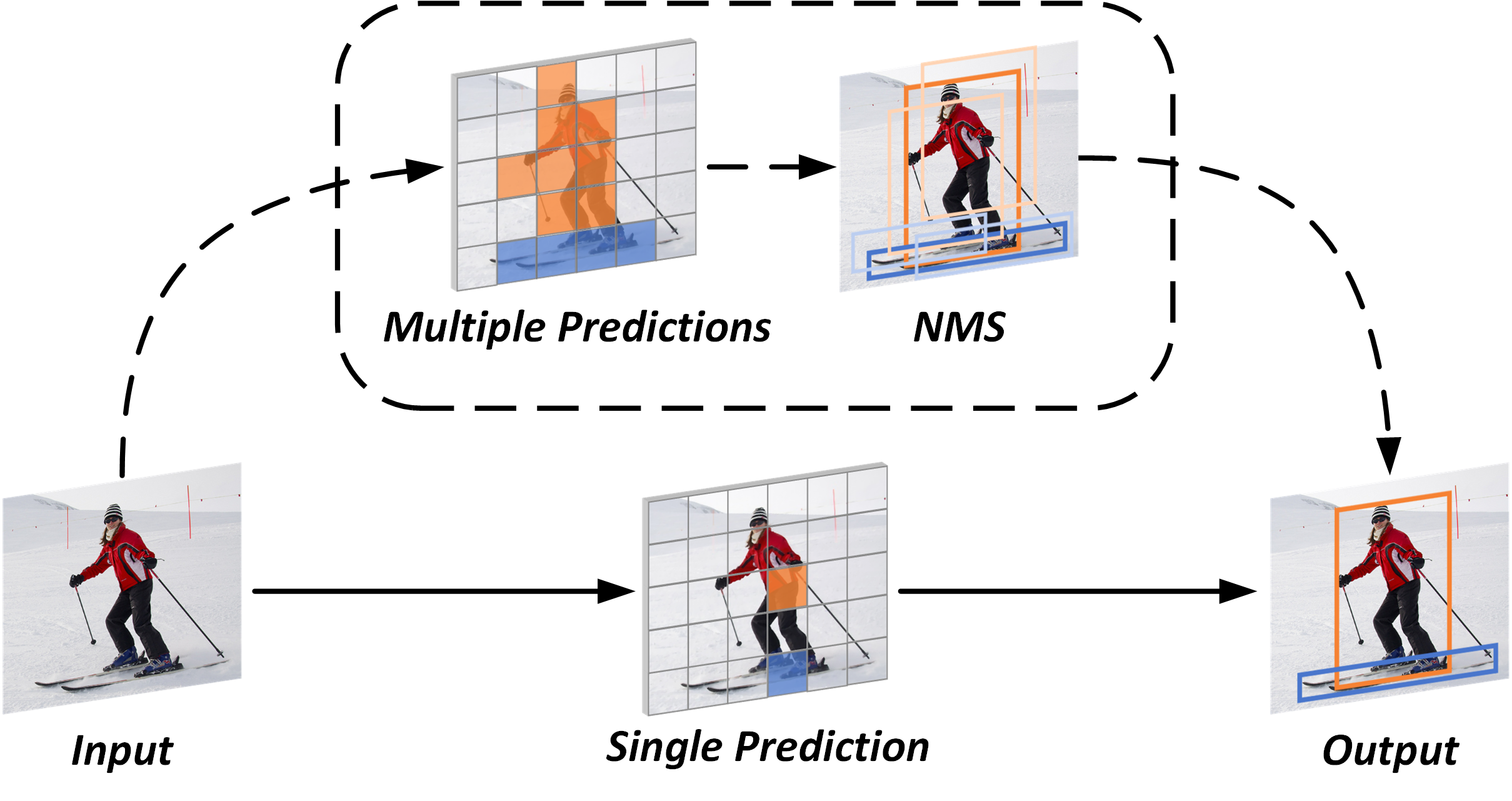
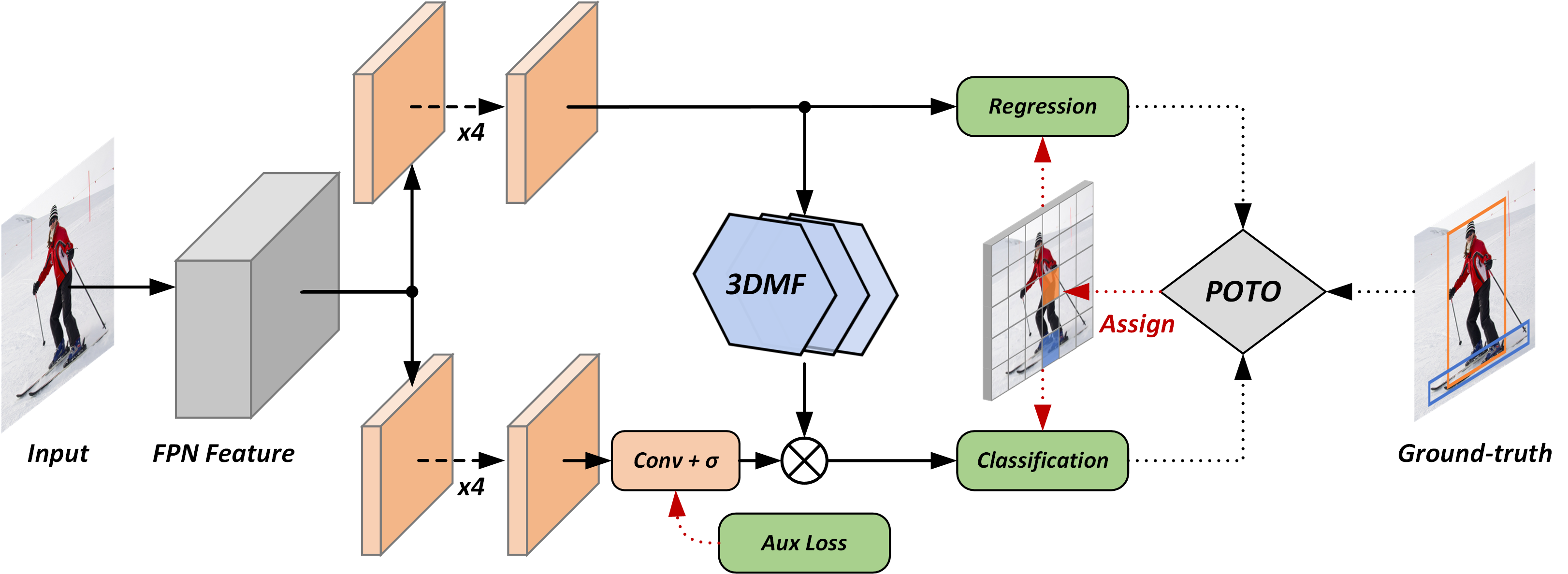
- Proposes Prediction-aware One-To-One (POTO) label assignment that dynamically assigns one positive sample per ground truth based on joint classification and regression quality.
- Introduces 3D Max Filtering (3DMF), a differentiable, multi-scale spatial filtering module applied across adjacent feature pyramid levels to suppress duplicate predictions.
- Employs an auxiliary loss based on one-to-many label assignment to provide sufficient supervision for feature learning while maintaining end-to-end training.
- Integrates POTO and 3DMF into the FCOS framework with ResNeXt-101 and ResNet-50 backbones for evaluation on COCO and CrowdHuman.
- Uses a 3D max pooling operation across spatial and scale dimensions (kernel size φ=3, τ=2) to enhance local region discriminability.
- Removes hand-designed post-processing by replacing NMS with learnable, differentiable components, enabling full end-to-end optimization.
Experimental results
Research questions
- RQ1Can a fully convolutional object detector achieve competitive performance without non-maximum suppression (NMS) post-processing?
- RQ2What label assignment strategy enables effective end-to-end training in anchor-free detectors?
- RQ3How can multi-scale feature representations be leveraged to reduce duplicate predictions in object detection?
- RQ4Does a differentiable, spatially-aware filtering mechanism improve detection performance and robustness in crowded scenes?
- RQ5Can end-to-end training with POTO and 3DMF outperform NMS-based state-of-the-art detectors on challenging benchmarks like COCO and CrowdHuman?
Key findings
- The proposed end-to-end detector achieves 1.1% higher mAP than FCOS with NMS on COCO using a ResNeXt-101 backbone.
- On the CrowdHuman dataset, the method achieves 3.0% higher AP50 and 6.0% higher mMR than FCOS with NMS, demonstrating superior performance in crowded scenes.
- The recall rate of the end-to-end model exceeds that of ground-truth boxes with NMS, indicating improved detection completeness.
- Performance gap between end-to-end and NMS-based models diminishes over training, with the end-to-end model surpassing the baseline after 180k iterations on COCO.
- 3DMF with kernel size φ=3 and τ=2 achieves optimal performance, confirming that duplicate predictions originate from local regions across adjacent scales.
- The method maintains low computational overhead, with only a slight increase in inference cost compared to baseline NMS-based detectors.
Read this paper
Open the full text in the Nubint reader and ask about any passage as you read.
Read this paper on NubintThis review was generated by AI from the original paper. Please check the paper before citing it.