
[Paper Review] Engagement, User Satisfaction, and the Amplification of Divisive Content on Social Media
The paper reports a preregistered randomized experiment showing that Twitter's engagement-based ranking amplifies emotionally charged, out-group hostile content and polarizing effects, while ranking by stated preferences reduces anger and hostility but may risk echo chambers.
In a pre-registered algorithmic audit, we found that, relative to a reverse-chronological baseline, Twitter's engagement-based ranking algorithm amplifies emotionally charged, out-group hostile content that users say makes them feel worse about their political out-group. Furthermore, we find that users do \emph{not} prefer the political tweets selected by the algorithm, suggesting that the engagement-based algorithm underperforms in satisfying users' stated preferences. Finally, we explore the implications of an alternative approach that ranks content based on users' stated preferences and find a reduction in angry, partisan, and out-group hostile content, but also a potential reinforcement of pro-attitudinal content. The evidence underscores the necessity for a more nuanced approach to content ranking that balances engagement and users' stated preferences.
Motivation & Objective
- Motivate understanding of how engagement-based ranking shapes sociopolitical content and reader emotions on social media.
- Quantify the causal impact of engagement-based ranking versus reverse-chronological feeds on six sociopolitical outcomes.
- Explore whether ranking by users’ stated preferences aligns better with user welfare and sociopolitical goals.
- Assess potential benefits and drawbacks of ranking by stated preferences as an alternative to engagement-based ranking.
Proposed method
- Conducted a preregistered randomized within-subjects experiment (N=806) comparing Twitter’s engagement-based timeline with a reverse-chronological baseline.
- Collected the first ten tweets each participant would see under both timelines and surveyed them about each tweet.
- Classified outcomes into six sociopolitical measures related to content and reader emotions (plus a seventh measure of user preference) and analyzed with paired permutation tests.
- Also simulated a third condition ranking by users’ stated preferences (SP timeline) using about twenty unique tweets per user to assess its effects.
- Validated results with GPT-4 labeling in supplementary analysis showing qualitative consistency.
Experimental results
Research questions
- RQ1RQ1: How does the engagement-based ranking algorithm impact sociopolitical outcomes (emotions, partisanship, and out-group animosity) among readers?
- RQ2RQ2: Does engagement-based ranking align with users’ explicitly stated preferences for content?
- RQ3RQ3: What are the effects on sociopolitical outcomes when ranking by users’ stated preferences, and what trade-offs arise?
Key findings
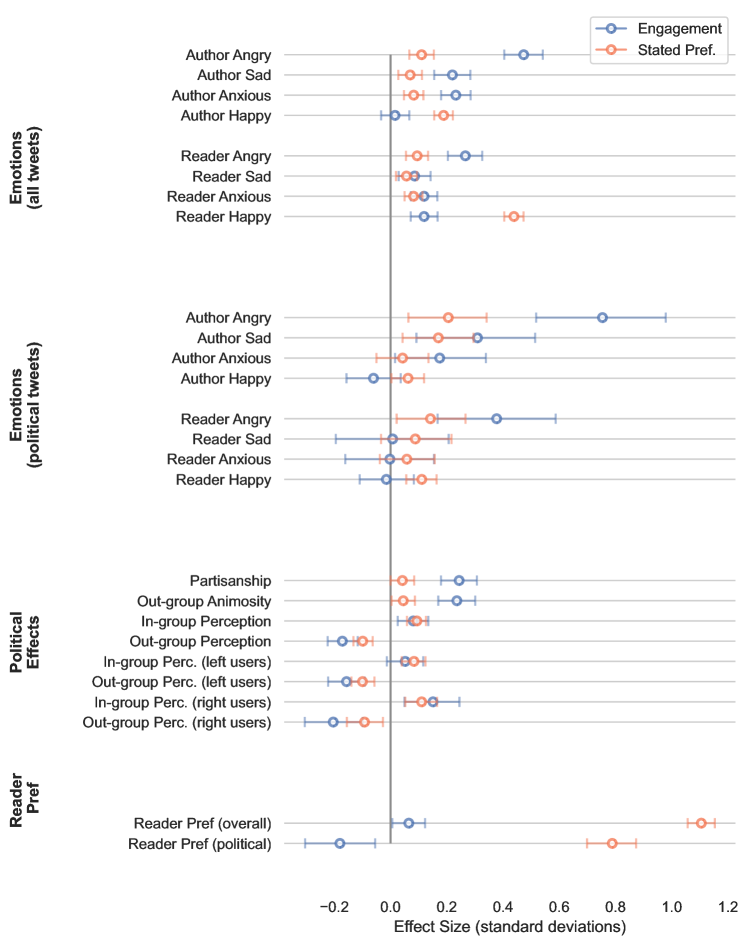
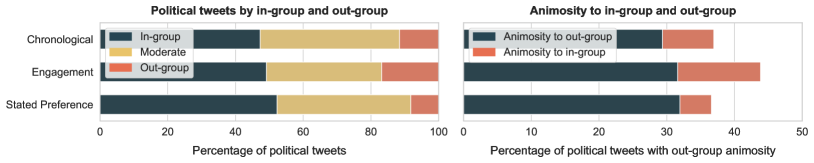
- Engagement-based ranking amplifies more partisan and out-group–hostile content relative to a reverse-chronological baseline.
- Engagement-based tweets increase reader anger, sadness, anxiety, and negative perceptions of out-groups, while boosting in-group positivity.
- Political tweets from the engagement-based timeline show higher anger expression and reader-associated anger (0.75 SD and 0.37 SD for author and reader emotions, respectively).
- Readers report slightly higher desire to see tweets from the engagement timeline overall, but rate political tweets from the engagement timeline lower in terms of user value (−0.18 SD).
- Ranking by stated preferences reduces anger, sadness, anxiety, and out-group animosity relative to the engagement timeline, but mainly by reducing out-group content toward the reader’s in-group instead of their out-group (potential echo-chamber risk).
- An exploratory SP timeline can match engagement in engagement benefits while reducing divisive content, with trade-offs requiring further study due to limited tweet pools and real-world dynamics.
Better researchstarts right now
From reading papers to final review, dramatically reduce your research time.
No credit card · Free plan available
This review was created by AI and reviewed by human editors.