
[论文解读] Enhancement of gravitational waves at Q-ball decay including non-linear density perturbations
本文通过引入非线性密度扰动,将早期宇宙中Q球衰变产生的随机引力波(GW)背景预测扩展至非线性密度扰动 regime,超越了以往研究的线性区域。通过采用基于N体模拟的非线性功率谱拟合公式,作者表明,由此产生的GW谱在nHz频段内与近期脉冲星时标阵列(PTA)观测结果所青睐的幅度和频率范围一致,同时与原初氦丰度和暗物质的宇宙学约束保持一致。
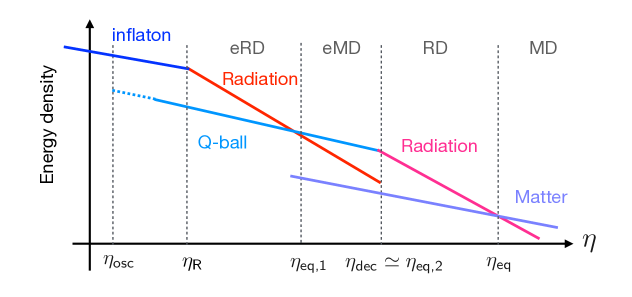
The existence of a stochastic gravitational wave background is indicated by the recent pulsar timing array (PTA) experiments. We study the enhanced production of second-order gravitational waves from the scalar perturbations when the universe experiences a transition from the early matter-dominated era to the radiation-dominated era due to Q-ball decay. We extend the analysis in previous work by including the frequency range where density perturbations go non-linear and find that the resultant gravitational wave spectrum can be consistent with that favored by the recent PTA experiment results.
研究动机与目标
- 将引力波(GW)产生中Q球衰变的鬼魅效应模型扩展至密度扰动的非线性区域。
- 评估由此产生的GW谱是否能与近期脉冲星时标阵列(PTA)实验报告的随机GW背景的幅度和频率范围相匹配。
- 评估Q球场景在同时解释PTA信号、原初氦丰度和通过引力ino产生暗物质方面的可行性。
- 研究早期物质主导时期中非线性密度增长和微星系团形成对GW产生效率的影响。
提出的方法
- 使用基于N体模拟推导的非线性密度功率谱拟合公式,以建模非线性区域中的引力势。
- 应用二阶微扰理论计算由标量扰动产生的GW,其中源项由泊松方程决定。
- 将GW谱计算的频率范围扩展至线性区域之外,而此前研究受限于线性区域。
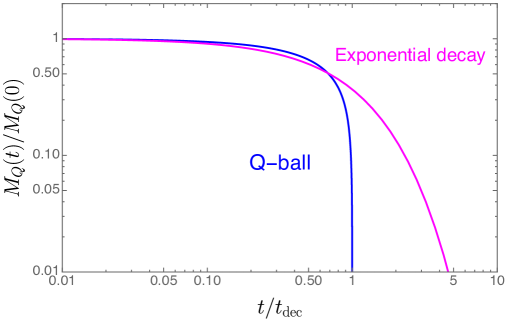
- 引入Q球时间依赖的衰变包络(非指数型,质量演化为t^(-3/5)),以模拟从物质主导到辐射主导时期的急剧过渡。
- 利用转移函数和非线性功率谱评估GW能量密度谱,重点关注k_cut附近的平台区域。
- 考虑由原初曲率扰动激发的GW的共振贡献,假设势能具有高斯统计特性。
实验结果
研究问题
- RQ1在nHz频段内,包含非线性密度扰动是否能显著增强Q球衰变产生的引力波谱?
- RQ2Q球衰变产生的扩展GW谱是否仍与近期PTA实验报告的随机GW背景的幅度和形状一致?
- RQ3在早期物质主导时期,非线性密度增长和微星系团形成如何影响GW产生效率?
- RQ4Q球衰变场景是否能同时解释PTA信号、原初氦丰度和通过引力ino产生暗物质?
- RQ5非高斯性和时间依赖衰变对非线性区域中GW谱有何影响?
主要发现
- 包含非线性密度扰动使GW谱延伸至更高频段,其峰值幅度与PTA在nHz频段观测到的信号一致。
- 当引入非线性效应时,Q球衰变产生的引力波谱与近期PTA结果所青睐的参数空间相匹配,尤其在低频段。
- 该模型在平台区域预测了平坦的GW谱形,与近似恒定的Ω_GW h²所需的k^(-7/4)依赖关系一致。
- 该场景在宇宙学约束下仍具可行性:它能解释原初氦丰度,并可在Q球衰变后通过引力ino产生暗物质。
- 非线性区域增强了GW产生,特别是在非线性尺度k_cut附近,由于密度扰动中功率增强,谱在该区域显著上升。
- 分析表明,未来PTA实验(如SKA)可能探测到该信号,且在较低频段,非共振GW贡献可能不可忽略。
更好的研究,从现在开始
从阅读论文到最终审阅,大幅缩短您的研究时间。
无需绑定信用卡
本解读由 AI 生成,并经人工编辑审核。