
[Paper Review] EuCd$_2$As$_2$: a magnetic semiconductor
This study redefines EuCd₂As₂ as a magnetic semiconductor with a 0.77 eV band gap, not a topological semimetal. Through combined transport, optical, and ultrafast photoemission measurements, it demonstrates that an external magnetic field induces a 125 meV reduction in the band gap via strong exchange coupling between localized Eu 4f spins and band states, preserving the semiconductor nature across all temperatures and magnetic fields.
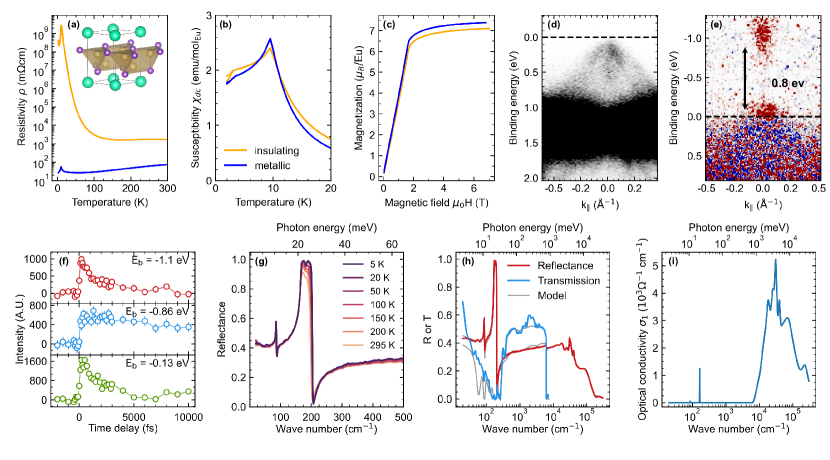
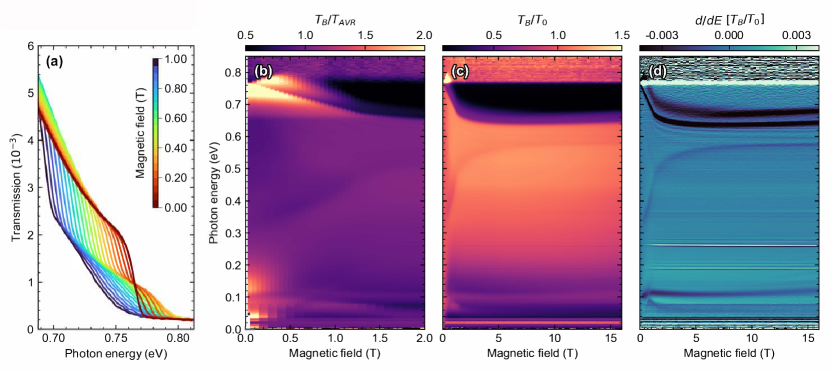
EuCd_{2}As_{2} is now widely accepted as a topological semimetal in which a Weyl phase is induced by an external magnetic field. We challenge this view through firm experimental evidence using a combination of electronic transport, optical spectroscopy, and excited-state photoemission spectroscopy. We show that the EuCd_{2}As_{2} is in fact a semiconductor with a gap of 0.77 eV. We show that the externally applied magnetic field has a profound impact on the electronic band structure of this system. This is manifested by a huge decrease of the observed band gap, as large as 125 meV at 2 T, and, consequently, by a giant redshift of the interband absorption edge. However, the semiconductor nature of the material remains preserved. EuCd_{2}As_{2} is therefore a magnetic semiconductor rather than a Dirac or Weyl semimetal, as suggested by ab initio computations carried out within the local spin-density approximation.
Motivation & Objective
- To re-evaluate the electronic nature of EuCd₂As₂, challenging its widely accepted classification as a magnetic Weyl semimetal.
- To determine whether the observed electronic responses under magnetic fields arise from topological band crossings or a genuine band gap.
- To investigate the role of localized Eu 4f spins in mediating large, field-tunable band structure changes in EuCd₂As₂.
- To assess the validity of ab initio calculations based on local spin-density approximation in describing the electronic properties of this strongly correlated system.
- To establish whether the magnetic field-induced band gap reduction is intrinsic and persistent in the paramagnetic phase.
Proposed method
- Electronic transport measurements on ultraclean single crystals to determine carrier concentration and confirm insulating behavior.
- Optical spectroscopy, including infrared reflectance and transmission measurements, to extract the real part of optical conductivity and detect the absence of Drude response.
- Pump-probe angle-resolved photoemission spectroscopy (ARPES) to directly probe the band gap and carrier dynamics on the picosecond timescale.
- Magneto-optical reflectivity and transmission measurements up to 16 T and 140 K to map the field and temperature dependence of the band edge and gap.
- Modeling of multilayer optical response to extract the real part of optical conductivity σ₁ from reflectance and transmission data.
- Use of the effective exchange coupling model ΔE_g = -½ J_eff S M(T,H)/M_S to quantify the field-dependent band gap reduction and extract J_eff ≈ 80 meV.
Experimental results
Research questions
- RQ1Is EuCd₂As₂ truly a topological semimetal, or does it possess a fundamental band gap that has been misinterpreted in prior studies?
- RQ2To what extent does the application of an external magnetic field alter the electronic band structure of EuCd₂As₂, and is this effect reversible or persistent?
- RQ3Does the magnetic field-induced band gap reduction originate from a topological phase transition or from a spin-dependent exchange interaction with localized Eu 4f moments?
- RQ4Is the observed band gap tuning robust in the paramagnetic phase, indicating a long-range magnetic order or a strong local exchange coupling?
- RQ5Can the observed field-dependent band gap changes be quantitatively explained by an effective exchange coupling model involving Eu 4f spins and band states?
Key findings
- EuCd₂As₂ is a semiconductor with a fundamental band gap of 0.77 eV, as confirmed by pump-probe ARPES and optical conductivity measurements showing no Drude response.
- The band gap decreases by up to 125 meV under a 2 T magnetic field, with the gap reduction proportional to the magnetization of Eu 4f spins.
- The effective exchange coupling strength J_eff between band carriers and Eu 4f spins is estimated at approximately 80 meV, indicating strong local exchange interaction.
- The band gap reduction persists up to 140 K, even within the paramagnetic phase, demonstrating that the effect is not limited to the antiferromagnetic ground state.
- The field-dependent band edge shift closely follows the magnetization curve, confirming that the band structure is controlled by the Eu magnetic sublattice via exchange coupling.
- The absence of a Drude component and the presence of a strong Reststrahlen phonon mode confirm the insulating nature of the material, ruling out metallic or semimetallic behavior.
Read this paper
Open the full text in the Nubint reader and ask about any passage as you read.
Read this paper on NubintThis review was generated by AI from the original paper. Please check the paper before citing it.