
[论文解读] Explanation of the Hints for a 95 GeV Higgs Boson within a 2-Higgs Doublet Model
该论文提出,CMS和ATLAS在双光子和双tau末态中观测到的95 GeV Higgs玻色子,以及长期存在的LEP $b\bar{b}$ 超额信号,可以在三重希格斯双生子模型类型-III(2HDM-III)框架内同时得到解释。该研究证明,该模型中最轻的CP偶性希格斯玻色子能够满足当前实验和理论约束的同时,解释全部三项超额现象,并预测顶夸克Yukawa耦合存在18%的增强,该预测可在HL-LHC上进行检验。
We suggest an explanation for and explore the consequences of the excess around 95 GeV in the di-photon and di-tau invariant mass distributions recently reported by the CMS collaboration at the Large Hadron Collider (LHC), together with the discrepancy that has long been observed at the Large Electron-Positron (LEP) collider in the $b\bar b$ invariant mass. Interestingly, the most recent findings announced by the ATLAS collaboration do not contradict, or even support, these intriguing observations. Their search in the di-photon final state similarly reveals an excess of events within the same mass range, albeit with a bit lower significance, thereby corroborating and somewhat reinforcing the observations made by CMS. We demonstrate that the lightest CP-even Higgs boson in the general 2-Higgs Doublet Model (2HDM) Type-III can explain simultaneously the observed excesses at approximately 1.3 $σ$ C.L. while satisfying up-to-date theoretical and experimental constraints. Moreover, the 2HDM Type-III predicts an excess in the $pp o t\bar t H_{ m SM}$ production channel of the 125 GeV Higgs boson, $H_{ m SM}$. This effect is caused by a up to 12\% enhancement of the $H_{ m SM}tt$ Yukawa coupling in comparison to that predicted by the Standard Model. Such an effect can be tested at the High Luminosity LHC (HL-LHC), which can either discover or exclude the scenario we suggest. This unique characteristic of the 2HDM Type-III makes this scenario with the 95 GeV resonance very attractive for further theoretical and experimental investigations at the (HL-)LHC and future colliders.
研究动机与目标
- 解释CMS和ATLAS在Run 2数据中观测到的持续存在的95 GeV双光子和双tau超额现象。
- 将这些超额现象与2006年LEP报告的长期 $b\bar{b}$ 不变质量超额信号相协调。
- 证明2HDM类型-III框架能够同时解释所有三项异常现象,且不违反现有约束。
- 识别出该模型中一个独特且可检验的预测——顶夸克Yukawa耦合最多增强18%。
- 为未来在HL-LHC及更远的实验中提供可行的参数空间。
提出的方法
- 作者采用通用的2HDM类型-III,其中两个希格斯双生子均与所有SM费米子耦合,避免使用 $Z_2$ 对称性,以允许非对角Yukawa耦合。
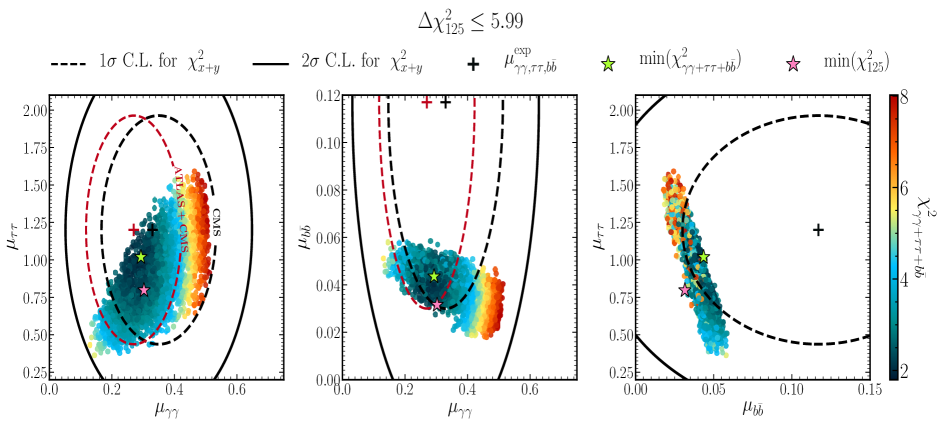
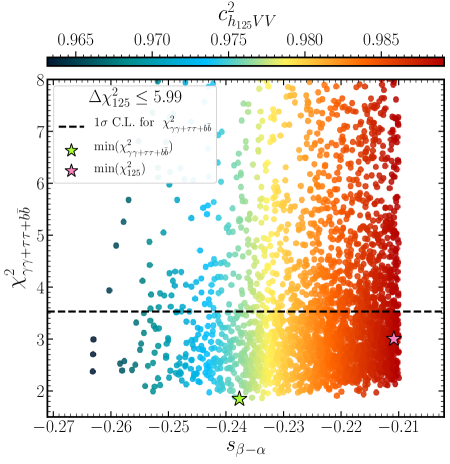
- 他们对CMS和ATLAS的双光子、双tau及 $b\bar{b}$ 信号强度进行全局拟合,通过在125 GeV希格斯信号强度约束下最小化 $\chi^2_{\gamma\gamma + \tau\tau + b\bar{b}}$ 来实现。
- 通过LEP $e^+e^- \to Zh_{95} \to Z\tau\tau$ 截面限制检验该模型与先前实验的兼容性。
- 计算最轻CP偶性希格斯玻色子的衰变分支比、总宽度及信号强度 ($\mu_{\gamma\gamma}, \mu_{\tau\tau}, \mu_{b\bar{b}}$)。
- 顶夸克Yukawa耦合被评估为 $c_{h_{95}t\bar{t}} = 0.511$ 和 $0.541$,分别对应两个基准点,相比SM值增强12%-18%。
- 对参数空间进行扫描,以识别在2$\sigma$水平或更高下能同时解释全部三项超额现象的区域。
实验结果
研究问题
- RQ1CMS和ATLAS观测到的95 GeV双光子和双tau超额现象能否在单一BSM框架内得到解释?
- RQ2LEP长期存在的 $b\bar{b}$ 超额信号是否与LHC中观测到的同一低质量共振态相容?
- RQ32HDM类型-III模型能否在满足125 GeV希格斯玻色子约束的前提下,同时解释双光子、双tau和 $b\bar{b}$ 三项异常?
- RQ4该模型是否预测了可在HL-LHC上检验的顶夸克Yukawa耦合显著偏离?
- RQ5该模型的预测是否与现有LEP对 $h_{95} \to \tau\tau$ 产生的限制一致?
主要发现
- 2HDM类型-III模型成功地同时解释了95 GeV双光子超额(CMS:2.9$\sigma$,ATLAS:1.7$\sigma$)和双tau超额(全局显著性3.1$\sigma$)。
- 该模型还解释了LEP在98 GeV处的 $b\bar{b}$ 超额信号,观测质量分辨率的兼容性表明存在共同共振态。
- 该模型中最轻的CP偶性希格斯玻色子的信号强度为 $\mu_{\gamma\gamma} \approx 0.30$,$\mu_{\tau\tau} \approx 0.80$,$\mu_{b\bar{b}} \approx 0.03$,与观测到的超额现象一致。
- 该模型预测顶夸克Yukawa耦合相比SM增强12%-18%,两个基准点的值分别为 $c_{h_{95}t\bar{t}} = 0.511$ 和 $0.541$。
- 预测的 $pp \to t\bar{t}H_{\rm SM}$ 截面最多增强18%,因此可在HL-LHC上进行检验。
- 该模型与LEP对 $h_{95} \to \tau\tau$ 的限制保持一致,预测的截面远低于LEP观测到的限制。
更好的研究,从现在开始
从阅读论文到最终审阅,大幅缩短您的研究时间。
无需绑定信用卡
本解读由 AI 生成,并经人工编辑审核。